
Concussor modular synth and Oberkorn step sequencer
Quick demo of Concussor modular synth and Oberkorn step sequencer
The trigger input has a range of about 5 to 12V. A trigger pulse of around 1mS is recommended, although the gate output of a synth can be used. A larger trigger pulse will increase the level of the sound (accent the notes). When the accent socket is used, the trigger input socket only triggers the sound and the level of the sound is controlled by the voltage of the CV at the accent socket. The accent voltage can be from another trigger pulse generator, or from an LFO or Envelope. When using for example an LFO, you can have the level changing with the LFO sweep.
WOLFGANG DUEREN
Former boss of synth company PPG and chief demonstrator of its products plus Tangerine Dream’s touring sound man, Dueren’s privately released album Eyeless Dreams is a showcase of what the great PPGs could do. In 1983 PPG announced… the PRK Processor Keyboard…. The PRK sported a 72-note (F to E) velocity-sensitive, weighted action keyboard. In addition, the PRK could be loaded with up to eight PPG voice cards, each with four wavetables…. During the next year Palm continued development on the …PRK, resulting in the introduction of the …PRK FD at Frankfurt in 1985…. The PRK FD [along with the new Waveterm B] also sported a 68000 CPU, as well as a 5 1/2″ floppy drive, so that wavetables and samples from Waveterm B disks could be loaded and played. In addition, the PRK FD was outfitted with some impressive MIDI master controller capabilities, including a 99-track sequencer and four independently addressable MIDI outs. Unlike the PRK before it, the PRK FD had pitch-bend and mod wheels. Still the PRK FD suffered from the same fault that the original PRK had: Both were limited to a simple two digit LED display – hardly tolerable for keeping a handle on all the unit’s functions.
Here’s a review from Electronics & Music Maker magazine in the UK:
‘PPG demonstrator and now company Geschaftsfuhrer Duren is no slouch when it comes to taking the PPG computer keyboards through their paces. Although this isn’t a demo LP but a very accomplished album, it relies mainly on PPG’s own 8-Voice 360A, Modular System 300 and 1020 Synthesizer units, together with a 350 Sequencer and a Micro Moog for some lead lines.
The interesting point is that Duren can do all this in live concert and has done so in Wissen and Bad Breiseg to name but two instances. The title track opens with very fast synchronised sequences and slips into. a Jarre-like melody with splashes of percussion and a wailing lead line. ‘Phila’, ‘904’ and ‘Proton’ develop the style, with imaginative and gentle changes of tempo, rich digital abstract sounds and expressive chords making full use of delay and keyboard response effects.
The closing ‘Eyeless Dream 2′ has Bettina Weber’s spoken German text over a huge variety of PPG abstract sounds and chords. There’s a feeling of tremendous power latent in every track, quite understandably in view of the highly sophisticated and desirable instrumentation involved!’
It can be found over at the Synopsis Elektronika blog.
See also: http://www.tangerinedream-music.com/forum/viewtopic.php?t=918&sid=bc32aca…
Sharp sample slicing with the SunVox
SunVox is a small, fast and powerful music sequencer with modular synthesizers. It is a tool for those people who want to compose music anywhere. SunVox available for desktop PC (Windows, Linux, Mac OS X), pocket computers (Windows Mobile, PalmOS, Maemo, iPhone/iPad) and netbooks.
Forbin Accenta Electronica
Background info:
Forbin Accenta Electronica is an entirely electronically-produced experimental composition using the KX-Synth X16software synthesizer. The KX-Synth X16 is a successful and extremely flexible software re-creation of the famous EMS VCS3 Putney or various Synthi models, using a virtual pin matrix to inter-connect the various oscillators, filters and modulation effects together. For this work, twin KX-Synth X16 synthesizers were connected in parallel within the VST host. Both synthesizers responded to playing, making the sounds truely bi-timbral, with both outputs able to be recorded by the host software for later integration into a multi-track environment. Various presets were used and modified to create etheral tones. Most of the patches employ ring modulation , or were configured by the virtual pin matrix to add ring modulation and extra feedback delay to create metallic and etheral melody lines. Those who every wanted to play an EMS VCS3 or Synthi synthesizer can have a feel for what it is like playing a KX-Synth X16 VST synthesizer on their own computer.
The experience is extremely satisfying and open for much exploration and experimentation. The first mix comprised a reverberant tonal line with two tracks of a lone reverberant synthesizer line with heavy short feedback delay. These tracks were mixed down to one stereo track and slowed down significantly to create a more dreamy combination. Added to this was a metallic vibration tone with very short delay and heavy feedback. This was faded in and out as appropriate to the first mix. At the end are two time-shifted tracks of a sample of the ending, looped, then progressively slowed down until a very low frequency combination is heard receding into the distance. This then concluded the composition.
The final mix was twice-compressed to level out the dynamics, then this version was used for the video. The visuals comprise vintage digital and analogue computers from the last 50 years – including UNIVAC, ORACLE and other systems, including SketchPad by Ivan Sutherland and various radar systems such as SAGE. These images were colourised with painting software, then keyed over modulating derivatives of a striped pattern, or motion-tracked versions of other images. The music reminded one of the feel of the music score in the film The Forbin Project; so the title of the work pays homage to this science fiction classic. The vintage computer images help to connect the music to previous generations when the technological landscape of computer science was of a different order.
In orbit with the Moog Satellite synth
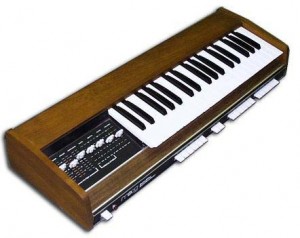
The Satellite is shaped after the organ-type synthesizers from its era. Although cased in a nice looking wood case the Satellite boasts little features. It’s a single-vco monophonic preset synthesizer. Preset sounds include brass, reeds, strings, bell, and the far-out new lunar sound. The 37-note keyboard is slim and presets are selected from the clunky flip-switches just below the keyboard. Left hand performance controls offer modulation, pitch bend and filter sweeps.
In this video:
Just a basic run through showing the Moog Satellite in working condition and the types of sounds it makes. Its a preset synth with a few adjustable parameters. It is capable of making many typical analogue synth sounds.
Free Reaktor Plugin Delivers Multiband Sonic Mayhem
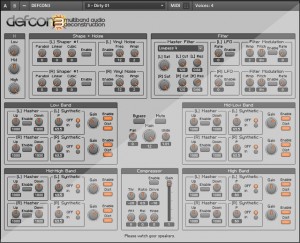
DNR Collaborative has introduced DEFCON3, a ‘Multiband Audio Deconstruction Unit’ for Native Instruments Reaktor.
According to the developers, ‘DEFCON3 is a complete multiband lo-fi, distortion, audio deconstruction device that is capable of taking any audio and completely mangling it in a variety of ways. It can go from subtle dirt to all out war in just a few knob turns.’
The DNR Collaborative is an organization ‘committed to community, constantly looking for new ways to help small developers, artists, designers and musicians reach others with their work.’
Pricing and Availability
DEFCON3 is available now, in beta, as a free download.
Link:
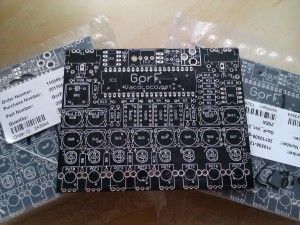
First teaser for the Gorf step sequencer
Gorf V2 demonstration video Part 1
More google doodles – Tim Exile “Google Guitar Homepage Song”
t had to be done! I saw the Les Paul interactive guitar Google homepage www.google.com a couple of hours ago so I performed a quick song/mashup about it… here it is.
MOOG SOUND LAB: Tegan & Sara – Living Room
Tegan and Sara re-envision their single “Living Room” from their album entitled “If It Was You,” filling it with Moog Guitars and the ultra low end of the Taurus 3 Bass Pedals. Sara uses the Full Sustain mode on the Paul Vo Collector Edition Moog Guitar to create swooshing string pads to accompany Tegan’s upbeat acoustic guitar.
Ted Gowans uses the E1 Moog Guitar in a couple of ways: He’s using Mute mode during parts of the versus that give a real staccato feel, then switches over to Controlled Sustain where energy is given to just 1 or 2 strings at a time.
Shaun Hubert makes use of his hands and feet with the Taurus 3 Bass Pedals, bringing a massive low end growl to the song. There’s also an Etherwave Plus Theremin being used to sweep the Taurus 3’s filter via the CV output on the theremin.
See other Moog Sound Lab performances: http://www.moogmusic.com/sight-and-sound/sound_lab
Phonogene producing a lots of bleeps
The Phonogene consist of a round piece of plastic with inside four or six play-back heads from a tape-recorder. The four heads are conected in series with each other. This means that they are not four individual heads anymore but actualy they are one big play-back head. Take a piece of tape carrying sound-information. Let this tape run over one quarter of the circle of the Phonogene (from A to B). When the Phonogene turns counter-clock-wise head nr 1 will “read” the tape in between A and B. When head nr 1 is about to pass B, then nr 2 will just start reading from point A. This results in looping a very short piece of sound. The pitch of the sound is determent by the RPM of the Phonogene. When the tape slowly moves from A in the direction of B, the Phonogene will time-stretch the sound.
In this video:
Regenerative Record Patch from Phonogene manual. Using Harvestman Hertz Donut and QMMG for signal source. René for sequence, MATHS and Wogglebug to modulate the Phonogene.
DATAMASKIN

