
Carbon Electra – soon to be released 4 oscillator subtractive synthesiser by David Carbone
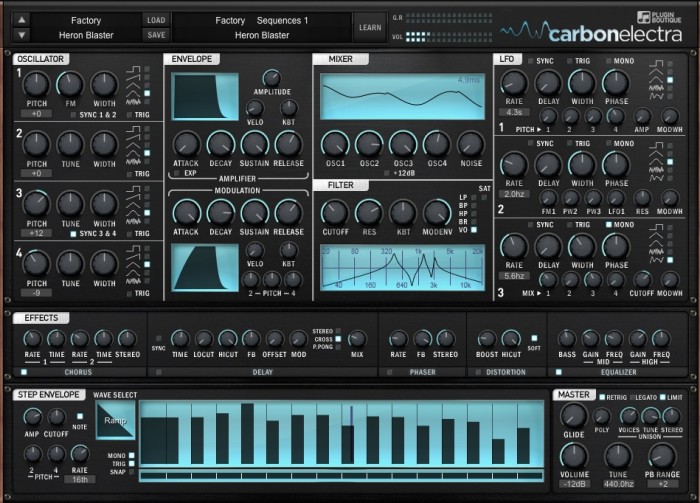
Plugin Boutique has announced Carbon Electra, a soon to be released 4 oscillator subtractive synthesiser by David Carbone.
Carbon Electra is a powerful and intuitive synth built by producers, for producers. It’s a four-oscillator subtractive synth with a modern feature set.
It has been developed as an advanced learning tool whilst also being a powerful and easy to program synth. It is based on vintage analogue routing and features flexible modulation options including an editable stepper and note performer. The graphical displays act as a comprehensive information tool and as an accurate guide to each parameter change. Best of all, it sounds incredible.
Carbon Electra features
- Powerful synth engine that is easy to learn and use with no hidden menus.
- 4 Analog style syncable oscillators with adjustable pulse width, frequency modulation and multiple wave types including pitchable noise.
- Informative physics based graphic displays with comprehensive info pane.
- 6 filter types including powerful vocal filter with filter drive and saturation.
- Simple, usable and useful FX section, like having a bunch of great guitar pedals.
- Editable step editor that can be assigned to pitch, volume or cut-off independently or simultaneously, with various wave types and edit mode allowing node creation and line curves.
- Over 600 factory and artist presets covering sequences, chords, motions, bass, leads, keys, pads and effects.
- Ability to run the amp section “too hot” into the built in optional limiter at the main output, creating a modern hyper-compressed sound.
- Super flexible unison control ranging from subtle warmth to massive super saw or super square sound.
- Multiple stereo width parameters allowing high precision control of the stereo field.
Carbon Electra for Windows and Mac (VST/AU) will be available late July 2015 for $99 USD / £59 GBP.
X1L3 – Circuit bent – Casio SK-1 – for Meng Qi Music
The Casio SK-1 is the cheapest sampler in the world. Followed by the SK-5, the second cheapest in the world. It’s a polyphonic synthesizer (just four voices) with very cheap sounds and it can store one sample in its memory. The sampling is 8-bit PCM, 9.38kHz, giving about 1.4 seconds. It’s so gritty… Samples can only be recorded through the awful mini-mic built-in to the upper-right corner or a 3.5mm line-input plug on the backside of the synth. Alas, its memory clears when turned off.
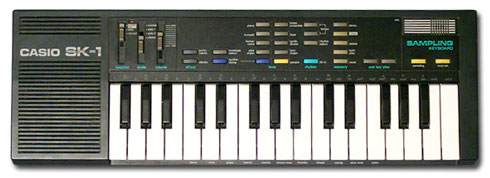
There are 11 built-in accompaniment-style drum patterns (disco, rock, samba, etc.) which are all embarrassingly fun and totally unusable. The keyboard uses mini plastic keys. It lacks MIDI, lacks effects, edit-ability, memory, and filtering. However there are 13 envelope shapes that can affect your sample or synth sounds somewhat. There is also portamento, vibrato, and chord accompaniment with the chord selector system.
Background video description:
One off custom Casio SK1 project.
Built for:
Evolving improvised set. Melodic ambience to drone to noise. Touching on the lines of PE and HNW. Anyone who’s familiar with the Alec Empire live dvd of intelligence and sacrifice will probably recognise the tone of this from the noise set in new world order.
No post processing or production. It is what it is.
Listen to the Korg MS2000 Synthesizer Factory Demo Songs
Factory demo songs from the Korg MS2000 virtual analog synthesizer recorded direct with no additional effects.
Song List:
1. Grooven Dugan (0:03)
2. Neon Lamp (0:51)
3. Pink Doll 2001 (2:58)
4. Joker (4:32)
5. Tube (6:20)
6. Past Memory (7:33)
7. Fragmented (8:57)
8. Pineapple (9:38)
9. Next Wave (11:11)
10. Jingle “MS2K” (12:29)
The MS2000 is a turn-of-the-millennium virtual analog synthesizer that is 4-note polyphonic. Its design focuses on real-time controls with lots of knobs. The same synth engine was used in the MicroKorg, which has a much-reduced interface that is less suited to real-time control.
It included a vocoder at a time when hardware vocoders were rare, expensive, and inconvenient. The revised MS2000B version has a darker case and a built-in XLR microphone input to make the vocoder engine easier to use.
For more information and manuals for this and other synthesizers, visithttp://soundprogramming.net/synthesiz…
Out now the Roland Driftbox-R Limited Analog Monosynth
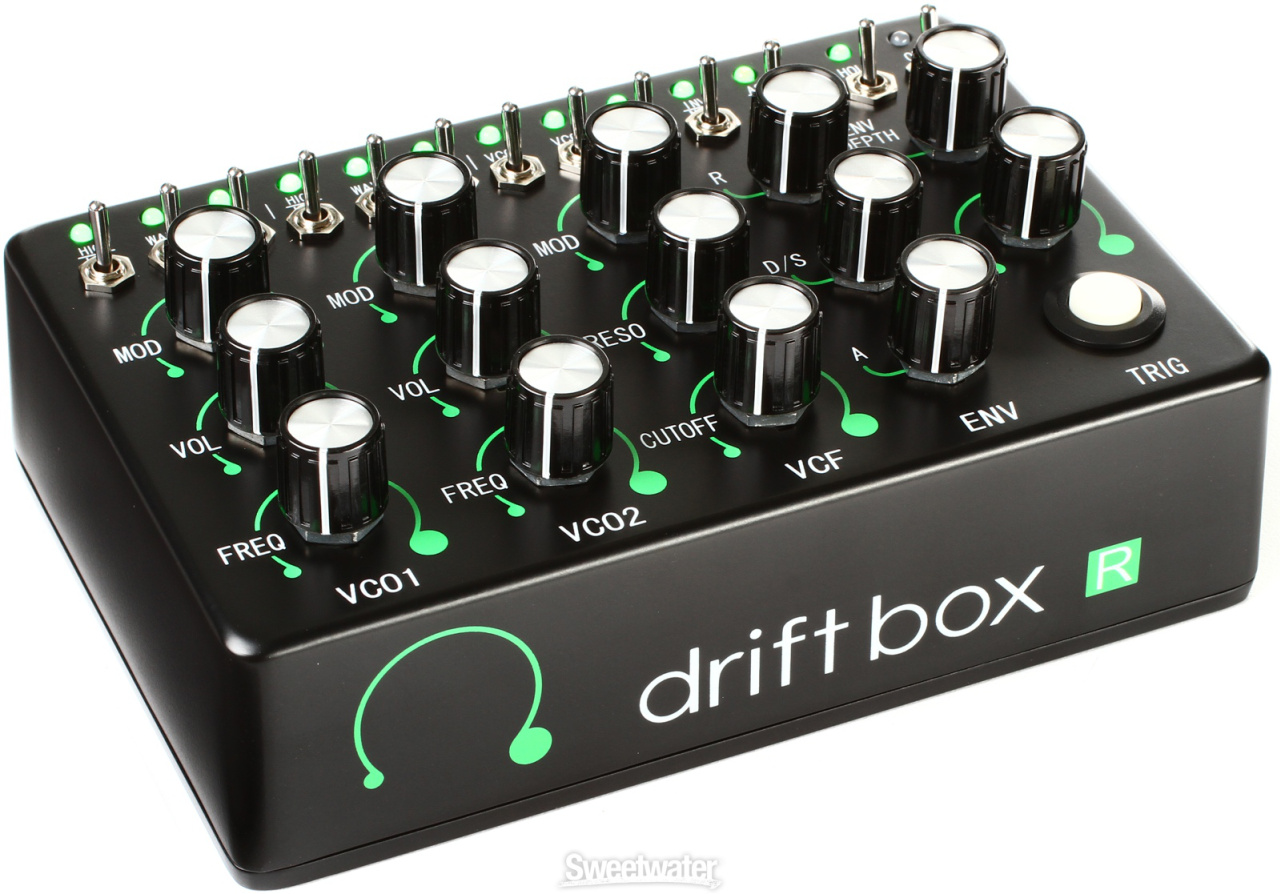
Roland has released a new analog synthesizer – the Roland Driftbox-R Limited Analog Monosynth. The Roland DriftBox-R Limited is an updated version of the original Reon DriftBox.
Originally commissioned by Roland to demonstrate the the SBX-1 Sync Box, the DriftBox-R Limited features two oscillators, filter, and envelope generator.
Control is via five CV/gate connections, letting you integrate the synth with other analog gear.
Features:
- Updated version of the original Reon DriftBox
- A wide range of functions in a small desktop box
- Two VCOs, a great-sounding filter, and an envelope generator
- CV/gate I/O for semi-modular flexibility
- Use it alone, triggering its envelope with the onboard momentary button
- Combine it with other hardware for endless possibilities
Mixfood Unison Xs – new sample-based synthesizer for the Reason Rack
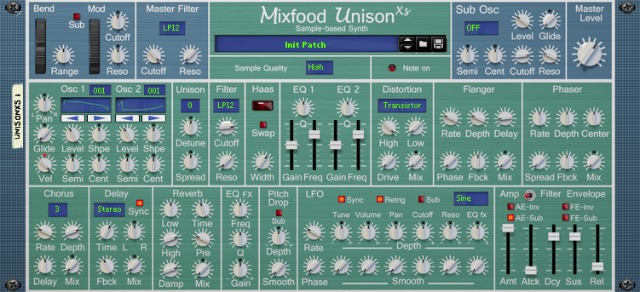
Mixfood Unison Xs is a sample-based synthesizer and the perfect tool for creating deep bass sounds and sharp synth sounds. Here’s more details in their own words…
Mixfood Unison Xs contains 1100 different waveforms. Standard waveforms include Sine, InverseSine, Triangle, Square and Saw. Next to the standard waveforms Mixfood Unison Xs hosts many more crazy but usable waveforms. With 2 oscillators, each containing the same 550 waveforms many different sounds can be created. Each oscillator has its own controls which include: level, shape and tone control. Both oscillators are routed through the effects and the LFO. After that a filter and amp envelope add more control to the synth. On the master output an extra filter is added for the finishing touch. A Sub-Oscillator is added for extra depth!
Use the Unison with Stereo Spread for more Wow and the Pitch Drop Fx for extra Punch! It gets even better when using the EQ fx combined with the LFO, try it and you’ll love it.
Mixfood Unison Xs is perfect for all music styles and can produce all kinds of different synth sounds, from deep bass to hard, sharp synth sounds.
If you flip the rack over, 6 audio outputs are revealed. The main mix, 2 “wet” audio outputs and 3 “dry” audio outputs. The “wet” audio outputs contain the processed signal of each of the 2 oscillators, the “dry” audio outputs contain the signal of the unprocessed/clean signal of each of the 2 oscillators or the sub-oscillator. This way all of the 1100 waveforms can be used! By combining Mixfood Unison Xs with all your favorite effects endless possibilities are at your fingertips.
THE SOFT MOON (Slices Feature)
Slices has always presented the whole spectrum of electronic music, and the variety is apparent in this feature with The Soft Moon on Electronic Beats TV. Oakland native Luis Vasquez’s project is a one-man exploration into the darker sides of self-discovery that was first brought to our attention by Slices alumni Trentemøller. He’s been compared to bands like Joy Division and supported Depeche Mode live, so we wanted to find out more about this intriguing artist and experience his show at SchwuZ in Berlin.
Links:
https://www.facebook.com/thesoftmoon
https://twitter.com/thesoftmoon
https://soundcloud.com/thesoftmoon
http://www.thesoftmoon.com/
EMW – ARCADE NOISE Eurorack module – first test
EMW’s new module can create almost all the noises from vintage arcade machines. Among many possible modulations to the Clock frequency and algorithm tap points, you can also PLAY the module using a square wave from a VCO to modulate the internal algorithm reset point.
Cubasis Update, 5 New Pianos, New Drum Kits and a Minisampler for iPad
You can get Cubasis here at the App Store.
https://itunes.apple.com/us/app/cubas…
Cubasis is Steinberg’s streamlined, multitouch sequencer for the iPad. Specially designed for quick and easy operation, Cubasis makes recording, editing and mixing a breeze. Record tracks in high-resolution audio quality, and edit your music with the Key and Sample Editors, while the included mixer and audio effects polish your song to perfection. Cubasis comes loaded with three virtual instruments which can be played in real time using the virtual keyboard and drum pads. Cubasis’ projects can be even opened in Cubase under Windows and OS X! Cubasis places touch-intuitive production tools in your hands, opening up a new world of possibilities for your creativity.
Key features
• Unlimited audio and MIDI tracks (depending on the device used)
• 24 assignable physical inputs and outputs
• 32-Bit floating point audio engine
• Audio I/O resolution of up to 24-bit/96 kHz
• iOS 32- and 64-bit support (depending on the device used)
• Micrologue virtual analog synthesizer with 50 ready-to-go presets
• MicroSonic with over 70 virtual instrument sounds based on HALionSonic and 16 Allen Morgan drum kits
• MiniSampler with more than 20 instrument sounds to create your own instruments
• Mixer with 15 effect processors (insert and send effects)
• Over 550 MIDI and audio loops
• Virtual keyboard and virtual drum pads
• Sample Editor and Key Editor
• Automation
• MIDI CC, program change, aftertouch support
• AirPlay, Buetooth and HDMI audio out support
• Export to Cubase, Dropbox, SoundCloud, AudioCopy & email
• MIDI clock and thru support
• Core Audio and Core MIDI compatible hardware supported
• Full Inter-App Audio and Audiobus support
• Import audio from your iTunes music library or using iTunes filesharing, use AudioPaste or set up a Wi-Fi server in Cubasis
Getting started with convolution reverb
If you want to get up to speed on the new convolution reverb that’s part of Reason 8.3’s revamped RV7000 MkII reverb unit, then you’ve come to the right place. In this tutorial we’ll take a look at the history of reverb to understand how convolution fits into the story, how it works, and how you can go about making your own presets with custom spaces.
Grab the free RV7000 MkII Patches ReFill: https://shop.propellerheads.se/produc…
Learn more about Reason:
http://propellerheads.se/tryreason
Free update to the released Reason and Reason Essentials version 8.3
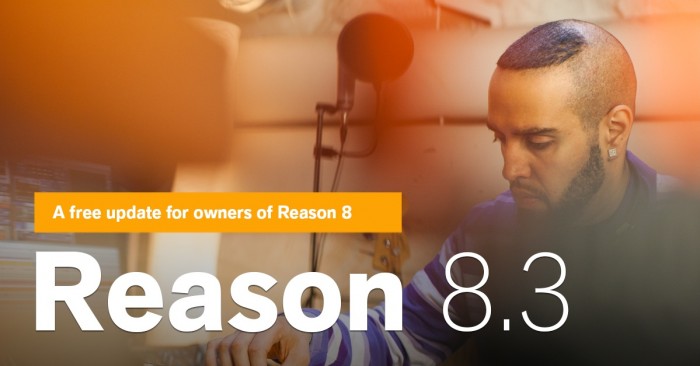
Propellerhead Software has updated its Reason and Reason Essentials software to version 8.3, which includes new features, improvements and bug fixes.
The new version of Reason packs a fantastic update to Reason’s classic RV7000 Advanced Reverb, while also delivering a number of workflow enhancements that will help you work faster than before.
The RV7000 was praised for it’s fantastic sound when it was introduced in Reason 2.5. Today it’s getting an update with an advanced convolution mode that let’s you use the reverb characteristics from actual spaces in your music. Or to go all experimental and conjure up your own reverb sounds based on any samples.
Changes in Reason 8.3
- The detached rack window can now have a separate browser panel.
- Added convolution mode to RV7000 reverb.
- Zoom to Selection function for quickly zooming in on selected clips or notes.
- Buttons for setting MIDI focus to a device directly from the rack.
- The static value for an automated parameter is now adjustable in Arrange Mode.
- Added fold button for Info area in browser.
- Remote files for Akai MPK Mini added.
- Removed outdated splashes shown when copying sound banks from DVD.
- Increased horizontal zoom in Edit mode in all template songs.
- In Manual Rec mode, Parameter Automation Rec Enables are no longer turned off when you select another track.
- The template song chosen in the Setup Wizard should be set in the Preferences.
- Mixer scrollbar no longer overlaps the channel strip name labels
- Replaced “Beta Version” dialog on startup with label in splash (in Testing versions of the program).
- Added tool tip for browse/clear button in Browser side panel.
- Audio is now properly clipped to range [-1,1] when dropping to Propellerhead.
- Assert Failure When Browsing Nested Folders Using Kong’s NN-Nano Sampler Module.
- Assert on duplicate many clips.
- Authorizer could crash if it tried to start Codemeter service (Mac) and failed.
- Assert on drag and drop of REX file to Dr OctoRex.
- User statistics failed if Codemeter wasn’t installed.
- Reason and Authorizer now works with earlier versions of Codemeter (Mac).
- Fixed a problem using network attached storage in Reason.
- If Music folder was broken, Reason couldn’t start (Unknown exception).
- Corrected text field validation in Drop dialog.
- 3rd party RE patch files didn’t show proper icons in Reason Essentials.
- Having subfolders in the DiagnosticReports folder on Mac could cause Reason to crash.
- New Authorizer version included (handles full disk better).
- It wasn’t possible to drop an NN19 patch on an NN-XT device in Reason Essentials.
- The Windows installer now requires the channel.phat file to be present (avoiding broken auto-update).
- Improved support for folder aliases and symbolic links.
- Text parsing when importing MIDI files could cause unknown exceptions.
Reason 8 is available for purchase for 369 EUR. The Reason 8 Upgrade is 129 EUR. Reason 8.3 and Reason Essentials 8.3 are free updates to Reason 8 and Reason Essentials 8 users.
DATAMASKIN

