
Elektron Analog Keys NAMM 2014
The Elektron Keys builds on the already superb Elektron Analog Four and gives it 61 keys making an already amazing classic a solid performance tool.
3 new videos: Moog Sub37 Paraphonic Analog Synthesizer at NAMM 2014
Playing around with the new Moog Sub37 Analog Synth at NAMM 2014!
Here’s a presentation of the new Moog Sub 37 at the NAMM Show 2014.
Enjoy
Intellijel Atlantis – fully patchable dual oscillator analog subtractive synth
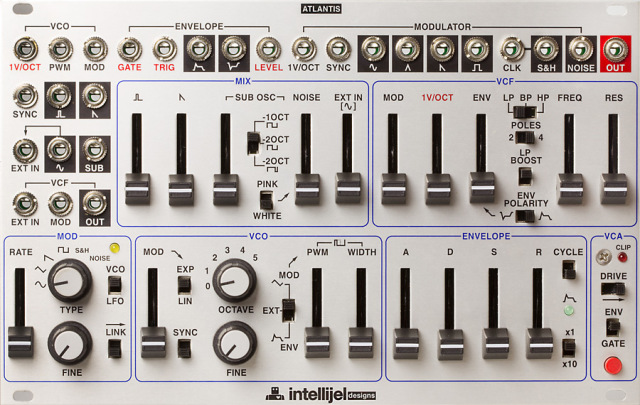
Intellijel has introduced the Atlantis – a fully patchable dual oscillator analog subtractive synth voice in Eurorack format.
The Atlantis is heavily inspired by the architecture and sound of the classic Roland SH-101. However, the Atlantis uses triangle core VCOs (based on the Dixie core) instead of Saw core, which respond much more musically to FM. The modulation oscillator can be used as an LFO or VCO (audio rate) and both track very precisely over 8 or more octaves.
The Intellijel Atlantis
In the mixer section you can adjust the balance of the primary oscillators waveforms including a sinewave which is normalled to the EXT IN jack. You could also patch in one of the modulation oscillators waveforms into this channel and be able to operate the Atlantis as a proper two oscillator synth. There is a switch labelled ?LINK? which enables the modulation vco pitch to be based as an offset of the primary VCO. This is useful when using it as a stacked dual vco or when you have the mod VCO acting as the linear FM source for the primary vco and wish to maintain the ratio.
The filter section is a Roland style cascaded 4 pole multimode filter with LP, BP and HP modes. The LP Boost switch engages a special mode useful for the LP that produces a much fatter and prominent sound that is not drowned out by resonance (unlike the original SH-101). The filter self-oscillates to produce a very clean sine wave which also tracks 1V/Oct. Between the Mod VCO, Primary VCO, Sub Oscillator and resonating filter it is possible to layer up to four different pitches at one time.
The envelope section is an ADSR with a dual range switch. It also can be set to a looping mode which can be gated on/off externally.
The output VCA feeds into a two level output clipping circuit that you can use to get a much ballsier/dirtier sound.
Features:
- Modulation VCO: triangle core with Hard Sync and Link switch to connect pitch to primary
- Primary VCO: triangle core with Hard Sync, Octave switches, Linear/Exp FM and PWM
- Global modulation bus with four VCO waveforms, noise and S&H options
- Cascaded 4-Pole multimode filter
- Looping ADSR with range switch, manual gate, and external level (velocity) control.
- Three position output clipping circuit
- 27 jacks for creative and complex patching options
- Header on back of pcb that allows it to be linked (normalled) to the Intellijel Metropolis sequencer
- Skiff Friendly
Summary of enhancements/differences over the SH-101 core:
- Discrete triangle core vcos (with far better tracking and Hard sync) instead of CEM based IC.
- Primary vco has linear FM (not just exp)
- MOD VCO can be linked to the primary VCO pitch CV.
- Modulation oscillator switchable from LFO to VCO
- Filter is multimode, 2/4pole switchable and has a special LP boost mode
- Filter allows for selection of inverted ADSR mod source
- Mixer section includes and external source which is normalled to a sinewave
- Filter has built in soft clipping
- Envelope has looping option, re-trigger and selectable time range
- Output VCA has two stage clipping circuit
- Patch points for every synthesis section
The Intellijel Atlantis is priced at $699 and is available now.
Teaser image of the new Moog Sub 37

Moog Music shared this teaser image of what looks like it could be the new Moog Sub 37 Paraphonic Analog Synthesizer.
More details will be provided as soon as we get them 😀
Time machine: Yamaha CS-50 Analog Synthesizer
All sounds from the 1976 Yamaha CS-50 !
The Yamaha CS-50 is the baby brother to the mighty CS-80. Actually it has almost exactly the same Voice cards as the CS-80. However the baby brother has only 4 Voice cards where the CS-80 has 16 ! Also the CS-50 is lacking the velocity polyphonic aftertouch keyboard so even though the core sound is similar the CS-80 has a more organic and dynamic sound because of the better keyboard. The Kenton MIDI gives the CS-50 the ability to play with MIDI velocity for example controlling the filter depth. Unfortunately you can´t assign MIDI aftertouch to the CS-50 Touch Response section but only to the modulation section.
All sounds coming from The mighty 1977 Yamaha CS-80 analog synthesizer.
The song is called Ode To The Holy Grail Part II composed by Firechild.
The CS-50 was released just ahead of its famous big brothers, the CS-60 and CS-80. The CS-50 looks like a scaled-down version of the monstrous CS-80, and it is! This will benefit those who crave the famous classic Yamaha synth sound without the struggle of lugging around the 215 pound CS-80! The CS-50 weighs in at about 100 pounds. The CS-50 is also just 4-voice polyphonic, and lacks the quality weighted 61-note keyboard of the CS-80. The CS-50 has just a 49-note standard keyboard. It does feature pressure (aftertouch) sensitivity route-able to several destinations, however.
The CS-50’s sound is unmistakably related to other classic CS-series synthesizers. At just four voices with one osc. per voice and lacking warm filters (at just 12dB/oct) the CS-50’s sound can be thin. There are 13 preset sounds of various instruments and synth sounds but, unfortunately, no on-board memory storage for your edited presets. At its low street price, the CS-50 makes a great way to get your hands on these classic sounds without going broke! It’s too bad their tuning is just as unstable as the other CS-series synths. It’s housed in a built-in travel-case like the other (big) CS-synths
Arturia MiniBrute Review
Background video description:
My reaction and playing around with the Minibrute. Also included is a quick look at the preset templates. Check out this awesome analog synth!
ALESIS ANDROMEDA A6 – Ambient performance demo
Alesis Andromeda A6 ambient meditation music synthesizer demo — playing relaxing live ambient chillout / electronica arpeggiator soundscape on Alesis A6 Andromeda analogue synth keyboard.
Created using 2 oscillators, filter and envelope adjustments, reverb, arpeggiator controller on vintage Alesis A6 Andromeda analog synthesizer keyboard.
Performed live, no external processing. Excerpt from a longer session.
FutureRetro XS Review / Demo
Quick reactions and exploration of the FutureRetro XS semi-modular analog synthesizer.
Product description:
The XS is a true semi-modular analog synthesizer with a universe of sonic possibilities just waiting to be discovered. Our versatile design allows it to be used as either a rackmount or desktop instrument, and its compact size makes it ideal for musicians on the go.
In its simplest form, the XS is an extremely powerful monophonic synthesizer including 46 controls with internal signal routings pre-wired to allow the unit to act similarly to traditional synthesizers. The unit also provides 7 inputs and 11 outputs that can be connected in various ways to override the pre-wired signal routings, interface the unit with other instruments in a modular fashion, and even process external audio.
The XS can be controlled by both MIDI and CV/Gate control signals simultaneously in a variety of ways. It can also act as a MIDI to CV/Gate converter with outputs, including CV/Gate/Mod Wheel/Velocity signals for controlling other analog instruments.
With a single unit you can easily create basslines, leads, drones, percussion, and sound effects. Connect multiple units together to form larger systems and the possibilities are endless.
The XS provides 2 ultra stable, wide range voltage-controlled oscillators, each capable of covering a range of 0.5 Hz to 100 kHz. Oscillator A generates saw and square waveforms. Oscillator B generates sine, triangle, saw, pulse width/square waveforms, and its own sub oscillator waveform, which can be 1/2, 1/4, or 1/8 the frequency of the main waveform. The pulse width shape of Oscillator B can be set manually or modulated with an internal or external control voltage, and Oscillator B can also sync its frequency to Oscillator A. Each oscillator can be frequency-modulated independently by both internal and external signals to create more complex waveforms. The XS also provides a white noise source and ring modulator that can be used on the internal oscillators or an external source. Dedicated outputs are provided for the waveform select controls A, B, and C.
A dedicated LFO generates triangle, saw, square, and random waveforms to modulate internal parameters, or external circuits as well with its dedicated output. The LFO can act in a free-running mode, or sync its rate to divisions of an external MIDI clock. When synced to an external MIDI clock, the LFO can be used to generate analog clock signals at various synced rates for stepping analog sequencers or arpeggiators in time with modern sequencers.
The mixer section sets the levels of the oscillator waveforms, sub oscillator waveforms, white noise source, ring modulator, or any external audio signal to be sent to the input of the filter.
The 2-pole multimode filter provides 4 filter types, including lowpass, bandpass, highpass, and notch settings, each capable of covering a range from 5 Hz to 18 kHz. With high resonance settings, the filter will self-oscillate, allowing it to act as an additional audio source. The cutoff frequency can be modulated by both internal and external signals, and the filter’s input and output can be overdriven independently, giving it unique tone characteristics. A dedicated output for the filter is also provided.
The XS includes our unique Velocity-sensitive ADSR type envelope with additional attack and decay time settings for accented envelopes. It’s like having two envelopes in one, and it’s capable of some truly funky sounds. This is the main modulation envelope internally routed to the modify the oscillators and filter. The envelope can be triggered by internal or external logic signals. Both normal and inverted polarity envelopes are available at the output.
And finally, a voltage-controlled amplifier is provided to process the amplitude of signals. The amplifier normally affects the filter’s output but it can also be used to process external audio signals. The amplifier has its own dedicated envelope with four selectable shapes, Velocity-sensitive amplitude, and independent accent times. The amplifier also has a volume control for attenuating signals sent to the main output.
Magnificence Multiplied: Analog Four OS 1.1
Analog Four OS 1.1. has finally arrived! This is a major OS upgrade, adding polyphony, resonance boost, MIDI multi map. Oh yeah, it also unlocks the pre-installed +Drive of all units. Head on over to http://elektron.se/support-and-downloads and upgrade today!
The Analog Four is a four voice polyphonic analog synthesizer. Analog oscillators and filters ensure the most organic sounds imaginable and the Elektron step sequencer caters for the innovative sound control. With sequencer features like parameter locks and variable length per track, intricate Analog Four compositions can be created quickly and efficiently. Add the completely new and incredibly well-crafted effects to the mix and experience the next chapter in analog sounds.
Elektron released OS 1.1 for Analog Four and Analog Keys adding polyphonic functions and increased strorage using +Drive. Here’s my demonstration of some new (slightly altered) factory sounds.
Cupid – new virtual analog synthesizer for Kontakt
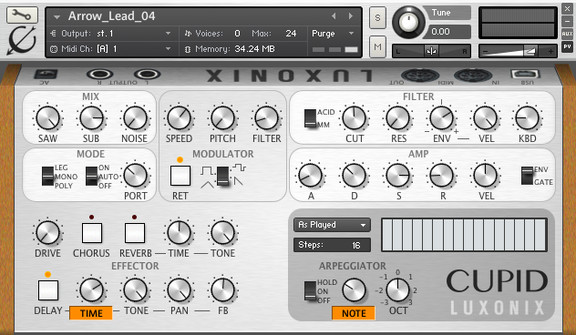
Luxonix has launched Cupid, a virtual analog synthesizer instrument for Native Instruments Kontakt.
Cupid is a sample library for Kontakt of a virtual analog synth. Cupid has easy to use user interface on one screen without a complex menu diving. So you can direct handling and quick sound making.
For good sound quality, we mapped perfectly looped high resolution 24-bit waves into all chromatic key map. So Cupid plays equal sound quality by each keys all octaves.
Cupid features
- Easy to use user interface on one screen without complex menu diving.
- Mapped high resolution 24-bit waves into all chromatic key map.
- Can mix with three waveforms level – Saw, Sub oscillator, Noise.
- Uniquely designed Sub oscillator wave.
- Very wide value and extreme pitch range Modulator.
- Switchable two low-pass filters.
- Easy to control arpeggiator, unison and effectors.
- 166 .NKI / 85 .NKM Kontakt instrument presets for Kontakt 5.
- 186 samples, 24-bit / 44.1 kHz .NCW format samples (Lossless compression).
- About 53 MB installed.
Cupid for Kontakt is available to purchase for the introductory price of $29.90 USD until December 31st, 2013 (regular $39.90 USD).
DATAMASKIN

