
CAUSTIC Electronic Music Rack for Android devices
CAUSTIC Music Rack lets you create powerful electronic music on the go. Demo video showing an example of what can be done with CAUSTIC Electronic Music Rack for Android devices. This is a quick overview of how to the different machines to put together a song loop. Hoping to create more in-depth videos explaining some of the more complicated machines like the SubSynth and Sequencer in the near future. The app is available for most Android devices, and there’s a full demo version with no time restrictions. To unlock full-version features (song save/load/export), use the in-app purchase option.

This app is packed with 8 machines including:
* 1x Virtual analog subsynth
* 2x PCM synths (23 demo samples included)
* 2x 303-like BassLine synths
* 1x Sampling drum machine (9 demo kits included)
* 1x Mixer desk with Delay/Reverb and 6 insert effects
* 1x Song sequencer
All files are stored on the SDCard, and users can supply their own WAV files for use in the PCMSynths (drum machine setup coming soon)
Minimum recommended device specs are:
– 800 MHz ARMv7 processor
– 800 x 480 resolution screen
– Headphones or external speakers
This is a demo version of CAUSTIC Music Rack, with the ability to unlock to full version. There is no time limit in demo mode but save/load/export are disabled. The app will automatically save your current song between sessions.
Full version unlock is available as an in-app purchase. For those who can’t use in-app billing, other options will be available shortly, more info on the developer’s website.
Permissions:
– SDCard: All samples and songs are stored on your sdcard.
– Wake Lock: A few people have requested an option to keep the app awake, this is now available through the menu options.
– Billing: To contact Android market servers for full-version unlock.
CAUSTIC Music Rack has been released for the Android platform
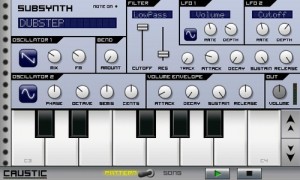
CAUSTIC lets you create powerful electronic music on the go. This app is packed with 8 machines including: Virtual analog subsynth. 2x PCM synths (23 demo samples included) with Song sequencer. 2x 303-like BassLine synths. Sampling drum machine (9 demo kits included). Mixer desk with Delay/Reverb and 4 insert effects.
All files are stored on the SDCard, and users can supply their own WAV files for use in the PCMSynths (drum machine setup coming soon)
Minimum recommended device specs are:
– 800 MHz ARMv7 processor
– 800 x 480 resolution screen
– Headphones or external speakers
This is the demo version of CAUSTIC Music Rack, because 15 minutes isn’t enough time to get familiar with everything this app can do. There is no time limit in this version but save/load/export are disabled. The app will automatically save your current song between sessions.
A full-featured paid version should be out in the next few weeks.
More info from the developer’s website:
- “The first version of is finally out on the market and I’m very excited. I’ve been working on this since Christmas, and am anxious to see what people think.When I got my Nexus One, I was disappointed in the lack of audio apps on the market. Since then, a few good ones have come out, but I really wanted a virtual rack full of machines to tinker around with and make some grooves. The goal was to get a similar experience to some of my favorite software: Reason and ReBirth by Propellerhead.
It struck me as impossible that ReBirth ran on a Pentium 90 MHz back in the day, yet somehow there was no way to get even close to that on Android because of various API issues. Well there certainly are some shortcomings in regard to audio on Android, but working around them and optimizing as much as possible, CAUSTIC was born.
I’m hoping to get how-to videos for each of the machines soon, as well as a F.A.Q. section as I’m sure they’ll be lots of common questions about this app, but please be patient. I’ve got a full-time job and only get a few hours a day to work on this.
If you’re reading this and want to help out, there’s lots to do and my time is limited so I’m still looking for:
+ A good demo song to ship with; contact me through the market’s developer email if you’d like to help.
+ More subsynth presets; if you’ve got cool presets you’ve created, send them to me and I’ll include them in future contents packs.
+ PCMSynth samples; if you’ve got any samples ( tuned to C ) that are of your creation (no copyrighted material), send me a link and I’ll look at including them in future content packs as well.
+ The other big task I’ve got on my list is the paid version with Save/Load and file export. I’ve got a basic WAV exporter working, it just needs more testing. Then I have to integrate Android licencing scheme and a few other little things. Hopefully the paid version will be out in the next few weeks.
I hope to release updates frequently with bugfixes and add-ons, and I plan to release free content packs with synth/drum presets and samples too. If you’ve got a feature you think would be cool, write me, I’m open to suggestions.
Thanks for reading, be patient with this first release and send in your feedback.”
You can download CAUSTIC Music Rack for free now from Android Market at https://market.android.com/d…
Can you make an entire album on Android, check this one out
COOLOUT has released a new album entirely built with Android music apps. The album is called RISE and the apps he has been using can befound below.

- The world’s first Android album.
-
Written, Produced, and Mixed by Christopher “coolout” Davis
All sounds created and vocals recorded through an Android cell phone
Apps used: Virtual Amp, MusicGrid, Electrum, Jasuto, Ethereal Dialpad, MicDroid, PureData/RJDJ, Solo Lite, Chordbot, VirtualSynthesizer, Brainwave Tuner, Musical Bubbles, Silicon Oxide, Buddhist Instruments, Tone dialer, PP-Electone
Album artwork made using: Retro Camera and Photo Illusion
Workstation for Android powered devices – Caustic Music Rack

Single Cell Software has announced Caustic Music Rack, a synth workstation/virtual studio, inspired by Propellerhead Reason.

Features:
- 1x Virtual analog subsynth
- 2x PCM synths (23 demo samples included)
- 2x 303-like BassLine synths
- 1x Sampling drum machine (9 demo kits included)
- 1x Mixer desk with Delay/Reverb and 4 insert effects
- 1x Song sequencer
The current version is free; a commercial version is in the works.
New Sketchpad Joins Groovebox
SPC — Music Sketchpad is a sample-based audio tool designed for aspiring and accomplished musicians alike
The SPC is designed for Android users to produce, record and share original music incorporating their own loops and samples or those provided by mikrosonic. A 16-pad multi-touch enabled opening screen lights up rhythmically to simplify playing live. There are then five additional screens for editing samples and programming sequences
SPC can integrate content from various sources. Additional audio material is available on mikrosonic’s website, and loops created with RD3 – Groovebox are directly loaded into SPC — Music Sketchpad.
more info at: http://www.mikrosonic.com/spc
mikrosonic SPC – Music Sketchpad for Android
SPC — Music Sketchpad is a sample-based audio tool designed for aspiring and accomplished musicians alike
The SPC is designed for Android users to produce, record and share original music incorporating their own loops and samples or those provided by mikrosonic. A 16-pad multi-touch enabled opening screen lights up rhythmically to simplify playing live. There are then five additional screens for editing samples and programming sequences
SPC can integrate content from various sources. Additional audio material is available on mikrosonic’s website, and loops created with RD3 – Groovebox are directly loaded into SPC — Music Sketchpad.
more info at: http://www.mikrosonic.com/spc
Android’s putting up a fight with Apple on the music scene
Highlights from the latest Android platform release – Gingerbread
The 2.3 operating system opens its doors to music programming with low latency hardware level recording and encoding. Built in AAC and AMR encoding as well as resident audio effects processing such as reverb, visualization and eq that can be applied globally or any of the multiple audio streams that can be run. This gives applications access to powerful audio controls and effects from native code.
TouchOSC ported to Android- finally
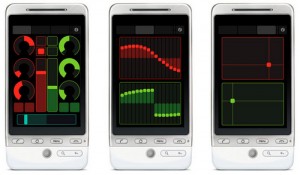
TouchOSC, the popular IOS OSC control application, has been ported to Android.
TouchOSC for Android is available now on the Android Market as donationware.
While it’s free, its features don’t match the iOS version. Current limitations are:
- No importing of custom layouts
- No ZeroConf/Bonjour publishing/browsing
- No multi-touch support
- No support for resolutions higher than 320×480
- Some other minor features missing
Here’s what the developer has to say about TouchOSC For Android:
This version basically represents the feature set that TouchOSC version 1.0 for the iPhone supported when it was first released. Minus the bugs of course. There’s a couple of reasons that led to the decision to release the application in this form. First of all, I didn’t want to make all of you wait any longer. Constructing a full port would have probably taken me another 12 months of trying to play catch-up with the original which is constantly improving. Secondly there seems to be an endless stream of new Android devices coming out every other moment, so testing the more advanced features on every possible configuration is basically impossible. Keeping it lean and simple will probably help in making it work for most of the available gadgets right now.
All that said, I also decided to make the application available for free. There don’t seem to be a lot of (successful) paid applications available on the Android Market right now and from my research the general user-base is also not exactly used to actually pay for apps. The ad-supported model that a lot of developers go with is also something that I wouldn’t even consider at my most delirious. Call me crazy.
via Palm Sounds
Turn Android into a vintage drum machine
This is an Android application called Silicon Oxide that simulates an old analog, preset-based drum machine like the Korg Mini Pops 7, used in some synth classics from the 1970s. No samples used, all instruments are played using software-modeled oscillators, filters and envelope generators.
The strangeness in the bass drum sound is an artifact from Youtube conversion, it’s not in the original audio.
Beat a can drum machine on Android
Although pretty silly it is nice to see more stuff showing up on Android and more importantly demonstrating the very powerful audio platform Pure Date on smart phones. This might be a turning point for the still widely unknown open source platform also known as the unknown brother of MAX/MSP!
“Chris McCormick’s clever and fun scene shows off Pure Data running on Android, via the free libpd created by Peter Brinkmann. Also available on: everything.”
“It’s a way of making Pure Data (Pd), the visual development tool for interactive music and media, more accessible across a range of applications and gadgets. It lets you embed Pd pretty much anywhere. It’s not a new version of Pd. Instead, it makes use of the standard, “vanilla” distribution of the free and open source software. What’s different is that it separates the sound processing part of Pd from the part that talks to audio hardware, allowing Pd to run on a greater variety of mobile devices and inside other applications.
libpd:
* turns Pd into an audio synthesis and processing library
* liberates Pd from GUI and drivers
* allows for easy communication between Pd and the code into which it is embedded (so you can send and receive messages with your Pd patch)”
DATAMASKIN

