
Soft Circuitry With Mini Synth
I guess the term soft synths can be used in many different meanings 
This soft interface is made from metallic wools, Velostat (a resistive material), conductive fabrics, sheep’s wool and acrylic craft felt.
It is connected to the circuit with snaps soldered to wires and alligator clips.
The circuit is comprised of 2 oscillators using the 4093 IC, piped through a distortion filter built using the 4049 and then out through the 4040, a 12 stage binary counter, it has 12 outputs, each dividing the source by 2.
Four of the twelve outputs from the counter IC are taken onto the soft interface using snaps to wire and mixed using a felted patch cord of sheep and metallic wool.
One oscillator is controlled by a force sensing resistor made from Velostat and conductive fabric.
Oscillator number two is controlled by a felted sculptural potentiometer, one side of the spike is a needle felted bronze trace, the opposite side is Velostat. You connect the two through your body by wearing stretchy conductive fabric over the tips and touching both sides at once.
Your body naturally has a high resistance, so you mainly get slow oscillation and hear low tones.
Each of the two oscillators have a control pin, they turn on and off based on if that pin is set to high or low. Each oscillator’s outputs are feeding into the other’s control pin, so you can turn one off and on, by touching the other.
Experimental – musical table
This project by Kouichi Okamoto is awesome! 504 musical box movements which each play only a single note:
The musical table installed 504 volumes on the top plate,
and there are 504 musical box movements which play only a single sound
in the point of the 5-m electric line extended from there.
The motor revolving speed of the musical boxes are adjusted by the volume of
the table, and the musical boxes play sound at random.
Enjoy
Resonant Chamber | Making
Resonant Chamber is an interior envelope system that deploys the principles of rigid origami to transform the acoustic environment through dynamic spatial, material and electro-acoustic technologies. Our aim is to develop a soundsphere able to adjust its properties in response to changing sonic conditions, altering the sound of a space during performance and creating an instrument at the scale of architecture, flexible enough that it might be capable of being played. The project is developed through three streams of iterative research and development in both computational testing and full-scale prototype installation: Dynamic Surface Geometries; Performative Material Systems; and Variable Actuation and Response. Resonant Chamber is funded through the 2011 Research through Making Grant, U-M Office of the Vice President for Research, 2011 Small Projects Grant, U-M Center for Wireless Integrated Microsystems, Social Science and Humanities Research Council of Canada Research Creation Grant.
Moog Freqbox Trio
Background details:
Moog FreqBox 3x
4ms Peg RCD VcaMatrix
Analogue Systems RS 100 RS 110 RS 360
Doepfer A 134 pan by Moog MP 201
foh choices
Make Noise Maths Moddemix Optomix QMMG René Wogglebug
Malekko JAG
Moog CP 251
Roland System 104 Sequencer
SSL Modulation Orgy
Toppobrillo Quantimator Sportmoulator
Master Clock Logic via Kenton Pro 2000II and 2x 4ms RCD.
Drums Logic Ultrabeat
Space Palette at STEIM
A performance by Tim Thompson on the Space Palette at STEIM (see steim.org) in Amsterdam. This three-dimensional instrument uses the Microsoft Kinect to translate hand motion directly into both music and visuals. It’s like having four 3D mousepads in mid-air. See http://spacepalette.com for more information. Thanks go to Vivian Wenli Lin for the recording.
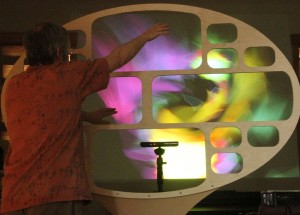
The Space Palette is a Kinect-based instrument used to perform music and graphics simultaneously, controlled directly by your hands. The picture above shows the newest version, which you can see in action in this video of an open house performance on the Space Palette. The new version also appeared at the Sea of Dreams 2012 New Year’s Eve party in San Francisco. At that event, it was only doing graphics, because it was too loud to do anything else. The previous (rectangular) version of the Space Palette can be seen in this video of people playing with it at Burning Man 2011. Search YouTube for “Space Palette” to find other videos.
Technical details about the latest version can be found in these slides from a talk about the Space Palette. I’m now using Resolume as a FreeFrame host, which I highly recommend.
Source code and a Windows executable for the core bit of software (that talks to the Microsoft Kinect, recognizes your hands within an arbitrary flat surface with holes, and sends out TUIO/OSC messages that can drive whatever you want to control) is available here. If you’re interested in a more recent version of that software, send email to me at timthompson.com.
Mr. Kaplin Official Release: Toob “Wavaphon” Music Video
Track: Wavaphon
Music: Toob // toob.org.uk/
‘Taken from Chromaphon EP on Process Recordings’
Some buy links – bleep.com/release/30552
Video Directed, Designed and Animated by: Mr Kaplin // mrkaplin.com
Albert Einstein is quoted to have said “It should be possible to explain the laws of physics to a barmaid.”
This video is our attempt at creating a graphical representation of the mathematization of motion, showing only a small amount of the different formulas used to define the chaos within our universe.
Visuals were influenced by: scienceworld.wolfram.com
Human Resistance Synthesizer
http://www.handmadeelectronicinstruments.com/
This is a lo-fi synthesizer that is played by bridging a connection between the two large contact handles. The pitch is controlled by the amount of resistance. The more resistance or lighter touch produces lower frequencies. This oscillator is then modulated by a LFO, giving this device very nice throaty, almost vocal sounds. It can also be played through multiple people creating a human chain.
The three large knobs control the speed of the LFO, a low-pass filter, and volume. It is powered by an included 9volt battery. A green LED indicator flashes in sync with the modulation. A standard 1/4″ output makes it perfect to connect to amps, effects, or recording equipment.
“This is the second of a matched pair of these I built using repurposed cigar boxes, salvaged handles, and new as well as salvaged components.”
Magnetometer Virtual MIDI Controller App
This is a magnetometer enabled virtual MIDI controller app made by Aaron Pride for the RVA Hackathon 2012 (RVAHackathon.com) The other apps featured are Sunrizer and NLog Synth.
Using core MIDI, audio backgrounding, along with the Z axis readings off the magnetometer… negative pole vs. positive pole of the magnets will trigger pitch up or down. Sends pitchwheel, modwheel, and random note commands w/ poly-aftertouch.
BE CAREFUL PLAYING WITH STRONG MAGNETS!
Cool Sound and Water Experiment!
This is really simple but has such an awesome effect. Fill a bucket full of water and place it about 5 feet off the ground. Place a subwoofer about 1 foot lower than the bucket. Run a plastic tube from the top bucket down in front of the subwoofer. Tape the tube to the front of the speaker. Then aim the end of the tube to an empty bucket on the floor. Get the water flowing from the top bucket. Now just generate a 24 hz sine wave and set your camera to 24 fps and watch the magic happen. Basically your cameras frame rate is synced up with the rate of the vibrations of the water so it appears to be frozen or still. Now if you play a 23 hz sine wave your frame rate will be off just a little compared to the sine wave causing the water to “move backward” or so as it appears. You can play a 25 hz sine wave and cause the water to move slowly foward.
Really fun experiment. You should definitely give it a try.
Thanks to JacobTMcgarry for giving me the OK to create my own version based on his original video:
http://www.youtube.com/watch?v=8GkHePfcpbY&context=C40ee253ADvjVQa1PpcFPc…
Check out the Droner for iPad
Welcome to The Droner, experimental noise & drone station for iPad. On the left, you can see the routing schematics of the synthesizer. Be careful, you don’t have a classic or a regular machine in your hands. Indeed, it can produces very unique and strange sounds textures and you have to learn to handle it.

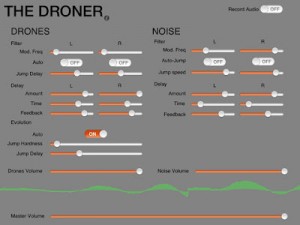
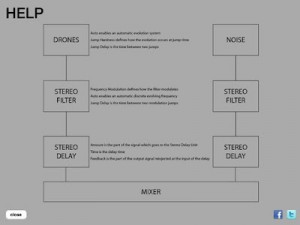
You have to use it with earphones or to use a line input on your sound-system in order to render the best results.
You can record while playing with it. The PCM file will be saved in the document folder of The Droner application on your iPad. You use iTunes to manage the files in this folder to backup them on your computer, or remove them.
DATAMASKIN

