
New patch library for the Arturia MiniMOOG
Kid Nepro has introduced the Arturia Minimoog V Collection, a new patch library for the Arturia Minimoog software synthesizer:
Kid Nepro purchased his first original Minimoog back in the mid 80’s and has been using them ever since. We still have one in our studio which continues to get lots of use when we are looking for that certain sound – that only the Moog can provide. So for us, programming a Minimoog is like riding a bicycle – you never forget how to do it! The collection of sounds that we have programmed for the Arturia V collection is done with expert care from someone who knows the Minimoog very well – so you can be sure that the sounds are well crafted and sound great.
The Minimoog V patch library is available for download for $25.
|
The original Minimoog was released in 1970. By the time it was discontinued in 1981, about 13,000 were produced. One of the true landmark synthesizers produced though the 70’s – it’s compact design, great sound and easy to use interface made it popular with both Rock & Jazz keyboard players ranging from Keith Emerson to Chick Corea. The Minimoog was designed to include the most important parts of a modular synthesizer in a small package, without the need for patch cords. The original Minimoog is monophonic and its three-oscillator design gave it its famous fat sound. The Minimoog Model D adapted some of the circuitry (such as the filter section) from earlier modular instruments, but designed other circuitry (such as the oscillators and contour generators) from scratch. You could not save patches in it’s internal memory – so just one sound at a time could be stored and played. Yeah, that’s the way things were back then! Original Minimoogs did not have midi, but you could get several midi retro kits which could be installed to give you basic midi features. Kenton makes a good own which we have installed on our vintage Minimoog.
Kid Nepro purchased his first original Minimoog back in the mid 80’s and has been using them ever since. We still have one in our studio which continues to get lots of use when we are looking for that certain sound – that only the Moog can provide. So for us, programming a Minimoog is like riding a bicycle – you never forget how to do it! The collection of sounds that we have programmed for the Arturia V collection is done with expert care from someone who knows the Minimoog very well – so you can be sure that the sounds are well crafted and sound great. Our Minimoog V Collection is available as a download via our free e-mail delivery. Just open the file in your Arturia software and your ready to roll! Pick the Mac or PC “patches” format when ordering online at our web site. Please contact us if you need any more info. |

New analog challenger to the microMOOG
This is a demo of the Helmtronic Challenger – a new retro-style analog synthesizer.
Only at the MusikMesse you have the opportunity to meet with a manufacturer of analog synthesizers all buttons and knobs. Challenger and equipment with four oscillators, two filters, dual audio path and panel-style recliner Minimoog. The price, once reached the marketing of the series, should be very interesting.
A good look at the Moog
Bill Holland was minding his business in the Gearwire studio when the ancient alien creature known as the Caretaker transported him to the Delta Quadrant, where his only hope of getting home was to shoot this series of video demos on the Moog Music Minimoog Voyager.
Part 1
Bill Holland wakes up on the wrong side of the Voyager in this amazing display of ghost piano. Where’s the sound coming from if nobody’s pressing the keys? The secret lies within this video. Don’t look at the Moog Minimoog Voyager, look through it!
Part 2
Ever onward with our look at the Moog Music Minimoog Voyager. The next stop on this luxury-synth cruise will take us to the banks of assignable control options, including everyone’s annular favorite, the mod wheel.
Part 3
Can't afford a real Moog?
Well here’s the second best 
Mini-paper-Moog


Rhytmic modulations with Moog's MF-101
The MF-101 Low Pass Filter’s ENV OUT Control Voltage makes a number of amazing Rhythmic Modulation techniques possible. This video shows some of these applications in a Dance Music setting. This technique is not limited to Dance Music. The applications are as endless as your imagination.
[youtube=http://www.youtube.com/watch?v=W868tnYADDk]
The award-winning MF-101 Lowpass Filter is a direct descendant of the original Moog modular synthesizers. It contains two complete modular functions: a voltage-controlled lowpass filter and an envelope follower. It can be used with any instrument level to line level signal.
The moogerfooger filter’s control parameters are signal mix, cutoff frequency, resonance amount, and envelope amount. All of the Lowpass Filter’s parameters can be controlled with expression pedals or external control voltages as well as by great feeling knobs which beg to be tweaked. Panel switches select filter mode and envelope follower speed. 1/4″ jacks are provided for audio input and output, pedal/control inputs and envelope follower output. A heavy-duty, yet smooth-acting bypass switch allows tabletop or foot operation.
A lowpass filter removes high frequencies from a tone. It makes the tone sound more mellow or muted. The lower the Cutoff, the more muted the tone sounds. Imagine a window shade. As it is pulled down, it cuts out the higher light, then the light from the middle of the window, then finally all the light. The MF-101 Lowpass Filter does the same sort of thing to the sound spectrum with it’s Cutoff Control.
As you turn up the Resonance control, the overtones near the cutoff frequency are boosted. Resonance gives the moogerfooger filter the same classic Moog filter sound as the Minimoog; and Moog modular synthesizers.
The envelope follower tracks the loudness contour (envelope) of a sound, and produces a voltage that follows the dynamics of your playing. Every time you play a note, the envelope voltage goes up and then down. The harder you play, the higher the envelope voltage goes. The envelope follower opens and closes the lowpass filter. Think of the envelope voltage as an invisible hand that turns the CUTOFF knob up and down every time you play a note. Since the envelope follows the dynamics of your instrument’s signal, you actually play the filter as you play your instrument.
For all virtual Moog-fans out there
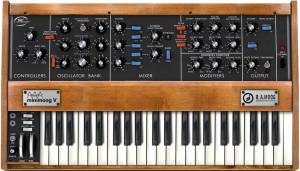
Arturia has released version 2.0 of Minimoog V, a virtual Minimoog synthesizer instrument for Windows and Mac.
| Retromatic
by Larry Hopkins |
Track made using the Minimoog V and the ARP 2600 V. |
| 5 blips house
by Fabrice Gabriel |
11 Minimoog V instances were used in this demo song. Many thanks to the author, Fabrice Gabriel. |
| Elektro side of the minimoog V
by Jean-Michel Blanchet |
12 minimoog V tracks in Cubase SX. No additional samples were used. All the sounds used in this piece are available in a preset bank of the minimoog V plug-in. Many thanks to the author, Jean-Michel Blanchet. |

MAIN FEATURES
- All the parameters of the original minimoog V
- Advanced automation mode ( Minimoog V 2.0 Only )
- Revolutionary preset navigation system called the SoundMap (Minimoog V 2.0 Only )
- New formant-analysis-based FX called the Vocal Filter (Minimoog V 2.0 Only )
- New modulation matrix with up to 6 connections (12 sources and 32 destinations)
- New arpeggiator
- New LFO
- New Chorus and Stereo Delay Effect section
- More than 500 presets created by talented artists and sound designers
- Up to 32 voices of polyphony, and a Unison mode
- 3 voltage controlled oscillators with 5 waveforms
- 1 amazingly sounding 24 dB/octave filter
- 1 VCA
- 1 Mixer
- 1 Noise Generator
- 2 ADSR envelopes
- 1 external audio input and 1 external oscillator and filter modulation input
- Soft clipping function
- No aliasing from 0.1 Hz to 20 kHz
- 64-bit floating point precision
- Sampling rate: up to 96 kHz
NAMM 2009: New from Arturia – miniMOOG V
Updates to software instruments
 French physical-modelling company Arturia were showing updates to two of their software products at the NAMM show.
Free Moog VST

If you are looking for a free Moog emulator in VSTi format, the Minimogue VA is a cpu friendly synth producing lead, FX and bass using the same sound architecture of the real Minimoog. It is programmed to be as expressive as possible. It is created by Voltkitchen group with Synthedit, a Modular Synthesiser for Windows XP and Vista that allows you to create your own synth and save it as a VST.
From the Minimogue’s site: “The first 3 rows of knobs represent the original Minimoog. The only additions here is a button for retrig and legato. The original Minimoog is always set to legato. Also there are sliders for fine tuning that is not present on the Minimoog, but these works just like the pitch knob, only that it is more sensitive. Its just there to help you, because the Mini moog sounds best when it is almost in tune, but not 100%. Tuning plays a big part in the MM sound. Also release in the envelope generators is added. The upper section is where you create sounds.
The last row of knobs represent new features not present on the original Minimoog: midi control, oscillator sync, LFO, autopan, overdrive, chorus and a delay section that you can sync to host BPM. The LFO has 3 functions. At low level settings it is intended to simulate the small tuning and instabilities in an original MM. At high level settings it simulates the tweaking of a knob so that you can focus on the playing. The third function is to give oscillatorsync pitch variations to work with. It also syncs to host BPM. ”
To download this this free full-functional plugin + presets click here.
DATAMASKIN

