
Intro to the MiniMoog Voyager XL
This official Moog video is an introduction to the Moog Minimoog Voyager XL.
The Minimoog Voyager XL is a semi-modular monster synth that combines the best features and the sound of the Minimoog, the flexibility of Moog modular synthesizers and a full host of control options. Incorporating virtually all of the sound resources and functions of the original Minimoog Model D and Voyager, The Minimoog Voyager XL features extensive front-panel patchability that harkens back to the original ground-breaking Moog modular synthesizers. A host of features previously found only on massive modular synthesizers combined with state-of-the-art analog technology make it a sound design and control dream machine.
Highlights include:
- Unmistakable Moog Sound and Quality
- 100% Analog Audio Path – Moog Ladder Filter
- 61-Note Velocity Sensitive Keyboard with After-Pressure
- Extensive Control Voltage Connectivity
- Modular-Style Patching
- Ribbon Controller with Pitch and Gate CV Outputs
- Touch Surface Controller with X, Y, A and Gate Outputs
- Additional LFO Source with Multiple MIDI-Syncable Waveforms
- External Audio Input & Effects Loop Insert
64 presets for the Arturia Minimoog V2
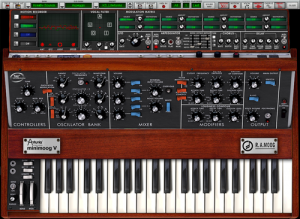
Kreativ Sounds has announced the release of SYN Minimoog V Sounds, a collection of 64 presets for the Arturia Minimoog V2 software synthesizer.
With this collection, we took the warmest and fattest sound of the planet even further for Minimoog V2.
SYN Minimoog V Sounds features
- 64 outstanding presets in Native, FXP and KORE format for Arturia Minimoog V2.
- Each KORE preset has macro knobs assigned and all 8 pad variations (64 presets x 8 variations = 512 sound variations).
- Minimoog V KORE Template for easily creating your own sounds with pad variations.
- Each preset features modulation wheel and velocity information for more control over the sounds.
SYN Minimoog V Sounds is a “pay-what-you-wish” product starting from 5 EUR.
More information: Kreativ Sounds / SYN Minimoog V Sounds
Berlin old school synth
Hi lovely Synthfolks, sorry for my bavarien english;-)))
I make a short sequence with four steps with three Oszilators from the GRP A8 Synth, the other three Oszilators go to the leads. The other leadsound comes from the Minimoog. The Noice comes from the Juno 60.
The gear of John Foxx
Here’s a video coming from Future Music featuring John Foxx with loads of gear, so time for synth spotting I guess
Be sure to watch through the beginning for the gear tour. Tons of synth spotting. He gives a good comparison of the ARP Odyssey and Minimoog. The Yamaha CS1X gets a mention too! It’s fun digital PCM synth not to be confused with the AN1X virtual analog. Icy strings.
Retrosounds gives us a vintage heads up
http://www.youtube.com/watch?v=QqRJyOql3ac
vintage synth demo by RetroSound
“Odyssey feat. Minimoog”
2 VCO deep bass: Moog Lintronics Minimoog
2 VCO lead sound: ARP Odyssey MkIIII
FX: Lexicon reverb and delay
more info: http://www.retrosound.de and
http://www.myspace.com/retrosound72
Moog to Voice <> Voice to Moog
How to make your MiniMoog sound like it has a voice of its own, in 10 simple steps.
All the analog you might need
Analog Player includes no less than 1,000 classic Arturia synthesizer sounds made from the company’s flagship software synthesizers (Minimoog V, Prophet V, ARP 2600 V, Jupiter 8V, and many others) that re-create the sounds and the look of classic hardware synthesizers. According to the maker, Analog Player’s straightforward editing functions give access to the most essential parameters, making sound design both easy and fun. In addition, its smart preset manager helps you find the sounds you want quickly, without having to waste time scrolling through endless menus.
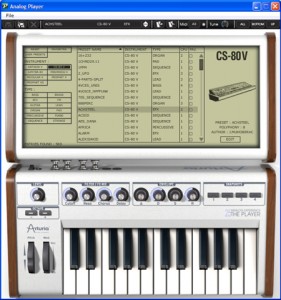
The new release is fully compatible with major plugin formats (VST, Audio Units, and RTAS) and hosts on Mac OS X and Windows XP / Vista / 7. Analog Player not only integrates into all the major hosts and sequencers, but it can also be used in standalone mode and be controlled by a remote external MIDI keyboard with keys, knobs and faders, allowing you to make changes via a simple twist of a knob.
Artura Analog Player’s main features:
- 1,000 synthesizer sounds selected from the Arturia Classic Synths (Minimoog V, Moog Modular V, CS-80V, ARP 2600 V, Prophet V, Prophet VS, and Jupiter-8V)
- Smart preset manager allows you to fast filter the presets to your requirements, by instrument and by type (Bass, Pads, Leads, and so forth)
- Organize Presets view by Name, Instrument, Type, CPU usage, Favorites, or User Presets
- Straightforward editing with the most essential parameters for personalizing presets: Cutoff and Resonance, Chorus and Delay mix, ADSR envelope
- Full compatibility with major formats and hosts on Mac OS X and Windows XP / Vista / 7 (VST, Audio Units, and RTAS)
- 4 Snapshots buttons let you store up to 4 snapshots for sound comparisons, variations, and more
- Integrated as a plugin within your sequencer or plays as a standalone software synthesizer
- Optimize your screen space — choose to view the Preset Manager only, the Keyboard only, or both at the same time
- Set to Control with your external MIDI keyboard
- Save and recall presets
- VST 2.4 / Cubase 5 ready
Analog Player is now available as a downloadable product for $99 (MSRP) from the Arturia online store. For more details, please visit arturia.com.
OK so now its launched – the new miniMOOG XL
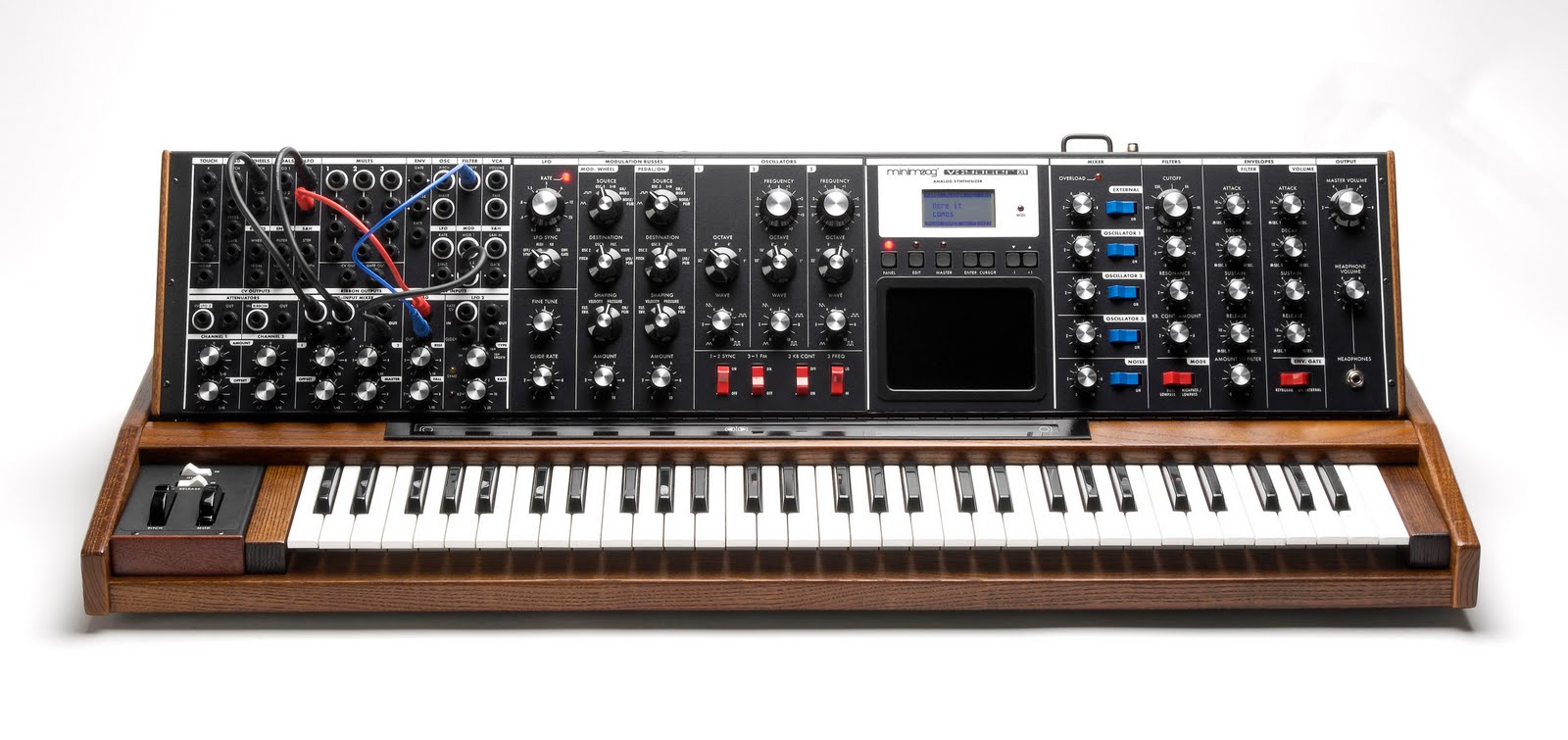
Designed in celebration of the 40th anniversary of the Minimoog, the Minimoog Voyager XL is a sonic powerhouse that pays homage to important milestones in the Moog synthesizer legacy. It starts with the heart of a Minimoog Model D. Fat oscillators and warm Moog filters give it that unmistakable Moog sound and the rugged construction and intuitive user interface design immediately tells you that you’re playing a high-quality musical instrument.
From the current Voyager lineage, the XL inherits a 100% analog signal path with stable oscillators, patch storage, touch surface, pot mapping and extensive MIDI control functionality. To all this, add a ribbon controller and 61 note keyboard and you have a monster analog monosynth built on a 40 year legacy of sonic exploration.
And here is all there is to know about it:
Here are the official specs:
100% Analog Sound Engine
The MINIMOOG VOYAGER XL Synthesizer is a monophonic analog performance and production synthesizer. Based on the Minimoog Voyager sound engine, it incorporates virtually all of the sound resources and functions of the original Minimoog Model D and Voyager, with the addition of a number of exciting features from Moog’s modular synthesizer legacy.
Keyboard
61-Note Velocity Sensitive Keyboard with after-pressure. Identical to the Voyager 44-note keyboard.
Ribbon Controller
A 500mm Ribbon Controller is located on the middle wooden rail of the Voyager XL. It’s center-point is lined up with ‘middle-C’ of the 61-note Keyboard. Outputs are sampled and available as CV-OUT (-5V to +5V) and GATE-OUT (0V to +5V).
Control Voltage outputs:
- Keyboard Pitch (w/ internal trim to calibrate to 1 V/Octave)
- Keyboard Velocity
- Keyboard Afterpressure
- Touch Surface X
- Touch Surface Y
- Touch Surface A (area)
- Pitch Bend Wheel
- Mod Wheel
- MOD 1 signal (signal at MOD 1 input)
- MOD 2 signal (signal at MOD 2 input)
- LFO triangle wave
- LFO square wave
- Mod Wheel Mod Buss output
- Pedal/On Mod Buss output
- Filter Envelope
- Volume envelope
- Sample and Hold Step
- Sample and Hold Smooth
- Noise
- Ribbon Controller CV Output (-5V to +5V)
Gate outputs:
- Keyboard Gate
- Touch Surface Gate
- Ribbon Controller Gate Output
4-way Mults (top jack is ring-powered) (3 of them)
Control Voltage Inputs:
- Envelope Rate CV (-5V to +5V) Ring-Powered
- OSC Pitch CV (adj. to 1V/Octave) (-5V to +5V) Ring-Powered
- OSC Wave CV (all three osc. affected) ( 0V to +5V) Ring-Powered
- FILTER Cutoff CV (-5V to +5V) Ring-Powered
- VCA Volume CV ( 0V to +5V) Ring-Powered
- VCA Pan CV (-2.5V to +2.5V) Ring-Powered
- LFO Rate CV (-5V to +5V) Ring-Powered
- MOD Mod1 CV ( 0V to +5V) Ring-Powered
- MOD Mod2 CV ( 0V to +5V) Ring-Powered
- S&H CV (-5V to +5V) Ring-Powered
Gate Inputs:
- ENV Release ON/OFF (0V OFF, +5V ON)
- ENV Gate Input (0V OFF, +5V ON)
- LFO Sync ON/OFF (0V OFF, +5V ON)
- S&H Gate Input (0V OFF, +5V ON) No footswitch input
Active Attenuators (2)
Active Attenuators are identical to the VX-352 attenuators with the following difference:
CHANNEL 1 is normalled to LFO 2 output. So, if nothing is connected to the Channel 1 input jack, the output of Channel 1 will be the attenuated version of the LFO 2 output.
CHANNEL 2 is normalled to RIBBON output. So, if nothing is connected to the Channel 2 input jack, the output of Channel 2 will be the attenuated version of the RIBBON controller.
EXPRESSION PEDALS can be connected to the Attenuator inputs (i.e. they are ring-powered inputs).
AMOUNT controls gain of -1 (CCW) to 1 (CW). Thus, the attenuators can create an inverted version of the waveform.
OFFSET control allows you to add a DC voltage of -5V to +5V to the input signal. The Attenuator output will be clipped to approximately +/-10V.
Four-Input Mixer:
Inputs 1 and 2 can be attenuated via front-panel knobs
Inputs 1 and 3 can be controlled by Expression Pedals (i.e. ring-powered)
Two output CV’s (+) and (-)
DC offset can be added to signal via OFFSET knob
Overall output of MIXER can be adjusted via the MASTER knob
Lag Processor
RISE and FALL time constants are adjustable from 1 millisecond to 1 second (middle is 100 millisecond).
LFO 2
A MIDI-syncable second LFO source has been added to the Voyager XL. The default frequency range is 0.02Hz (50 seconds) to 20Hz (0.05 seconds). This range was made to augment the current Voyager LFO which does not go slow-enough for some very slow modulations.
INPUTS: LFO 2 can be
- Free-running (adjusted by the RATE knob on the front panel)
- MIDI SYNC from external MIDI clock
- Directly CLOCKED from a GATE CV via the front panel CLOCK jack
- Controlled via external CV or Expression Pedal via the front panel RATE CV jack
OUTPUTS: LFO 2 has two complementary LFO outputs labeled (+) and (-). In default mode, these are the same waveform 180 degrees out of phase.
WAVEFORMS
Available front-panel waveforms:
- TRIANGLE
- SQUARE
- RAMP
- SAW
- S&H
- S&H SMOOTH
How to use a Moog to control a modular synthesizer
YouTube user Paul Durso demonstrates how to use a Moog Minimoog Voyager to control a massive modular synthesizer.
While the video may leave most viewers with a bad case of synth envy, it does make clear the benefits of the Voyager’s VX-351 Voyager CV Expander module.
Link:
http://www.youtube.com/watch?v=CfAZbKa_Xx4
Arturia has released The Player
Arturia has released The Player, its latest addition to the Analog Experience Series. The Player combines a dedicated controller-keyboard and a native software application in one package.
The software features 1000 Arturia synth sounds, made from the company’s flagship software synthesizers (Minimoog V, Prophet V, ARP 2600 V, Jupiter 8V…).
Arturia The Player Features:
Keyboard:
- Ultra-thin aluminum and wooden case.
- Full sized keys
- 25 semi-weighted keys with velocity response
- Works as a Universal 25-key MIDI keyboard
- New MIDI control center to set up midi integration with any external software or device
Sotfware:
- 1000 synthesizer sounds
- Smart preset manager: fast filter the presets to your requirements, by instrument, and type
- Straightforward editing: only the key parameters are accessible to modify the sounds
- Full compatibility with major formats and hosts on Mac OS X and Windows XP/ Vista/ 7 (VST, AU, RTAS).
Arturia The Player is available now, listing $169 /149€. Expect to pay around $150 for it.
DATAMASKIN

