
Sputnik – Dual Waveform Generator Frequency Modulation
Sputnik Dual Waveform Generator Buchla 258 Inspired Oscillator + Plan B Model 13 Low Pass Gate + Doepfer A140 ADSR + Darktime Sequencer
Sputnik is a russian manufacturer by Roman Filipov. Sputnik’s first offering was a Dual Waveform Generator, which is basically a clone of the classic Buchla Model 258 triangle-core oscillator, supposed to be pretty good for FM.
A simple acid techno sequence on the Darktime to demonstrate the sonic capabilities of this amazing oscillator.
Thanks to Don Buchla, Mark Verbos and Roman Filippov.
Synth jam – Benge in the studio
Benge Studios in action. Featuring Moog Modular, ARP 2500, Roland Juno 60, Yamaha CS80
See http://myblogitsfullofstars.blogspot.co.uk/ for more info
The Voice of Saturn Synthesizer Euro format
Introducing the Voice of Saturn Synth in euro modular format! Modules available in limited quantity from me: recompas at gmail dot com
curiousinventor.com has pcbs, panels and vactrols for the DIY crowd.
The video demonstrates the basic sound of the unit by itself, then run through a filter (buchla 292c) with the VoS LFO modulating the filter cutoff. The CV1 input is demonstrated using a standard doepfer LFO. It has an attenuator on the panel and controls the rate of the VoS’s LFO. CV2 is fed an oscillator signal to modulate the pitch of the VoS. Towards the end of the video some interesting mod and sync effects can be heard utilizing these control inputs.
micromac with dual sv filter demonstration
Background info:
Here’s a video that I’ve just done of the micromac prototype loaded into a 3U Eurorack housing- Featured with it is the MacBeth X-Series Dual SV Filter- they make an interesting match! At times there is plenty of ‘ah yah ah yah ah yah’ sounds! Two oscillators were taken from the micromac and plugged into the Dual SV- the Vortex prototype pvides us with LFO modulation here!
Apologies for the indistinct talking through this one- toothache!! has set in! Anyway- I hope you enjoy this pure analogue example of synth stuff!
Vernal Season – modular systems and more in action
And here are the details:
The last few weeks I have been trying to make a video. Did many takes resulting in 3 takes which were acceptable but I was not convinced that one of the three was good enough. So this evening I decided to do something completely different which resulted in this improvisation. And I did this in 1 take.
The video begins with two 8-step sequences: one sequence on row 2 of the Doepfer MAQ16/3 which is driving the self-built Modular and one sequence on the Synthesizers.com Q960 which is driving the Rob Hordijk OSC HRM and the Ian Fritz Teezer Through-Zero VCO connected to the Blacet Miniwave. The bass is performed on the Clavia Nord Lead 1, the Mellotron strings sound is played on the Roland XP-80 and the Wurlitzer piano sound on the Waldorf Q Keyboard. Later on a 4 step sequence from row 1 of the MAQ16/3 driving the Creamware MiniMax ASB joins.
The video is filmed by my girlfriend Anne using my iPhone 4.
You can download/see/hear the video and music from my website.
Benge’s Buchla in action
John Foxx companion Benge has a new Buchla video out, enjoy
For more info go see http://myblogitsfullofstars.blogspot.co.uk/
New browser based controller for modular synths
Patchwerk is a new web browser-based application that lets you control a massive modular synthesizer, housed at MIT, and hear the results:
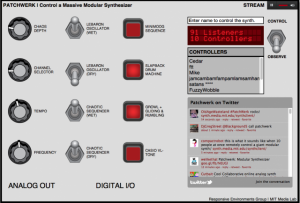
Patchwerk lets you control a massive analog synthesizer from your browser, and streams the results back to you and everyone connected. The interface on this site is linked to a physical synth cabinet connected to the world’s largest homemade modular synth, currently housed at the MIT Museum.
Turn a knob here, and Patchwerk will turn a motorized knob on the cabinet. If someone at the Museum grabs a knob, you’ll see it turn too.
The synth that you can control is the giant DIY modular synthesizer of Joe Paradiso:
Enjoy
The Paradiso Synthesizer
In 1973, Media Lab associate professor Joe Paradiso was an undergraduate at Tufts University, and didn’t know anyone who had built an analog music synthesizer, or “synth,” from scratch.
It was a time, he says, when information and parts for do-it-yourself projects were scarce, and digital synthesizer production was on the rise. But, he decided to tackle the project — without any formal training — and sought out advice from local college professors, including his now-colleague in the Media Lab, Barry Vercoe. Paradiso gathered information from manufacturers’ data sheets and hobbyist magazines he found in public libraries. He taught himself basic electronics, scrounged for parts from surplus stores and spent a decade and a half building modules and hacking consumer keyboards to create the synth, which he completed in the 1980s.
That synthesizer, probably the world’s largest with more than 125 modules (http://web.media.mit.edu/~joep/modlist.html), is now on display in the MIT Museum.
Every few weeks, Paradiso changes the complex configurations of wires connecting the synthesizer’s modules, called “patches,” to create a new sonic environment. The synthesizer streams live online 24 hours a day at http://synth.media.mit.edu; starting this week, visitors to the synthesizer’s website can even change the patch parameters online.
Learn more about Paradiso’s synthesizer! http://web.media.mit.edu/~joep/synth.html
Yusynth Modular – First Flight
Background information:
This is a quick video of the maiden voyage of my DIY modular synth.
Most of the modules are Yusynth designs, but it also includes a few Paia, CGS and Ian Fritz designs.
The patch is fairly straight foward. The two randomized sequences are generated by Reaktor (via a Paia MIDI2CV). A Kurzweil Mangler is adding a small amount of Delay.
About 2:05 you will hear the second VCO frequency modulated by an Ian Fritz Chaos module.
A big thanks to all of the DIY synth community, but especially the Yusynth designer Yves Usson. His designs are brilliant and sound unbelievably good! Hopefully this video does them justice.
Expert Sleepers ES-3 eurorack module – Silent Way system
Background data:
Here’s our first video using the super-slick Expert Sleepers Silent Way system. In this video we are using the ES-3 module with the black acrylic front panel. Lightpipe to control voltage! http://bigcitymusic.com
Using Ableton Live we called up our Silent Way LFO plugin. The LFO is synced to the master tempo of Live and we wrote in some automation on our Ableton clip., selecting 1/4, 1/8, 1/4. then 16th notes. The drum beat is from Live too.
In this demo we’re using an RME Fireface 800, ADAT output directly into the ES-3 module. The sound is the Pittsburgh Oscillator into a Division-6 Filtaire. The Silent Way LFO is controlling the filter’s cutoff frequency.
DATAMASKIN

