
Clung&Hnting – modular noodle
In this video:
A Modular Noodle, sorry for the video quality, but the sound is here 😉
Zorlon cannon sequencing, bass from Anti-OSc in tyme sefari in qmmg lopass gate and modulated from wogglebug
rythm from zorlon cannon screaming borg 1 modulated from wogglebug and tamed by a156 enveloppe duty by maths and envelator
HK
Full mix down made with the legendary Roland System 100M
As reported in the interview we did with Nitzer Ebb the Roland System 100M was their absolute favorite. Now this video was released that gives a neat overview of its capabilities.

The System 100m is Roland’s contribution to professional analog modular synthesis. It was based on the more limited, semi-modular System 100, but is several steps of ahead of its predecessor. The System 100m offers over 20 modular components to pick and choose to design a custom modular set-up. The Main unit is the M-110 which has a single VCO oscillator, VCF, and VCA section. You can then build upon this system adding any number and configurations of the various other modules which include dual VCOs, ring modulators, dual VCFs, eq, dual VCAs, dual envelopes, LFOs, various effects, mixers, sequencers, and control interfaces including 3 different keyboard controllers.
Modules are assembled into racks. The System 100m has 3 rack sizes, the M-190 holds 3 modules, the M-191 and M-191J hold 5 modules. Each rack provides the necessary 8-pin DIN power connectors and internal CV/gate connections between the modules. You still need to do some external patching, however, to send your signal through the modules of your choice to create any sounds. As for sounds, the System is basically monophonic, unless you get several racks of them for lots and lots of money! Its sound is not as warm as the System 100 before it, but it offers much more capability, as seen in Hans Zimmer’s system below!
Hans Zimmer’s massive System 100m, image and info courtesy of Kevin Lightner. “It features 58 VCOs, 37 VCFs, 32 ENVs, 12 VC Phase shifters, 9 Sequencers, 1 Remote controlled 4-space rack-mount power supply (25′ away.), and 24 Trunk lines go to his large Moog synth across the room. The unit can link the “Keyboard” inputs for all the modules, and with this feature, all VCO’s can track one input with only one patch cord. The unit was built into 6 flight cases on casters with removable front and rear covers, then later encased in wood and built into his studio. “—-Kevin Lightner
System 100’s have been used by Orbital, Hans Zimmer, Vince Clarke, Depeche Mode, Heaven 17, Freddy Fresh, Luke Vibert, Meat Beat Manifesto, Electronic Dream Planet, Jamiroquai, Human League, and Peter Howell of the BBC Radiophonic Workshop.
Analog gestural interface controlling a Bugbrand Modular
The Bugbrand Modular is an interesting synth mostly consisting of a huge number of banana jacks. Banana jacks are only used in a handful of other modular systems – notably Serge, Modcan and Fenix, plus in the control signals of Buchla. There are are certain electronic and aesthetic differences between each system, but that does not completely rule out cross-patching between systems. Differences in signal levels (and banana socket colour schemes!) should be considered and amplification / attenuation / offsetting may be necessary to achieve best results. A common ground connection must also be made between different systems – the BugBrand system has a black banana socket ground terminal on the power supply.
Read more about Bugbrand here >>

In this video:
This is a live performance by Palle Dahlstedt on a custom built instrument, using a simple pencil drawing as a gestural interface for controlling complex analog synthesis (on a Bugbrand Modular). The instrument works by creating a voltage potential field in the graphite/pencil markings on the paper using custom movable electrodes made from coins. Then, various control voltages are extracted from other points on the paper, controlling various aspects of the synthesized sound.
A big thanks to Tom Bugs for very valuable electronics advice!
The sound is recorded directly from the BugBrand Modular (with a slight reverb), and from contact mics on the pencil sharpener. There is no normal microphone, which explains the slightly awkward silence in the beginning, while I’m drawing.
Recorded at the second performance (of two), May 6th, 2011, Gothenburg, Sweden. Concert arranged by Levande Musik (www.levandemusik.org)
This work is part of the research project Creative Performance at University of Gothenburg, funded by the Swedish Research Council.
Heads up on the modular open source project – Synkie
Although uploaded a couple of days ago we thought it good to give you some heads up on this open source project:
The Synkie is a modular open source analog video processor, developed by Michael Egger, Flo Kaufmann and Max Egger.
Like the venerable modular Moog synthesizer it lets you toy around with the signal using patch cables – but this time not producing sound but images. It is an instrument for video, a playground, a platform to explore new ways to transform a video signal.

Synkie is still in development, we constantly develop new modules – and even the base specifications may still change over time. But right now there’s already enough stuff to have fun playing around and the instrument has already a complexity that gets hard to control…
Synkie’s main goal is playability not image quality, even though we try to design each module as best as we can. But patching is done with 2mm laboratory cables – not shielded 75Ohm BNC cables as one would normally use for video. No, you can even use any blank wire and tinker around with the signal in real time on the sk90-breadboard module
The laboratory plugs can be stacked, so you can easily divide the signal into multiple paths, feeding multiple modules at once and change the configuration on the fly. The resulting image can get quite messy down the road, but that’s part of the fun, or maybe even the main goal…
More information
* Synkie channel on Vimeo
* SVN Repository
* What’s the idea behind Synkie
* Blog posts tagged with Synkie
Synkie Modules
Basics
* sk00-Power Supply
* sk01-Sync Splitter – input Module: Separates sync and conditions the video signal for further use
* sk02-Resyncer – output module: Merges sync and modified video, conditions for monitors etc…
* sk04-Aux In – conditions an additional synchronized video source for use in the Synkie system
* sk05-Mux – voltage controlled Multiplexer
* sk07-Comparator – generates Black and white image with threshold
* sk08-Inverter – inverts the image
* sk09-Scalebias – shift and spread brightness
Mixing
* sk10-VCA – voltage controlled amplifier
* sk11-Adder – adds up to four signals together
* sk12-Difference – calculates difference between two signals
* sk14-Twoway Mixer – mixes two signals
* sk15-Fourway Mixer – mixes four signals
* sk16-Sixway Mixer – mixes six signals
Filters
* sk20-Bandpass – bandpass filter
* sk30-Gamma – contrast
Oscillators, Control Voltage
* sk50-LFO – triple low frequency oscillator
* sk51-Envelope Follower – audio to CV
* sk52-PLL – phase locked loop
* sk53-Pulsedelal
Misc
* sk60-Delay – line and frame delay
Amos iPad application with a modular synthesizer
“Im using the ipad app Amos, using the camera connector / m udio uno into a Encore Expressionist midi to cv converter to control 5 oscillators in my modular synth. Each oscillator is assigned a diff midi channel, each midi channel is a ball in Amos”
Kx-Modulad is an analog modular synthesizer and additive synthesis
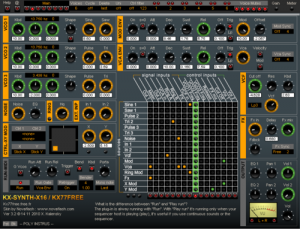
KX77FREE have released updates for the Kx-Modulad and KX-SYNTH-X16 software synthesizer plugins. Kx-Modulad is an analog modular synthesizer with stereo SF2 player and an additive synthesis WaveTracer to build high quality waveforms. 128 KX presets (70′s and 80′s). KX-SYNTH-X16 is a vintage modular polyphonic synthesizer, based on the VCS3 structure.
Changes in KX-SYNTH-X16 v3.3
* Vco1 improvement when it is synchronized by the Vco2 with the possibility to reduce the high frequencies modulations.
* Possibility to verify the Meter signal (all voices) before its ouput level and now the Meter output level is not linked with the Midi Prg Change.
* The Vca knob controls the vca level when the Mod envelop is used to modulate the vca level.
Kx-Modulad to v2.3 and KX-SYNTH-X16 for Windows (VST) are available as freeware.
Changes in Kx-Modulad v2.3
* Vco2 improvement when it is synchronized by the Vco1 with the possibility to reduce the high frequencies modulations.
* SF2 player improvement with the possibility to choice if the samples change following the pitch or not (Mod), useful for SF2 drum sets.
* Fixed: Now the probability to have audio clicks at the end of no looped sf2 samples is very low, tested with various sf2 banks.
* Fixed: The buffer size of the delays has been decreased to 5 sec to avoid a crash when the amount of the modulation is at max.
You can download both KX-Synth and Kx-Modulad Updates now from the KX77FREE web site at http://kx77free.free.fr/Engl…
Self-modulating modular analog patch
A self-modulating modular analog patch, “Howler Patch” is designed to drone and change with random patterns over a long stretch of time. In this example, I’ve fed a recording of Allen Ginsberg’s “Howl” into it, using the EH V256 vocoder to modulate the voice with the drone-synthesis from my modular patch.
This example contains no overdubs or live-tweaking of any kind. I just turned it on, started playing the “Howl” track, and walked away.
Modular Klonk Techno
A bit of a Klonky techno jam using the amazing Bugbrand system, all sounds and sequences provided by the modular, no midi or external fx. Bit of a rough mix, so sorry about that.
Sneak peak: AudioGL Pre Beta Demonstration Video – Music Software
AudoGL – Teaser video for a Modular Software Synthesizer and Sequencer
The music in this video is 100% synthesized, and does not contain any samples. The visuals are procedural as well.
General Contact: AudioGL@gmail.com
There is no website for this project as of yet
Modular beatmaking demo
Sorry about the commercial in the beginning:
Turning the modular into a drum machine, all sounds and rhythms created using just the modular, no processing, fx or midi. Sequenced using dividers and logic, no noise source used.
DATAMASKIN

