
Cool neon translucent synth and sequencer – Mochika XL
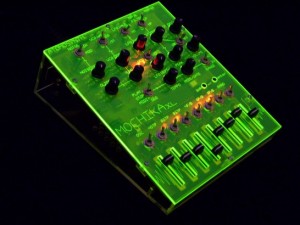
Definitely something for your next stage performance. Boutique synth maker AtomoSynth has introduced Mochika XL – a translucent sequencer + synthesizer combination.
Specifications:
- The Mochika XL synth features one analog square and saw waveform VCO (voltage controled oscillator), with a pitch range, from subsonic to ultrasonic sound.
- Glide effect with a large range.
- One square and triangle waveform LFO (low frequency oscillator), that modulates the VCO for the vibrato effect or the VCF for a tremolo effect, creating old school arcade Atari-like sounds.
- White noise generator that triggers the VCO and can create percussion like sounds, or mix the the noise with the VCO.
- Built in vactrol based Low Pass and High Pass Filter with cut off and peak controls and a envelope generator with decay control.
- Built in 8 step sequencer with global gate time control, note on/off switch and pitch slider for each step.
- The built in sequencer also has 8 playing modes:
- Oscillator mode, the Mochika becomes a drone oscillator, you can switch in real time between the 8 notes tweaking a knob.
- 4 step, 6 step, and 8 step sequencer mode.
- 4 step, 6 step, and 8 step forth and back sequence mode.
- Random mode, it generates a large pseudo random sequence.
- The Mochika XL features a MIDI input to sync it any midi device sending midi clock signals, the mochika can sync 1, 2, 4 and up to 8 times the tempo of the master clock midi device.
- All the Mochika sequencer modes, except oscillator mode, can be midi synchronized.
- The instrument is lit with 1 bright red led that indicates the LFO Rate, and 8 red leds to indicate the step that is being played.
- The Analog Sequencer is packed in a laser cut clear acrylic case.
- The instrument is powered directly from 110V or 220V AC.
- Dimensions: 177mm(W), 228 mm(D), 80mm(H. included rubber feet and knobs)
Details at the Atomolabs site.
Electronic sounds from the DS-8 Clone SPACE DRUM SYNTH Machine Synthesizer
The crown jewel of analog drum synths! Many adjustable features including:
-Piezo mic (box can be used as drum pad)
-Trigger input
-CV input
-9V Center Neg
-LOTS OF RAD SOUNDS!
-works with your drum machine
Richard Atkinson takes a look at the New England Digital Synclavier II
The first version of the Synclavier appeared in 1979 but was soon replaced by the Synclavier II with a new “partial timbre” sound editing feature (it tweaks the harmonics), built-in FM and additive synthesis, sampling, 64 voice polyphony, 32MB of waveform RAM (expandable to 768), 32 outputs, music-notation printing, multitrack sequencing, and digital hard-disk recording. In 1984 a third model was introduced and became the most infamous version of the line-up. The new features included a full sized and weighted keyboard with velocity and aftertouch which replaced the previous model’s plastic keyboard, and 128 voices polyphony. An optional DSP effects package including time compression/expansion was available for the Synclav as well. There was also a standard onboard arpeggiator and a robust sequencer with up to 200 tracks and its sampler had the ability to record and output at up to 100 khz!
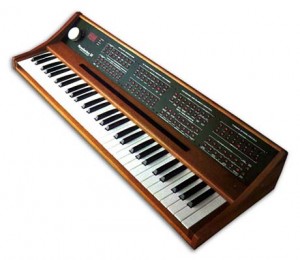
The typical Synclavier system consists of a durable 76-note keyboard peppered with 132 illuminated buttons and a single control knob, connected to a rack-mounted CPU running NED’s own 16-bit ABLE operating system plus the nostalgic mid-eighties looking mono-chromatic computer monitor/keyboard. Patches, sound files, sequences and samples are stored to 5.25″ diskette, hard disk or in some models, magneto-optical drives.
It should be noted that there are all sorts of ‘sub-revisions’ of the hardware component of the Synclav II, and these make each version capable/incapable of doing certain things. Some lower-end versions are not capable of using the ‘Timbre-frame’ timbral scanning programming method. Others are not capable of handling a MIDI retrofit. And all of these have different ‘top versions’ of the OS that they can handle, making the purchase of a used Synclav system a dicey affair. You can’t always be 100% sure of which variation you’re buying without some extreme care being paid to which hardware it has and what versions of the OS it’s capable of running. You could therefore be buying anything from a high-end sampling/sequencing workstation unit to a rather complex 12-op FM/additive synth, and several possibilities in between.
From its specs alone it can be seen that the Synclavier is a masterpiece digital sampler / synthesizer workstation which was the first of its kind, and way ahead of its time. They command prices well into the thousands ($25,000 to $200,000) and are only used by those who can afford such. New Synclavier systems (including new hardware, software, and Mac OS X emulations of the Synclavier operating system) service, and support are currently available through DEMAS, the company created after the fall of New England Digital in 1992.
Synclaviers have been used by The Cure, New Order, George Duke, Pat Metheny, Sting, Stevie Wonder, Paul Simon, Foreigner, Michael Jackson, Pink Floyd, Kraftwerk, Depeche Mode, Genesis, Kim Wilde, The Cars, Soft Cell, Geoff Downes, Frank Zappa, and film composer Alan Silvestri.
The nice NLog synth goes Poly
Above is a capture of the current version and as can be seen in the text below we will soon be treated with a Poly update. TempoRubato has announced the forthcoming release of NLogPoly Synth for Mac OSX. Availability in Mac App Store is scheduled for Saturday, May 21st. Here’s their press release with the details…
With the release of NLogPoly Synth for Mac OSX including an Audio Unit version TempoRubato’s virtual analogue synth technology – currently known from the iPad app NLogSynth PRO – is now available across both Apple’s major platforms: Mac OSX and iOS.
Musicians, composers and producers now have a synth platform which allows them freely to move between mobile devices and their studio environment without any loss of quality. You can easily share all your patches made on iPad with NLogSynth PRO with NLogPoly Synth on Mac and vice versa.
NLogSynth has started on iOS devices recreating professional virtual analogue synthesis freshly from scratch to unveil the power of their specific hardware architecture. Based on 32 bit floating point processing NLogSynth utilizes advanced signal processing optimizations of Apple’s A4 & A5 CPUs. After successfully running this new architectural approach for two years, we are now proud to provide the same algorithms on Mac’s Intel architectures.
Thus, TempoRubato’s NLogPoly Synth is bridging the gap between mobility and the studio.
NLogPoly Synth for Mac comes in currently two parts: A standalone app and an Audio Unit plug-in both supporting 32- & 64-bit environments. Depending on market response a VST version for Mac will be added later this year.
The standalone app is a multi-timbral engine providing the power of 8 polyphonic virtual analogue synths. Each with 4 OSC, 2 Filter, 4 LFOs, 4 Envelopes, Modulation Matrix and an individual Effect Rack with Reverb, 4 Band Parametric EQ, Chorus, Phaser, Flanger, Stereo Delay and Distortion. All 8 synths can be assigned to individual MIDI channels. With assigning them to the same MIDI channel NLogPoly Synth provides a polyphonic multi-layered synth with up to 8 layers.
The Audio Unit version is running in as many instances your hardware allows within your DAW. It provides the full set of more than 200 parameters of the NLogSynth engine for automation or remote control by external hardware controller. NLogPoly Synth for Audio Unit has been tested with the recent versions of major hosts like Apple’s Logic Studio, GarageBand, MainStage, Ableton’s Live, Native Instruments’ Maschine or Renoise.
TempoRubato is a synthesizer ‘microbrewery’ located in Frankfurt, Germany founded by Rolf Wöhrmann. We believe in the good life and doing things at work we really like to do for the pleasure, creativity and joy of our users.
Pricing and Availability:
NLogPoly Synth can be downloaded from the Mac App Store as a standalone application for 19.99 EUR / 24.99 USD. Owners of the standalone app can further download the Audio Unit plug-in as a free extension in parallel with the standalone app release starting on May 21st.
More information:
Exploring the Casio PT-82
Here’s a bit of a background on the PT-82. This keyboard from 1986 has many similarities with the Casio VL-Tone 1 and PT-1, but includes a “melody guide” key lighting feature for music teaching (not the keys itself light up but a row of small LEDs above them) and a ROM- Pack music cartridge slot. Unfortunately this instrument is missing the great built-in synthesizer, sequencer and 3 octave switch of the VL-Tone.
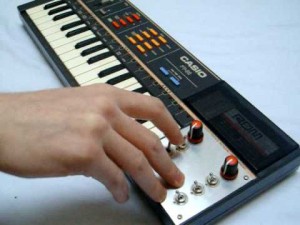
Although the music playback from the ROM- Pack includes wonderful polyphonic accompaniments, the player can play own musics only monophonic with thin and dull sounding blip rhythms. A bit unusual is that this white keyboard has brightly coloured orange and red buttons and red lines while Casio normally preferred pastel colours. Also a red case version of the PT-82 was made. In 1987 it was re-released in grey as Casio PT-87.
The PT-82 was likely intended as a technically simplified successor of the Casio PT-80. The speaker has an unpleasant, loud mid- range resonance. The main voice sounds are the same like with the PT-80, but tend to sound a little thinner and harsher. These sounds resemble much a Casio VL-Tone 1; unfortunately they don’t include the famous “fantasy” sound of the latter.
In this video:
This was my first ever instrument when i was 4 years old. I was wating too long to make something with this! So this is a music track from this and only with this. It has an exeptional meaning for me…
Reverb, delay,some chorus and an octaver for the organ bass. All sounds are presets of the PT-82. No other instrument is responsible for this track.
Workstation for Android powered devices – Caustic Music Rack

Single Cell Software has announced Caustic Music Rack, a synth workstation/virtual studio, inspired by Propellerhead Reason.

Features:
- 1x Virtual analog subsynth
- 2x PCM synths (23 demo samples included)
- 2x 303-like BassLine synths
- 1x Sampling drum machine (9 demo kits included)
- 1x Mixer desk with Delay/Reverb and 4 insert effects
- 1x Song sequencer
The current version is free; a commercial version is in the works.
Toro Mini Synth with 90 Instruments
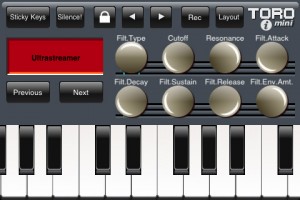
TORO mini synthesizer; with a 4-octave keyboard is one of the most innovative keyboards around making the synth truly playable. Record your masterpieces, export them through your computer web browser and include them to your DAW projects. Each instrument patch can be radically manipulated by the eight knobs controllers. For rhythmic instruments for example, the pattern of the rhythm can be altered. For other instruments filters, the LFO and the oscillator waves can be adjusted in real time.
Features:
– Over 90 adjustable instruments patches including electric pianos, 80’s synths, game music instruments, heavy industrial synths and loads of sound effects
– 5 oscillator waves
– 5 voices polyphony
– Low- and hi-pass filters
– LFO and Mod parameters
– Real-time parameter adjustment making it a joy to bend filters, the LFO and other values
– One of the most innovative 4-octave keyboards around: resizable, scrollable, slideable and with the Sticky Keys feature
– Recording Console: Record to wav, listen to recordings and export the files through computer web browser
– Built-in user manual
– Exchangeable skins
Get Toro Mini for just 99 cents on iTunes now at http://itunes.apple.com/us/a…
Audiolung Bruno-6 Sampled Synthesizer Demo
On-the-fly demo of the Audioung Bruno-6 Sample-based Synthesizer. More at audiolung.blogspot.com
This sample-based synth for NI Kontakt (player or full version) uses lossless .WAV samples taken from a vintage analog synthesizer of a similar name (the Roland Juno-6) and uses them as it’s oscillators. Very flexible, from sensible to crazy sounds, some of which you’ll hear in this demo.
Pac Man Joystick synthesizer
Description below:
This is (was) one of those old video game reproductions that you plug straight into a TV. I gutted it out after deciding I have enough versions of Pac Man to play with, (super pac man really sucks!) And built my own synth! It’s another 40106 based synth using four of the six schmitt triggers for main oscillators and one for the Lfo. It has a light sensor for one of the main voices and a “rate” knob for the Lfo speed. I was able to make it run on the original set up of four AA batteries in the compartment underneath and as you can see the blue knob that I use for wintergreen altoidsalmost matches perfectly. It has a 1/4 inch out to plug into any amp or mixer and i used the menu light for power. the menu button works to change the LFO into a swooping triangle instead of a square wave and the red trigger button makes the sound come out.
Voice of Saturn Synth II Prototype
I’ve implemented 3 of the possible 6 oscillators on this one (though the old sequencer case I used will hold 5). The circuit is based around a schmitt trigger oscillator. Super simple, and easy to make a lot of them. Sorry for the horrible video quality. Just finished it and wanted to get a quick demo done. Hopefully circuitboards will be tested and available sometime this summer. I will likely do a Kickstarter campaign to fund the first run. Keep an eye out!
Check out the official blog for updates on the Voice of Satrun II at http://voiceofsaturn.blogspo…
DATAMASKIN

