
100 mechanical sounds – free download
ToneScape – Small mechanics Demo by ToneScape
Morten Berthelsen has shared Small Mechanics, a free sample pack featuring 100 mechanical sounds recorded from various hardware and machines:
Small mechanics is my next free samplepack containing 100 mechanical samples. This pack was recorded with a Zoom H1 handheld recorder and contains 50 samples of switches and buttons from all sorts of appliances, tools and instruments and 50 electrical motors from kitchen appliances, cameras and a wheelchair, believe it or not. 
I hope you enjoy my work and that you put it to good use. If you use any of my samples in your productions, I’d love to hear it. Send a link to Music@ToneScape.de or post it on my page.
Get the pack at the Tonescape site.
Technos Acxel gets sequenced by the Elektron Octatrack
The Technos Acxel may look similar in operation to a sampler, although its workings were very different and the sound structure is accessible. Where samplers used an A/D converter to convert a continuously-variable analogue signal into digital data, the Axcel worked on the premise that any sound, no matter how harmonically complex, could be broken down into a finite number of sine waves, and that these sine waves could be individually altered to fundamentally change the sound, producing what Technos founder Nil Parent termed re-synthèse. The Acxel was invented by Pierre Guilmette, the operational design was Nil Parent realization, the system was developed at Technos, company own and directed by Pierre Guilmette, Nil Parent and other partners.
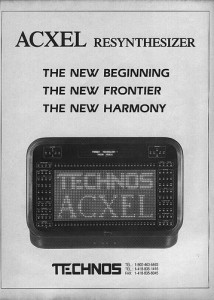
Utilising a FFT (Fast Fourier Transform) analysis, sounds inputted into the Acxel were broken down into a number of variable-amplitude and variable-frequency sine waves, up to a maximum of 1024. Once sounds had been processed by the Acxel, all the constituent waves could be pitched up or down by the same factor, which had the effect of increasing the pitch of the sound without affecting length, or introducing any of the digital artefacts that traditional samplers did (for example, pitching all waves up by a factor of 2 would raise the overall pitch of the sound by 1 octave, without affecting length. Using a traditional sampler, pitching a sound up by 1 octave would result in it being halved in length).
The Acxel also had the capability to synthesise sounds from scratch. The same 1024 sine oscillators, that in fact can be of various waveforms including of draw-able shape, which were used to resynthesize sounds could also be used for additive synthesis. You can either take Analyzed sounds and modify them. A large palette of parameters and controls is accessible, on the same manner if you start from scratch or from analysis, and in Real Time:
Features:
o Draw waveforms directly onto its LED matrix display with finger-tip (a feature once offered by the Fairlight CMI almost 10 years previously, albeit using a video monitor and light-pen).
o Draw dual Spectrum type shapes for Amplitudes, Frequencies (with separate: Integer / Decimal parts, and Envelope Variation), Phases – Corresponding to each parameter the base spectrum and the MIDI control spectrum.
o Draw dual Envelopes to each Oscillator Parameter: Amplitude, Frequency – Corresponding to base envelopes and MIDI control envelopes, independent on each oscillator.
o Draw dual Envelopes to each voice parameter: Volume, FM, Color, LFO1, LFO2 – Corresponding to base envelopes and MIDI control envelopes. Draw waveforms for LFOs.
o You can also apply a digital type of filtering named COLOR filter. With center frequency envelope. The frequency is expressed as harmonic number, then you apply the filtering on the same manner at 100 Hz or 2000 Hz or 5000 Hz. With possible selection of harmonic numbers to be filtered or not (example to keep fundamental). With drawn envelope and filter shape (Low pass, High pass, Band, User-drawn response curve – for example Comb type shape)
o FM (Frequency Modulation) envelopes is also accessible and applied on the created sound structure (or analyzed).
o Other controls and editing: Timbre interpolation, Time stretch / expansion, extended MIDI controls (programmable control curves), muting elements, chorus.
In this video:
Technos Acxel gets sequenced by the Elektron Octatrack, lfos controls different arpeggiator settings. the sound from the Acxel gets routed back into the Octatrack for some effects mangling.
A short film about the artistic creation
The video is called Mirrored and created by The sons of Stan Brakhage
Effective drum processing in Pro Tools
Rupert Brown from The DSP Project discusses with freelance sound engineer Mike Hiller about drum processing in Pro Tools:
Mike Hillier is THE Pro Tools guy for MusicTech magazine so I was thrilled when he agreed to show us how he approaches mixing down a real drum kit. While he is using Pro Tools most of the mixing techniques can be used in any DAW.
thedspproject.com/drum-processing-in-pro-tools-pt1 for comments and more info on Mike.
Going modular percussions with the Intellijel Corgasmatron
This is a 2-part video demonstration of the Intellijel Corgasmatron eurorack VCF, using it’s screaming resonant filters for percussive / subbass / metallic mayhem. No audio signals (VCOs / noise) are being passed through the VCF – what you hear is coming strictly via the Corgasmatron’s self-oscillating filters.
All of the sequencing is done via a Make Noise setup — Brains, 2x Pressure Points, and clocked by a MATHS.
In the first part, only the LPF is used. It’s being modulated by an MFB ADSR, and the Make Noise B+PP. The MATHS is being used as a slew/portamento occasionally.
In the 2nd part, Make Noise B+PP is also sequencing a Jomox MBase01 kick, and a Snare part created with MS-20 white noise into a YuSynth Arp VCF. The Cogasmatron’s signal path is set up just like an MS20 – HPF into LPF in series. HPF is being modulated by PP+B (FM2), + a Tip Top Audio z3000 mk2 VCO (FM1). I used the z3000’s sine wave out (I think). The z3000 is also being sequenced by the PP+b. LPF is being modulated by MFB ADSR (FM2), and PP+B (FM1).
Key features:
-16HP and shallow (two pcbs in parallel so it is skiff friendly)
-two independent filters, each with LP, HP and Notch modes.
-Unique resonant (Q) drive control
-A Switch links the two filters allowing both parallel and serial routing via normals to input B (which can be broken by inserting a cable at input B).
-Oscillates very easily and can be used as a dual sine VCO. Using the resonant controls this Sine shape can be colored.
-1V/Oct inputs
-Built in full featured cross fader allows voltage controlled xfading between the two filters. The Xfade has a switch to select either unipolar (e.g. envelopes) or bipolar (e.g. lfo) control of the xfade position. There is also a switch to select direction. With nothing plugged into the Xfade jack the xfade knob controls the fade position. When an external CV is patched in the same knob acts as an attenuator for the control signal.
-Jumpers on the back to select “modern” or “vintage” resonant modes (two different feedback paths for the resonance that use different diodes)
-expansion jacks for adding additional filter inputs and VC control of resonance
Theremin for the Classics
Schubert played on the theremin:
Some of my online theremin friends didn’t want me to record this theremin transcription of Franz Schubert’s SERENADE. They said it was too schlocky and romantic and that I shouldn’t waste my time on it! Nevertheless, it remains one of the most popular and recognizable melodies from one of my favorite composers. This arrangement is for theremin and Haken continuum (accompanied by the Korg TRITON EXTREME). The continuum is playing the delicate recorder/flageolet sound that follows the theremin. Although I think my brain could have played all three instruments at once, I just don’t have enough arms and hands, so I prepared the track and played the theremin live.
In the summertime, I often use my barn for music. The barn was built in the 1860’s during the American civil war and no nails were used in its construction. It is made entirely of hardwoods and held together with expertly fitted joints and wooden spikes. When you play music in it, the whole building vibrates like the soundbox of a giant bass or cello. Unfortunately it isn’t very well insulated and it isn’t heated so it is useless for music in the winter. But it’s great in the summer!
According to music historians the Austrian composer Franz Schubert (1797 – 1828) wrote this composition in the summer of 1826 in a beer hall, jotting the notes down on the back of a menu. He had apparently stopped in to the place to have a couple of pints and cool off.
The theremin in the video is a Moog Ethervox. The Haken continuum is a continuous controller which, unlike the theremin, does not have a sound of its own. It can sound like just about anything you want and, like the theremin, can elegantly slide from one end of its range to the other in a seamless “gliss”. It is also polyphonic and has 16 voices (the theremin is monophonic with only one voice).
I was going to call this piece, “Schubert & the theremin & the continuum go to Bollywood” because I am used to wearing Indian clothes when the weather is particularly hot (as it was today when I recorded this). Natural air conditioning
▌▌▌▌▌▌▌▌▌ BURNING PIPES @ Selector Festival ’11
(- HEADPHONES RECOMMENDED -) !
▌▌▌▌▌▌▌▌▌ BURNING PIPES – The Pneumatic Orchestra
Kinetic audiovisual installation for burn
displayed during burn Selector Festival 2011
Movement of the cans is controlled by 9 independent servos connected to the Arduino board while the sound is purely analogue – air pumped by 9 ordinary mattress pumps blows into the “whistles” at the top of plexiglass pipes. Tone is modulated by the current position of the can.
R2D2 learns the beat
This robot is doing a pretty good job 
My fellow lab mate, Tatsuhiko Itohara, created a program for HRP-2 to follow his hand while playing the guitar. By watching and listening to the beat, HRP-2 can sync to the sound of an acoustic guitar! What a great job he’s done!
Song: Auralee
Late night abstract acid modular jam
“Late night abstract acid modular jam using the MakeNoise rene, brains, and 4 pressure points. Everything clocked to 1 plan-B mini ELF lfo. Trying to make squelchy acid bass lines with the WMD Gamma Wave Source – Dual WaveTable VCO.”
Note: the audio was recorded into my ZoomH4n, no computers or drum machines used here.
Video demonstration of the SoundPrism 2.o
An introduction to SoundPrism 2.0
Available now! http://soundprism.com/
Features
* connects to your favorite DAW or hardware synth
* … via WiFi (iPhone, iPod touch or iPad) or USB (iPad only)
* allows individual control of multiple instruments at the same time
* support for non-diatonic scales (iPad only)
* turns your iOS device into a wireless 3D MIDI controller
What can you do with it?
* Create harmonies easily in any key
* Build loops graphically
* Compose effortlessly
* Experience new ways to control your Synth’s parameters while playing!
* Check out our interactive manual to find out more!
DATAMASKIN

