
All you can eat synths – live studio performance by Bruno Ender Lee
VELVET VOYAGE – “Music Of The Spheres” – Performed live by Bruno Ender Lee, July 10. 2011
ARP Odyssey (& Doepfer MAQ-Sequencer), MacBeth M5N (Bass), Synthesizers.com Studio-88 (Leads & FX), Moog Little Phatty & Absynth 4 (Leads), Roland Juno-60 (Wind-FX), Roland D-70 & Korg MS2000 (Pads), Moog Etherwave Theremin
New patch for the ImpOSCar synth – Big Bang Theory
ImpOSCar is a new softsynth from Gforce for which i had the privilege to contribute around 50 patches to its preset library.
This is a demosong where all the sounds were made with ImpOSCar including the drums.
Felix Marc – The Muse (Official Video)
The music video was shot at the red dot design museum in Essen, Germany, one of the most important industrial monuments of the 20th century. In December 2001 it has been declared a world cultural heritage site by the UNESCO. The museum displays the world’s largest exhibition of contemporary design. Felix Marc was the first artist to ever shoot a music video in this location.
Lots of eye candy in it as well 
Written and produced by Felix Marc.
Taken from the album „Parallel Worlds”, released on June 10th, 2011.
Released & Marketed by Infacted Recordings
(P)&(C) 2011 Infacted Recordings | http://www.infacted-recordings.com
Licensing and requests: info@infacted-recordings.com
Featuring the Roland MKS 30 + PG 200
Short track with the Roland MKS 30 Planet S. All sounds made with the MKS 30. Multitrack recording + external FX.
The MKS-30 Planet S is commonly referred to as a rackmount JX-3P, although it really shares its heritage with the GR-700 guitar synth. The MKS-30 has several advantages over the JX-3P, including simultaneous use of the PG-200 programmer and MIDI, a cartridge slot for storing an additional 64 patches, and velocity response.
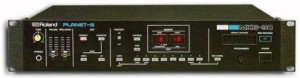
The voice architecure is identical to the JX-3P. The two digitally clocked oscillators use a master clock which is divided by an even integer to achieve the desired pitch. This method never allows the oscillators to produce a pure pitch across the entire range, and is probably accountable for the MKS-30’s somewhat cold sound. The two oscs can be synced together or cross modulated using the METAL setting. I’m not sure what actual process is used, but it definitely sounds metallic. The filter module is the same one featured in the Juno 106, and has both a resonant low pass filter and a variable nonresonant high pass filter. Only one shared envelope is available for VCA and VCF. The LFO provides sine, square, and sample and hold waveforms, and has variable rate and delay.
The PG-200 is the dedicated programmer interface for the MKS-30, JX-3P, and GR-700. The programmer communicates with and is powered by the synth via a 6 pin DIN cable. The PG-200 provides knobs and switches for all parameters such as DCO, VCA, VCF, envelope, and LFO. Unlike the JX-3P, the programmer and MIDI can be used simultaneously with the MKS-30.
Enabling efficient knob recording
This short video shows how to record knob positions for playback, aka controller automation.
This new feature lets you add much more character to your songs by changing values over the length of the track. You can accomplish classic things like filter sweeps and volume fades. Any automation will be saved into your file and exported into output files.
Editing modes in REAKTOR’s Massive
Part 2 of Bluewater VST’s Massive Essentials puts you in the driver’s seat with Edit Modes, the basis of total drum-computer domination…
Let’s dig in with Massive’s Control Section, starting with the Edit Modes at the left of the panel. The chooser offers four distinct ways of editing the sequencer and modulation patterns that make and sculpt Massive’s sound.
- Copy – Click and drag your cursor (from left to right) across the modulation/sequencer lane that contains the pattern you want to copy. Notice that the edit buffer top right will follow your mouse movements, recording all of the step/velocity data you cover.
- Paste – Enable Paste after you have copied your desired pattern to the edit buffer. Now click and drag your cursor across the destination lane (where you want to place the pattern).
- Remote – Use Remote mode when you want to use your computer or MIDI keyboard to copy and paste patterns (Remote mode activates separate copy and paste buttons to the right of the chooser). Hold down the key—[C] to copy and [V] to paste—while moving your cursor across the sequencer/modulation lane. If you are using a MIDI keyboard, key 52 enables the copy function and 53 enables the paste function.
Lock –When you want to make subtle changes to a particular step in a sequencer or modulation track, activating Lock will keep your cursor from straying into the lanes on either side. Because very small changes in step velocity often result in large changes to the resulting sound (especially if velocity is set to modulate sample pitch), this is a surprisingly useful feature.
First peek at the Fairlight CMI-30A
First peek at the CMI-30A. Peter Vogel presents a first look at the 30th Anniversary edition of the classic Fairlight sampler.
The Fairlight CMI-30A features the retro look of the original, but offers current technology to more much more power than was possible in the 80’s.
See the links below for more information.
Pricing and Availability
The Fairlight CMI-30A is priced at A$20,000 (Australian dollars) plus GST if delivered within Australia. A 50% deposit is required as part of the agreement. Deliver is expected to be within 90 days.
Links:
KORG iMS20 meets Cyclus 3
Korg iMS20 is controlled by a Spectral Audio Cyclus 3 sequencer, all 7 channels of the iMS20 are used, the Elektron TM1 interface connects the two.
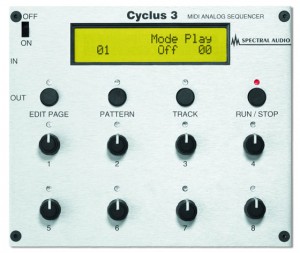
Cyclus 3 is a hardware MIDI sequencer combining both analog and digital style sequencing. It gives you old-school analog-style sequencing for your MIDI gear (no CV/Gate unfortunately). It offers 112 patterns with each 8 tracks. Patterns can be arranged into as many as 30 songs, each with 80 steps of pattern change and 1 to 32 loops and TRACK ON/OFF change. Each song can be named (8 characters). Each of the 8 tracks has 5 subtracks: note (pitch), xtranote, step length, note off time, velocity, ctrl value, ctrl length, ctrl glide on/off (you have to choose between xtranote or one of the controller subtracks). The ctrl tracks can also transmit pitch bend. A Last step (Loop point) can be set separately for each of the subtracks for creating ever-changing complex tracks. All tracks can loop independently, they don’t have to be equal in length. One track can even modulate the basic pitch of another track. Tempo is stored with each pattern.
Create new tracks for an external MIDI-device, in real or step time or by tweaking the Cyclus knobs (analog style). After a real time recording, it analyzes the note and controller data, and creates analogue style tracks from them, which then can be totally tweaked – analog style, even when the Cyclus is running. Create songs step by step, or start the Cyclus in rec mode, and change patterns in real time. There’s plenty of memory for all patterns/songs (will never write “out of memory”). The Cyclus 3 is very accurate due to its interrupt based sequencing machine. It also transmits/receives MIDI-clock. RAM Dump allows storage of your songs onto a PC and the possibility to import data from other sequencers and firmware updates over MIDI is possible. It can be used as a dektop module or rack-mounted with optional rack-ears.
VMeter MIDI Controller Touch Strip & Display
Control music software with touch and pressure. Also general purpose touch input and LED Meter output. Open source computer software and USB HID interface. VMeter™ (beta) is a USB MIDI touch strip controller & display. Touch location, on/off state and pressure can all be routed to MIDI controllers. The lights can also be controlled by MIDI messages.
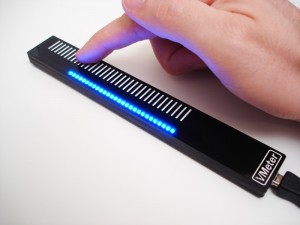
The protocol and computer-side software is open, so it can be re-purposed as any general I/O device you would like. It follows USB HID protocol (like a mouse or keyboard), making the VMeter usable by any USB host controller, even a host shield for arduino.
Features:
Control any music software that accepts MIDI controller messages
Textured touch strip guides finger
Compatible with OS X 10.3+, Windows coming soon
Connects via USB cable
8 inner capacitive sensors mappable for quasi-multi touch
Dimmable blue LEDs (brightness mappable)
USB HID protocol makes it accessible as general purpose I/O device
Upside-down mode reverses LED direction for mounting flexibility
Open-source computer-side software
Can control / display system volume. Nice for full screen video volume adjustments.
Lights mappable to MIDI controllers
Pulsator – analog synths, sequencers & drum machines
Music composition based around old skool sequencing programming combined with some edgy synth sounds. Featuring Jomox Xbase09 drums, SH101 & Pro-one sequences, Juno & JP8 arpeggiators, JP6 lead, Prodigy bassnotes, plus other bits & pieces.
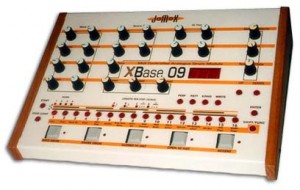
The XBase-09 is serious about emulating the Roland TR-909. Like the 909, it is an analog drum machine, and it sounds just like the 909, and more! It offers the same types of analog controls that the TR-808 and TR-909 did such as tuning, level, decay, snap, etc. However it provides more of these controls for more sounds than the originals ever did and has MIDI implementation and Patch memory making the XBase-09 a much more versatile machine than those originals.
Kick and snare are true analog, not emulation and not sampled. The Hihats, cymbal, ride, rimshot, claps and noise sounds are samples but are still quite tweakable. All your edited sounds can be stored into the 100 patches of memory. Use the built-in LFOs to modulate the Bass drum pitch, Snare Tune, Snare Snap, Snare Noise Tune, HiHat Tune or LFO 2.
The XBase-09’s built-in sequencer is also more advanced yet faithful to the style of its mentors. Step or Real-Time programming just like it’s done on the 909 and 808! However, on the XBase, any edits to the sounds will also be stored with the pattern or song! This really liven’s up your beats and allows you freedom and control to do things not easily possible on the original beat boxes! There’s also an extensive Shuffle mode. Of course the XBase-09 is also happy as a simple drum tone module, with all editable controls accessible using MIDI. The controls also send MIDI data when tweaked so you can record real-time edits into your external sequencer.
DATAMASKIN

