
New single with Daniel Savio – Screen to Screen
Daniel explains the composition in detail (in swedish).
A new synth from Teenage Engineering ? The PO-12
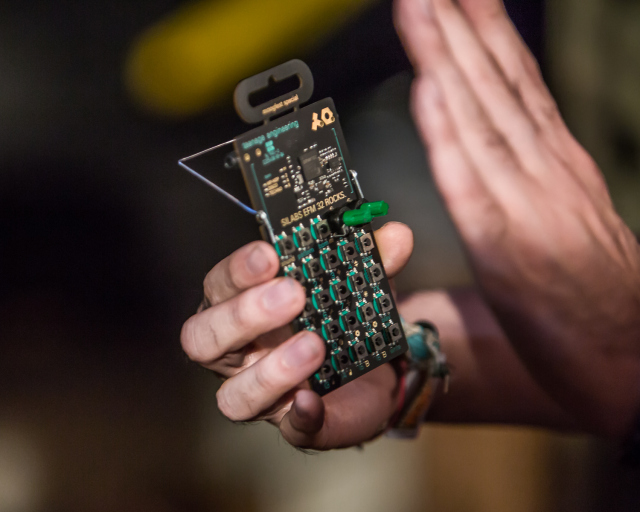
Robert Pluma has shared some interesting photos from last week’s Moogfest, including some shots of what appears to be a new Teenage Engineering synth, the PO-12.
“I wasn’t taking notes so I would suggest confirming details with TE, but from what I recall it … has a spring-loaded stand which doubles as a pitch bender when pressure is applied, includes 23 switches and two knobs (not sure if they’re rotary encoders or potentiometers), and has a built-in hang tab for retail display.”
Additional details:
- Teenage Engineering had intended to give these away at Moogfest, but all but the one seen in the photos were delayed by customs
- Integrated hang-tag says ‘moogfest special’ on this unit, and presumably on giveaway units
- Employs a Silicon Labs EFM32 [32-bit ARM microcontroller]
- Labels on tactile switches: ‘sound’, ‘pattern’, ‘bpm’, numbers ’1-16′, ‘clear’, ‘FX’, ‘play’, ‘write’
- Labels on knobs: ‘A’, ‘B’
- Other labeling on board: ‘HIP-HOP’, ‘DISCO’, ‘TECHNO’ (looks like they’re selectable options next to tiny surface-mount LEDs)
- Appears to have a bpm LED
- Has 1/8″ input/output jacks
- Not sure of exact dimensions, but appears to be the same size as the area to the left of the screen on the OP-1
- Retail price will be (I think they said) $49 US
- Uncertain of this [detail], but I think it was an initial run of 200 for Moogfest
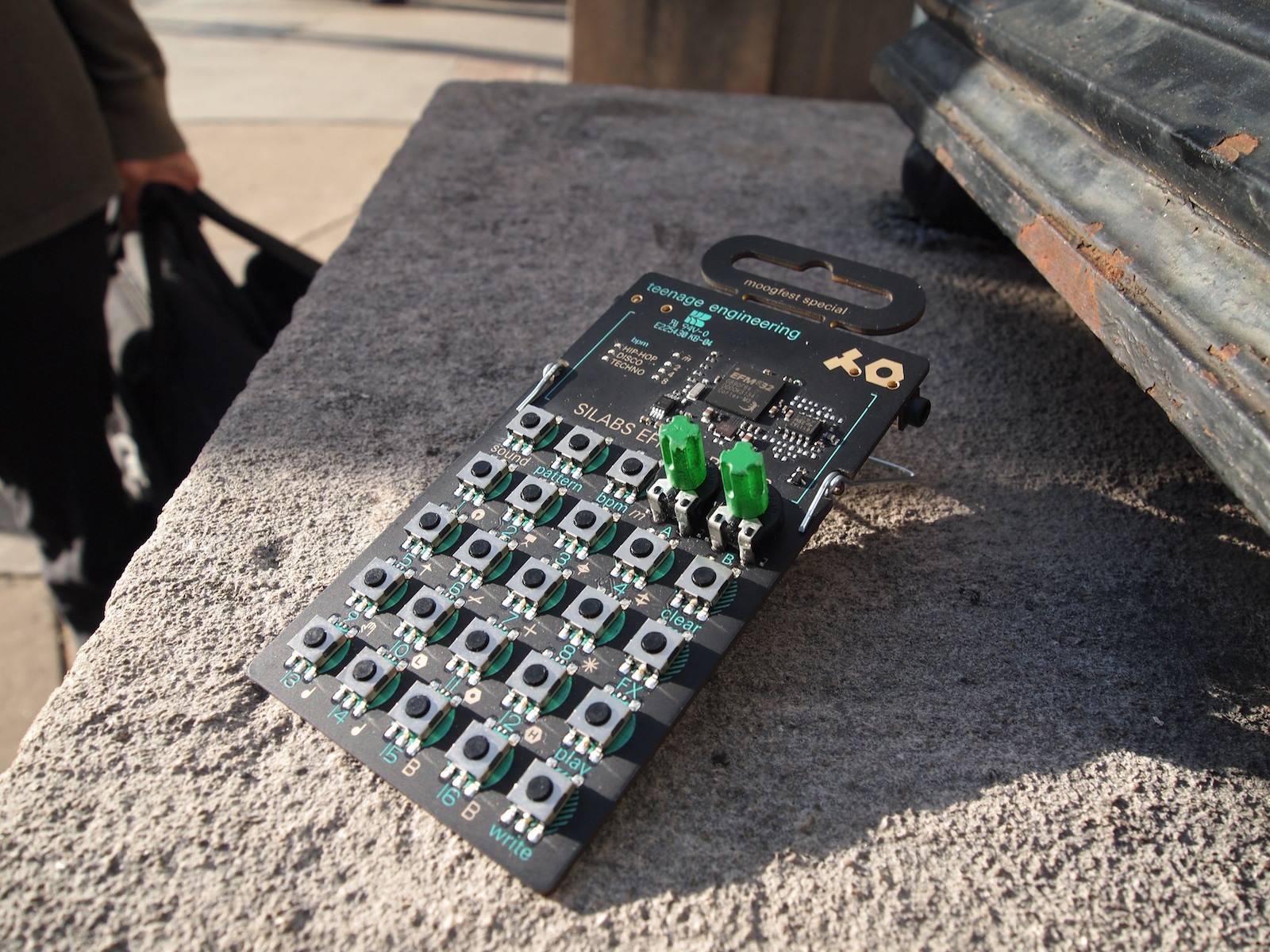
Response from the TE team:
“Robert more or less nailed it regarding the details for this product, but we’re not going to confirm or deny anything at this point. The image at CDM is official… We’re looking forward to keeping you in the loop as the project takes shape.”
Via Robert Pluma
DIY: Synthesizer by Thomas Strauß
Homemade analog synthesizer, partly built with minimoog model d circuits. VCF circuit here http://www.diodenfilter.de, which produced the synthi sounds (and drumbox V1.0).
Selbstgebauter analoger Syntheiszer, teilweise aus Minimoog Modell D – Schaltungen aufgebaut. VCF-Schaltung hierhttp://www.diodenfilter.de, welches die Synthie-Klänge produzierte (und Drumbox V1.0).
DlayR – new pattern controlled delay effect plug-in from Tek’it
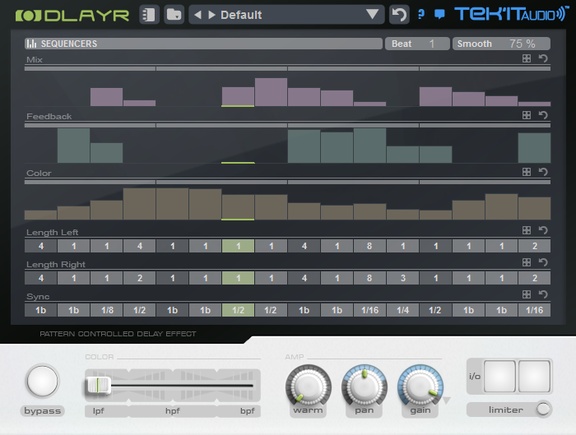
Tek’it Audio has announced the release of DlayR, a pattern controlled delay effect plug-in.
DlayR can be used to create delay, stutter and filter effects sync on the beat of your track. Control six parameters on 16 step sequencers, feedback, color, mix, delay length R/L and time.
Mix 3 filter types to color your effect, use the tube saturation and the soft limiter to give it more character.
DlayR features
- 16 steps pattern controlled delay.
- 6 sequence-able parameters, Mix, Feedback, Color, Length L/R and Sync division.
- Sync on the beat of your DAW with selectable speed.
- 3 mixable filter types to color your effect, low-pass, high-pass and band-pass.
- Amp tube saturation and soft limiter.
- Panoramic and output gain controls.
- Randomize and Undo on each sequencer.
- Full MIDI automation support.
- Easy MIDI learn on all parameters.
- Integrated Preset manager, rename, copy, save, load…
- 90 Factory presets.
- Up to 128 user presets per bank.
- Easy installer.
The plug-in is available for Windows (VST) for 29 EUR / $39 USD.
Robotic Drum Set and Analog Bass
This is drum & bass piece performed live using an automated drum kit and other percussion, playing together with a selection of vintage and new analog synthesizers.
All the sound is being generated in real time, the analog synths coming through the main rack mixer and the robotic percussion being recorded by microphones.
List of the main gear used :
Modulars : Roland System 100m (sub bass), Roland System 700 (basses), Doepfer system (stabs and atmospheric sound).
Other Synths : Yamaha CS-10 (more basses), Studio Electronics Omega 8 (chords and atmospheric sound), Korg Monotron Duo (more basses).
If you would like to download the audio file, you can do so at kxnz.bandcamp.com where you can find it in high-quality formats on a pay-what-you-like basis. All proceeds will go towards supporting a trip to London to present a paper about musical robotics at NIME 2014.
Sinevibes has updated its Cluster,Hexonator, Multitude and Octagon Audio Unit plugins
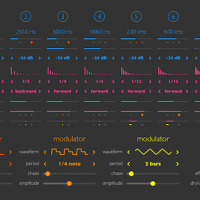
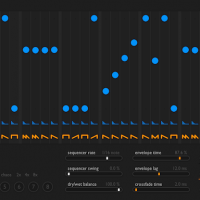
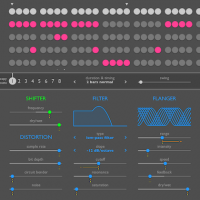
Sinevibes has updated its Cluster,Hexonator, Multitude and Octagon Audio Unit plugins for OS X.
Changes in Multitude v1.0.7:
- Multiple minor user interface enhancements.
- Improved user interface responsiveness.
- Fixed transport sync for hosts that hibernate plugins.
- Fixed validation issue on OS X 10.6.8.
Changes in Octagon 1.0.1:
- Command-click can now be used to reset sliders to default values.
- Fixes and enhancements in the plugin’s parameter interface.
- Fixed transport sync for hosts that hibernate plugins.
- New presets.
Changes in Hexonator 1.0.2:
- Command-click can now be used to reset sliders to default values.
- New presets.
Changes in Cluster 1.1.2:
- Fixed validation issue on OS X 10.6.8.
iVCS 3 for iPad a Demo and Tour Around This Amazing App
A Tour and Demo of this amazing simulation of the classic synth from EMS, the VCS 3.
https://itunes.apple.com/nz/app/ivcs3…
The VCS3 was created in 1969 by Peter Zinovieff’s EMS company. The electronics were largely designed by David Cockerell and the machine’s distinctive visual appearance was the work of electronic composer Tristram Cary. The VCS3 was more or less the first portable commercially available synthesizer—portable in the sense that the VCS 3 was housed entirely in a small, wooden case.
The VCS3 was quite popular among progressive rock bands and was used on recordings by The Alan Parsons Project, Jean Michel Jarre, Hawkwind, Brian Eno (with Roxy Music), King Crimson, The Who, Gong, and Pink Floyd, among many others. Well-known examples of its use are on The Who track “Won’t Get Fooled Again” (as an external sound processor, in this case with Pete Townshend running the signal of a Lowrey Organ through the VCS3’s filter and low frequency oscillators) on Who’s Next. Pink Floyd’s “On the Run” (from The Dark Side of the Moon) made use of its oscillators, filter and noise generator, as well as the sequencer. Their song Welcome to the Machine also used the VCS3. The bassy throb at the beginning of the recording formed the foundation of the song, with the other parts being recorded in response. The VCS3 was also a staple at the BBC’s Radiophonic Workshop, and was a regular (and most frightening) sound generator for the Dr Who TV series. Many fo the monsters and atmoshere;s created for the show came directly from the VCS3.
Description
The VCS3 has three oscillators (in reality, the first 2 oscillators are normal oscillators and the 3rd an LFO or Low Frequency Oscillator), a noise generator, two input amplifiers, a ring modulator, a 18dB/octave (pre-1974) or 24dB/octave (after 1974) voltage controlled low pass filter (VCF), a trapezoid envelope generator, joy-stick controller, voltage controlled spring reverb unit and 2 stereo output amplifiers. Unlike most modular synthesizer systems which use cables to link components together, the VCS3 uses a distinctive patch board matrix into which pins are inserted in order to connect its components together.
Keyboards controller
DK1 keyboard controller
Although the VCS3 is often used for generating sound effects due to lack of built-in keyboard, there were external keyboard controllers for melodic play. The DK1 in 1969 was an early velocity sensitive monophonic keyboard for VCS3 with an extra VCO and VCA. Later it was extended for duophonic play, as DK2, in 1972. Also in 1972, Synthi AKS was released, and its digital sequencer with a touch-sensitive flat keyboard, KS sequencer, and its mechanical keyboard version, DKS, were also released.
Moog Sub 37 Analog Synthesizer Demo
Adam Berzowski demonstrates the Moog Sub 37 analog synthesizer at Kraft Music.
The Moog SUB 37 Tribute Edition is a limited edition paraphonic analog synthesizer built on the award winning Sub Phatty sound engine, but specifically designed to meet the demands of synthesists, sound designers, and professional keyboard players. It is also the first Moog synthesizer released in over 30 years with the ability to play more than one note at a time. The SUB 37 panel is fitted with 40 knobs, 74 switches, and features a dedicated LCD display. Each critical sound creation element and live performance tool is quickly at your command
Intro to Synthesis 2014 – The Building Blocks the Sound
Background video description:
Learn how to make modern synthesizer music! Check out my channel and subscribe: http://www.youtube.com/subscription_c…
Electronic music is everywhere nowadays, so why not join the fun and maybe you’ll become the next synthesizer superstar! The 2014 School of Synthesis will show you how! Yeehaaaw!
Dr Blankenstein’s Circuit Bent “Pocket Calculator” Live Demo
More Dr Blankenstein: http://www.drBlankenstein.com
Twitter: https://twitter.com/Dr_Blankenstein
eBay: http://www.ebay.com/usr/dr_blankenstein
In this video we see a live demo / rehearsal for the Drew Blanke (Dr Blankenstein) for his presentation for MAKE magazine at Moogfest 2014. The jam is based loosely around the Kraftwerk classic “Pocket Calculator” off their “Computer World” album. Keep in mind this is live, and unedited…. just a raw jam on 4 circuit bent pieces.
The pieces include a Mattel Bee-Gee’s “Rhythm Machine” keyboard, Casio ML-831 Musical “Pocket Calculator”, a built from the ground up custom Stylophone and a prototype for the APC2600 V2.6. All pieces have the ILLUMIRINGER device modification kit installed in them, although most of the demo is featuring the pocket calculator in ILLUMIRINGER mode. Only reverb has been added to the mix via the mixer. The beat was made on an Electribe ER-1 and sampled into a Boss loop pedal.
Sorry about the slightly out of tune Stylophone in the beginning, it’s needs to be left on for a bit to warm up and get into tune (kinda like an old moog). Hey, that’s rock n’ roll. It’s worked into the jam nicely… so why not let it roll.
Stay tuned for individual demos of each piece in this video coming at you THIS MONTH (I promise, I know we have been slacking on the videos:) Thanks for watching, please remember to SUBSCRIBE and follow the twitter link up top to stay up to date on the newest Dr. Blankenstein creations.
Better Living Through Circuitry
DATAMASKIN

