
Runxt Life is pixels and bleeps and iOS meets Ableton
Runxt Life is pixels and bleeps and iOS meets Ableton. Full on music nerd fun. Available in the App Store now: click here
“Runxt Life is a generative music application created for the iOS® platform based on the cellular automaton theory “Conway’s Game of Life” by John Horton Conway.” – Firma 103
For more info: runxt.be
The ‘game’ is a zero-player game, meaning that its evolution is determined by its initial state, requiring no further input from humans. One interacts with the Game of Life by creating an initial configuration and observing how it evolves.
You can draw single cells or a predefined pattern stamp on a two dimensional grid. This pattern will evolve according to the rules of “Conway’s Game of Life” after you press ‘play’ or ‘step forward’. Five different colors each represent a different sound or channel.
Runxt Life uses the output of the grid, affected by a few parameters, to either generate sounds or send midi notes to your computer with the help of the Runxt Life – OSC to MIDI application. In this application you can configure which color is sent to which midi channel.
Showing off the power of the Bluebox
If you are pressed for time, be sure to forward through each video to get a taste of what this thing is capable of. Note these are early videos in the making of the bluebox. See the bluebox label below for more and of course check out the bluebox website at www.digitalsoundchips.com.
Playlist:
New 8-bit synthesizer demo
Pocket lo-fi synthesizer
Hard core synthesizer 1
Hard core synthesizer 2
Hard core synthesizer 3
Hard core synthesizer 4
Hard core synthesizer 5
Combining two different Auto Echo settings in Pulsar
Demo of combining two different Auto Echo settings in Pulsar. Putting the same phrases on two channels and setting an echo with a quick delay on one channel and an echo with a longer delay on the other, the combination produces quite a rich reverb-sounding effect.
Perhaps the most radical feature of Pulsar is that the synthesis engine runs independently from the sequencer and runs at 180hz – that’s 3 times faster than a “normal” NES audio engine. The advantage of this is that all modulation-based effects have 3 times the resolution so you can get ultra-fast and super-smooth sounds. At the same time it has allowed me to exploit a few quirks of the NES’s audio to provide some unique ways to craft your NES music and sounds.
It was this approach which, to a large extent, dictated the design of the sequencing/UI of Pulsar and why it shares so much in common with LSDJ: LSDJ really makes great use of a simple, fast interface and because I’m updating the audio engine 3 times per frame, speed and simplicity were paramount.
Pulsar borrows heavily from the design, layout and commands of LSDJ. If you’ve used LSDJ you’ll probably be pretty familiar with Pulsar’s UI. There are a few little differences though so watch out for those.
Via TCTD
Everything NES
First audio demo of my new NES tracker, Pulsar.
This time showing some advanced editing stuff: shifting pattern tracks left, right, up and down. And also mute/solo with UI indicators.
A cover version of Rihanna’s Rude Boy on NES.
Made using Pornotracker, an NES music tracker that I also made.
Education of the Noobz bei “Uwe Schenk trifft”
Chip frenzy 
29. Dezember 2010, Staatstheater Stuttgart in der Box: http://noobz.cc/ zu Gast bei http://uwe-schenk-trifft.de/
Via NOOBZcc
Mssiah CTRL for Mssiah synthesizer
A custom DIY hardware control mod for the Mssiah synth
A little insight on the Mssiah CTRL I built and what it sounds like. First you here the dry signal from the Mssiah, then I turn on the CTRL adding distortion. I have a little plate re-verb, but that’s it. Obviously not a real guitar, but not too bad from an 8 bit synth on a Commodore 128D with the Sid2Sid installed. I also made it easy to switch between the potentiometers and the mouse with a multi-pole switch. Great for switching back and forth from the mono synth and the sequencer. Here is more detailed info. http://www.absolutextremes.com/blarsk…
A quick demo of the Blip Blob 2
The Bit Blobs are designed by Dr. Bleep and The Loud Objects (Kunal Gupta andTristan Perich). By connecting their pins together, you are able to explore a huge range of evolving drones and noise loops.

Bit Blob 2
– 1/8″ output dongle included.
– Internal speaker.
– Pulse width control.
Bit Blob Jr
– Same sounds and controls as the Bit Blob 2.
– Internal speaker.
– 1/8″ output jack.
– Available as a kit or assembled noise synth.
Original Bit Blob chip
Use this chip with your Bit Blob 2 or Jr for all the sounds of the original Bit Blob (pulse width control not compatible). More info in the Blob FAQ.
Bit Blog Jr
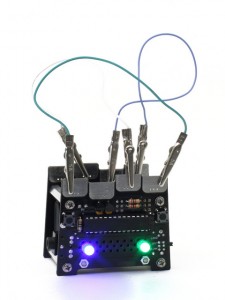
Dr. Bleep posted this teaser photo of the new Bit Blog, Jr., available for pre-order from Bleep Labs 11/11/10 as a kit or assembled noise synth.
Here’s an older video showing the concept:
Weekend chip delight
Awesome new video created by “virt”
Artist: virt (Jake Kaufman)
Song: Retro City Rampage Theme
It’s Retro City Rampage: The Soundtrack! The tracks from the video game are heading to your headphones!
Download this track at: retrocityrampage.com
In the mind of a video game nerd
Inverse Phase’s F***ed 6502 is a 8-bit take on Cee Lo’s viral hit Fuck You!
Cee Lo, if you ever read this, your single got VERY stuck in my head… you put together a great track and it’s obvious everyone loves it. I’m a video game nerd, so this is my tribute to your track, in true video game parody style. I hope you like it.
DATAMASKIN

