
KORG unveils ARP Odyssey Analog Synthesizer
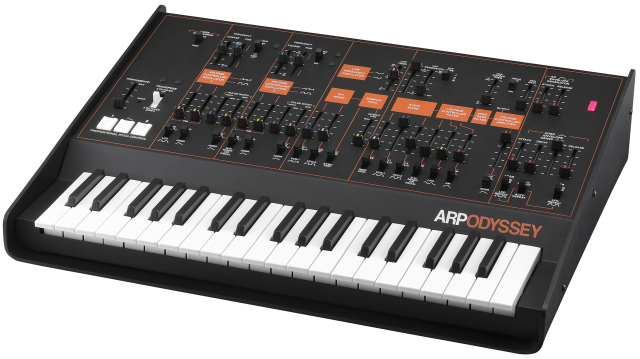
Originally produced in 1972, the ARP Odyssey was updated with several improvements throughout its history and was manufactured until 1981, due to economic hardships and the rise of cheap polyphonic digital keyboards.
The new Korg Odyssey has a compact body, highly operable sliders, and a 37 note slim keyboard. In addition, a new ‘DRIVE’ switch is provided and connectors include MIDI and headphone output as well as Patch cables have been added.
According to the company, “Korg has brought back the ARP Odyssey for today, while preserving the basic design of the original”.
The New ARP Odyssey
“Together the engineers at Korg and Arp were able to nail the sound and feel of the original. Under the advisory assistance of David Friend, the co-founder of ARP Instruments, every detail was adjusted to replicate the original unit’s distinctive synthesis,” says James Sajeva, Brand Manager for Korg products. “Every aspect has been carefully considered to stay true to the quality of the original, down to the sophisticated semi-hard case.”
Korg has completely reproduced the original circuitry for artists looking to recreate classic sounds and explore new ones. The ARP Odyssey has been downsized to 86% of the original. Carefully selected parts are used in the familiar slider section, providing an operating feel that’s even smoother than the original.
Product Specifications:
- Keyboard: 37-note (Slimkey, No velocity sensitivity, No aftertouch)
- Maximum Polyphony: 2 voices for duophonic; normally monophonic
- Controllers: Transpose Positions: 2 octaves down, normal, 2 octave up
- Proportional Pitch Control: b (Pitch down) Pad: about -2 / 3 octave – (Modulation) Pad
# (Pitch-up) Pad: about +2 / 3 octave - Noise Generator: Noise Spectrum Types (white and pink)
- Portamento: Maximum Speed: about 0.01 msec./oct
Minimum Speed: about 1.5 sec./oct - VCO (Voltage Controlled Oscillator): Waveforms: Sawtooth, Square, Pluse (Dynamic Pluse)
Frequency Range: VCO-1 in low freq. mode, 0.2 Hz – 20 Hz: VCO-1 and VCO-2 (audio range) about 20 Hz – 20 kHz
Warm Up Drift: 1/30 semitone from turn on max
Pulse Width: 50 % – 5 %
Pulse Width Modulation: ADSR, +45 %; LFO, +15 %
Voltage Controlled Response: 1 V/oct
Maximum Frequency Shifts: LFO sin wave, +1/2 oct.; LFO square wave, +1.5 oct.; ADSR, +9 oct.; S/H, +2 oct.
* VCO-1 is low note priority, VCO-2 is high note priority. - VCF (Voltage Controlled Filter): Types: Low pass (I: 12 dB/oct., II III: 24 dB/oct.)
Frequency Range: 16 Hz – 16 kHz
Maximum Usable Q: 30
Resonance: 1/2 – self oscillate
Voltage Controlled Response: C3 key (left edge): 0 V, C6 key (right edge) 3 V - VCA (Voltage Controlled Amplifier): Dynamic Range: 80 dB
- Ring Modulator:
Type: Digital
Input Signal: VCO-1, VCO-2 (square wave) - Sample & Hold:
Command Sources: Keyboard or LFO trigger
Sampled Signals: VCO-1 sawtooth wave and square wave, VCO-2 square wave and pink noise - ADSR Envelope Generator:
Attack Time: 5 msec. – 5 sec.
Decay Time: 10 msec. – 8 sec.
Sustain Level: 0 – 100 % or Peak
Release Time: 15 msec. – 10 sec. - AR Envelope Generator:
Attack Time: 5 msec. – 5 sec.
Release Time: 10 msec. – 8 sec. - Control Input Jacks:
Pedal: ?6.3 mm monaural phone jack
Portamento Foot Switch: ?6.3 mm monaural phone jack - Audio Output Jacks:
- LOW:
Connector: ?6.3 mm monaural phone jack
Maximum Output Level: -20 dBu@ 10 k? load
Output Impedance: 10 k? - HIGH:
Connector: XLR connector
Maximum Output Level: +4 dBu@ 1 k? load
Output Impedance: 330 ?
- LOW:
- Headphones Jack:
Connector: ?6.3 mm stereo phone jack
Maximum Output Level: 50 mW + 50 mW@ 33 ? load
Output Impedance: 10 ?
* Controllable by volume knob. - External Audio Input (Ext Audio Input) Jack:
Connector: ?6.3 mm monaural phone jack
Maximum Input Level: -10 dBu
Input Impedance: 22 k? - MIDI Connector:
IN - USB Connector:
Type B - CV IN/OUT Jacks:
Keyboard CV (IN/OUT): 1 V/oct.
Connector: ?3.5 mm monaural phone jack - GATE IN/OUT Jacks:
GATE IN: +3 V (minimum)
GATE OUT: +10 V, key down; 0 V all keys up
Connector: ?3.5 mm monaural phone jack - TRIG IN/OUT Jacks:
TRIG IN: +3 V pulse min., 10 ?sec. Duration minimum
TRIG OUT: +10 V pulse on key depression, 10 ?sec. Duration
Connector: ?3.5 mm monaural phone jack - Power Supply: AC adapter jack (DC 9 V)
- Power Consumption: 6.5 W
- Dimensions (W x D x H): 502 x 380 x 120 mm / 19.76″ x 14.96″ x 4.72″
- Weight: 5 kg / 11.02 lbs
- Accessories:
AC adapter, phone cable, mini-phone cable, owner’s manual, dedicated semi-hard case - Options:
VP-10 Volume Pedal, PS-1/PS-3 Pedal Switch
Pricing and Availability.
The new Korg ARP Odyssey has an MSRP $1400. Availability is TBA.
Demo of the three different ARP Odyssey filters
A short demo of the three different Odyssey filters. All three installed in an ARP Avatar.
Joachim Verghese designed a nifty 40235 filter combining the ARP 4023 and 4035 filters, and this video shows some of the characteristics between these two, and the original 4075-filter.
KORG/ARP Odyssey NAMM Teaser
Korg today shared this teaser on Facebook for a Korg/ARP NAMM Preview:
Korg invites you to be a part of our exclusive Pre-NAMM show experience.
We will be unveiling the industry’s most highly anticipated products with artist performances and featured guest speakers.
Teaser pictures of the new Korg Odyssey
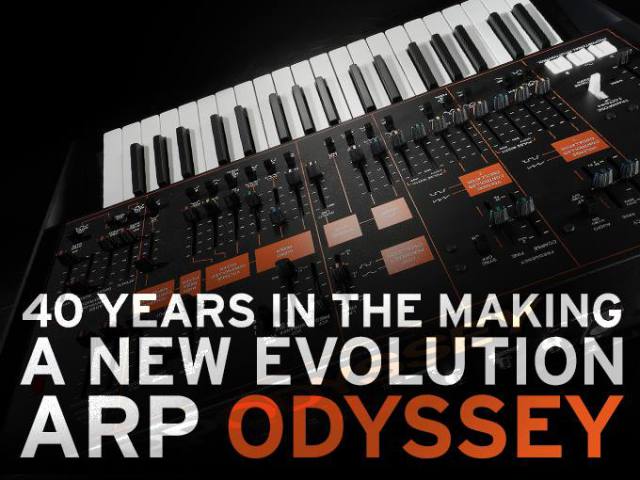
Korg has shared this teaser image for the new ARP Odyssey, saying only “Be prepared for a new evolution 1-22-15″. Jan 22 is the opening of the 2015 NAMM Show, so we can assume that the new Korg ARP Odyssey will make its official debut at the event.
Korg announced plans in February that it plans to reissue the ARP Odyssey. At the time, Korg also announced that ARP co-founder David Friend was joining Korg as their chief advisor on the Odyssey.
With Behringer also getting into the game, as announced some days ago, we may have an interesting NAMM show ahead of us 
New ARP Odyssey clone being teased from Behringer
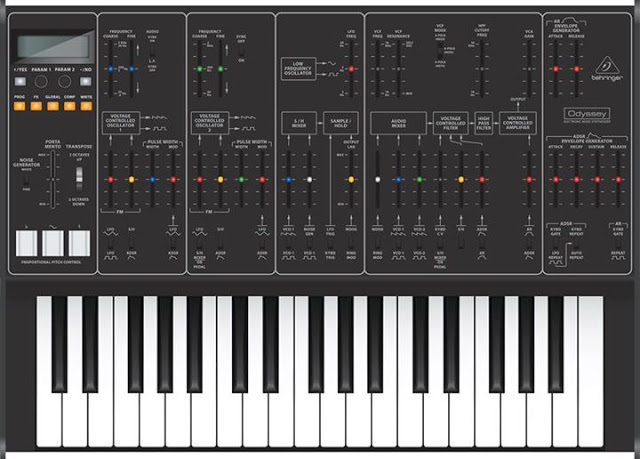
It is not just Korg who is in to this vintage classic, the below text can be found on the net now:
“How would you feel if we build an authentic ARP Odyssey synthesizer, but with a unique 3-mode VCF circuitry (that replicates all MK I to III versions) plus full Midi/USB implementation? Price around US$ 500. Shoot…”
Oddity2 – synthesizer instrument modelled on the legendary ARP Odyssey
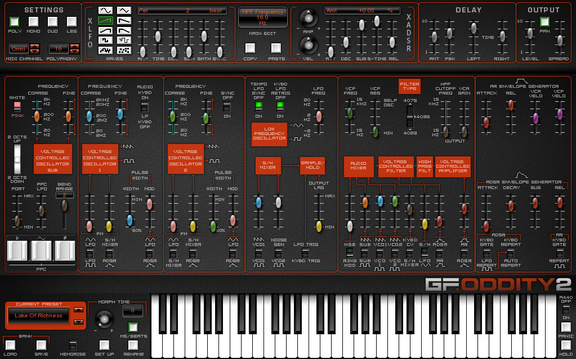
GForce has announced the release of Oddity2, a synthesizer instrument modelled on the legendary ARP Odyssey, manufactured between 1972 and 1981.
Sporting a new livery based on the final revision Odyssey, Oddity2 takes the character and operational architecture of the original and, via a wave of enhancements, transports the spirit of the original into a new dimension.
While the duophonic and monophonic modes have been retained, Oddity2 now also offers a monophonic legato mode which wasn’t evident on the Odyssey, plus a Polyphonic Mode. Now finally it’s possible to stop wondering what the Odyssey’s classic tones would sound like within the context of chord based structures, and put it into practice. Everything from spiky and resonant textures to lush and warm pads sounds can either be programmed from Oddity2’s intuitive controls or simply dialled up via the accompanying presets.
Furthermore, via three filter modes and an additional oscillator, Oddity2 can sound as versatile and punchy as its main rival back in the day.
Oddity2 doesn’t stop there either, in order to overcome the original instrument’s limitation of a single LFO, they’ve also added the ability to apply an additional LFO and ADSR to almost any of the main Oddity2 sliders, which gives the instrument almost unrivalled versatility and depth when it comes to sound design options.
Additional improvements over its predecessor include an on-board delay, spread or random pan modes, patch morphing via beats or seconds, program change recognition and implementation of the two octave transpose switch for dynamic real-time performances.
Oddity2 for Windows and Mac (VST/AU/RTAS) is currently on sale for £99 GBP inc VAT. The upgrade from Oddity is £49 GBP inc VAT.
GForce updates their ARP wanna-be: Oddity2 – Enhancements
A quick run-down of the new and enhanced features in Oddity2.
Music composed by DJ Dean Coleman using Oddity2
Oddity2 is the successor to the multi-award winning Oddity, modelled on the legendary ARP Odyssey synthesiser, manufactured between 1972 and 1981.
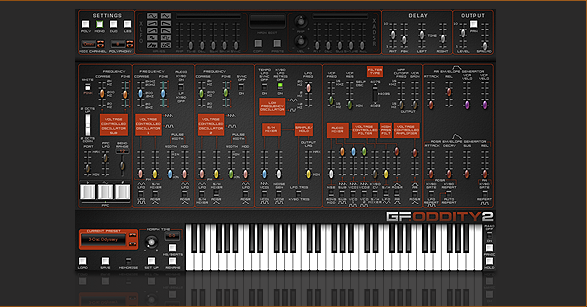
During its lifetime the Odyssey, due to it’s versatile and distinctive tones, was used by artists as diverse as Gary Numan, John Foxx, Herbie Hancock, Kraftwerk, Chick Corea, Roger Powell, George Duke, 808 State and countless others. Ultravox’s Billy Currie refers to it as the ‘first punk synth’ due to its snarling aggression, thanks in part to an on-board ring modulator, oscillator sync and duophonic capabilities.
Sporting a new livery based on the final revision Odyssey, Oddity2 takes the character and operational architecture of the original and via a wave of enhancements, transports the spirit of the original into a new dimension.
First up, while the duophonic and monophonic modes have been retained, Oddity2 now also offers a monophonic legato mode which wasn’t evident on the Odyssey, plus a POLYPHONIC MODE. Yes, now finally it’s possible to stop wondering what the Odyssey’s classic tones would sound like within the context of chord based structures, and put it into practice. Everything from spiky and resonant textures to lush and warm pads sounds can either be programmed from Oddity2’s intuitive controls or simply dialled up via the accompanying presets.
Furthermore, via three filter modes and an additional oscillator, Oddity2 can sound as versatile and punchy as its main rival back in the day.
Oddity2 doesn’t stop there either, in order to overcome the original instrument’s limitation of a single LFO, we’ve also added the ability to apply an additional LFO and ADSR to almost any of the main Oddity2 sliders, which gives the instrument almost unrivalled versatility and depth when it comes to sound design options.
Additional improvements over its predecessor include an on-board delay, spread or random pan modes, patch morphing via beats or seconds, program change recognition and implementation of the two octave transpose switch for dynamic real-time performances.
Put simply, Oddity2 further builds on the significance and lineage of the original hardware and software instruments, by taking its fundamental sonic character and, via a raft of carefully considered musical enhancements, transplants it into the hands of those musicians ready to take it to both familiar and new horizons.
Key Features
- Two syncable oscillators plus a sub oscillator
- Fully tuneable across a six octave range
- Monophonic, Duophonic and Polyphonic modes
- Sawtooth, Square, Sine & Variable pulse width waveforms
- Ring modulator
- Two resonant 24dB/octave lowpass filter modes
- One 12dB/octave filter mode
- Highpass filter
- Vast Modulation options via additional XLFO and XADSRs
- Dynamic control over filter cutoff and amplitude
- Timed Morphing between presets within a preset bank.
- Flying Slider feature
- A=440Hz Reference tone
- On-Board Delay
- Spread and Random Pan Modes
- Over 1000 Categorised Patches
- Full automation support
Date set for KORG’s reissue of the ARP Odyssey analog synthesizer
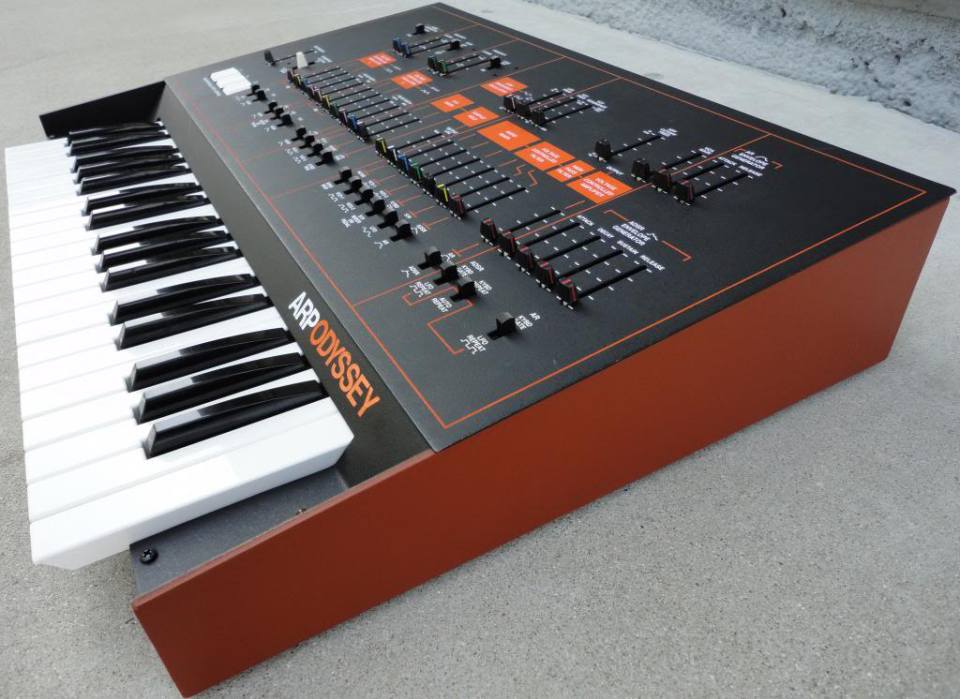
Korg has announced an update for the release date for the reissue of the ARP Odyssey analog synthesizer.
Korg’s new schedule has the updated ARP Odyssey shipping in early 2015 The original shipping schedule was September 2014.
“We are sorry for this delay especially since the extraordinary reaction to the initial Odyssey announcement. We are refining the Odyssey to make this product even better.
We appreciate your understanding regarding this delay and thank you for your continued interest in the reissued Odyssey.”
More info to follow….
Saturn – space music
runo Ender Lee – “Saturn” – studio recording August 16. 2014
the new album “Saturn” is now available:
http://brunoenderlee.bandcamp.com/alb…
Roland JP-8000 (Pads), Roland Juno-106 (bass), ARP Odyssey, Moog Little Phatty & Analogue Solutions Vostok (fx), Korg MS2000 (leads), Synthesizers.com Studio-88 (leads), MiniMoog Voyager OS (bass), MacBeth M5N & Korg MS-20 mini (sequence with Doepfer MAQ)
composed, arranged & performed by Bruno Ender Lee
2014 Velvet Voyage Productions / all rights reserved
Sounds of the vintage ARP QUADRA
all sounds: ARP QUADRA Analog Synthesizer (1979)
first demo of all four synth sections (Strings and Phase Shifter, Poly-Synth, Bass-Synth, Lead-Synth)
no multitracking, no midi
The Quadra is pretty much a hybrid version of ARP’s Omni II and Solus synths. It’s a four-section synthesizer consisting of a Bass synth, Poly synth, Lead synth, and String synth. It is quite good at emulating each of these sounds and can function in any of its four modes at a time with the ability of layering the different sections! Sounds you create in any of the four sections are instantly recalled from memory by the push of a button! There are 16 program patches for storing your sounds. Other major features are the incredible phase shifter, tons of balanced audio outputs for each section, dual portamento controls and a superior arpeggiator…that’s pretty good for 1978! On the downside, it has a fragile mylar front panel, very limited programability and a weird feature that autotunes the keys to play weird intervals.
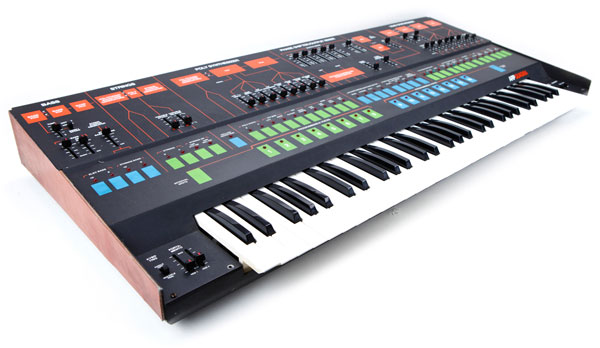
The Bass synth section is monophonic and can be programmed to occupy the lower two octaves of the Quadra’s 5-octave 61-note keyboard. The bass sounds pretty good and has 16′ and 8′ presets each for Electric and String Bass sections.
The string section is based on the Omni II String synth. It sounds excellent and implements a phase-shift effect that is sort-of like a chorusing effect that thickens its already great string sound. In Polyphonic synth mode there are more effects available such as sample-n-hold and the phase-shifter. String and Poly Synth sections have 8′ and 4′ Polyphonic Waveform Generators each along with a preset called Hollow Waveform.
In Lead synth mode the Quadra becomes a two voice screamer with aftertouch sensitivity in the upper octaves of the keyboard! It’s duophonic (like the Odyssey). Get a bass sequence going, switch over to another section and play along!
DATAMASKIN

