
8GB’s first-ever EP release is a small snapshot of the evolution of 8GB through these 4 years of existance.

Akira writes:
The main reason for this is that I am in need of funding for the Blip Festival Tokyo trip and this will help out. Anything you can help with is appreciated but since I don’t believe in taking money from people without giving anything in exchange I thought of this (among other stuff that will appear in the coming weeks). With this I also mean to fund the new A/V set that is in development to premiere in Blip Tokyo in early September. Many, many hours of filming, designing, motion graphics work, gear and have been invested in 8GB since 2004 and it’s getting harder and harder, specially with a tight deadline, a full time job that takes a lot of my energy and such a costy trip to the land of far east.
The Album copy:
On 10 October, the 8-Bit State Security Agency voted 10-2 for a resolution saying that “an armed uprising in chipmusic is inevitable”, and that “the time for it is fully ripe”.
As such began the revolt that lead to the RED OCTOBER, an uprising in chipmusic affairs, featuring 4 tracks of dancefloor-smashing data propaganda.
8GB’s first-ever EP release is a small snapshot of the evolution of 8GB through these 4 years of existance. Being their first ‘proper’, solo release, after years of holding onto tracks for the pleasure of those checking out live shows, the Agency decides to release onto the public a concentrated and powerful package of propaganda, featuring artwork by kiken.corporation.
Chip and Blade Runner
The music is a midi file from blade runner, one sound is the wtr and the other a synth from fruityloops.
The new XMP plays over 90 formats – Amiga, Atari, Acorn, Apple IIgs and PC
The Extended Module Player, or xmp, is a portable command-line module player for Unix and Unix-like systems such as Linux, BSD, Solaris, HP-UX and MacOS X, and also QNX, BeOS, Windows, OS/2 and AmigaOS. Xmp plays over 90 mainstream and obscure module formats from Amiga, Atari, Acorn, Apple IIgs and PC. There are experimental plugins for Audacious, Beep Media Player, XMMS and Winamp.
http://www.youtube.com/watch?v=ZXRAXZ6LcU8&feature=player_embedded
Attack of the clones – NTRQ 1.6
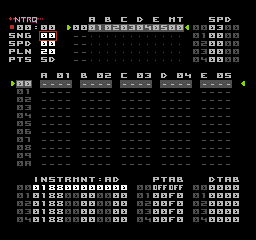
Mr. Baldwin has updated NTRQ to 1.6. New Features include:
Pattern Cloning
Something you should probably be aware of: I had to modify the NTRQ file format slightly to accommodate the clone/purge feature. This means that from V1.6 onwards, older .sav files will not be compatible. However, starting with V1.6, if you load up NTRQ with an older .sav file it will be automatically upgraded to V1.6 data format. The same also applies to the NSF outputter. It has been updated for V1.6 too and is not compatible with older .sav files. To re-output your old .sav files as NSF you need to first “load” and “save” them (however that happens on your platform of choice) with V1.6 (onwards) first.
DPCM Changes
Funnily enough, I’d been working on the changes to DPCM before I was talked into releasing the cloning feature. As such it’s still in a state of flux somewhat but the changes so far definitely make DPCM usage better (or at least more interesting
)
Evening chip tunes – enjoy
for chip fans only – The Arkos Tracker
Arkos Tracker is a freeware Windows-based tracker to compose music for the AY3-8912, a soundchip used in the Amstrad CPC, but also on MSX, Spectrum, Atari ST and many other computers in the 80′s.
Arkos Tracker is born from the native CPC tracker called STarKos. It retains most of its features, extends some, and will evolve in future versions.
One of the most interesting stuff is the pattern editor, the place where you edit your tracks and insert the notes to be played. This is what makes the tracker a tracker. Classic tracker stuff indeed: note, instrument number, volume, and effect column. But what is very interesting in AT is the fact that you can set a name for each track, and give it a special color. A bit like when you choose a color for a clip in a modern sequencer like Reason, Ableton, or whatever you want. Higher level! Renoise does this since version 2.5 only

Can 8-bit beat the original song?
Check out for yourself:
Here’s the original song by Kansas
And here’s the 8-bit version, although instrumental version
The Disco King – Carry On Wayward Son
Must say it is a pretty good attempt at least
SID and chip lovers – look this way
Reason Refill review

Last week I published a post on the new release from Soundcells. It was the bitBumber Reason Refill, a new SID, bit, chip, you name it, refill that I was intrigued to try out myself.
After listening in on hundreds of different refills for Reason it is quite seldom that I find something that feels totally new and fresh, but I am inclined to change my mind on this one. Sure other refills have been published in this space before but rarely with this amount of breadth. There are not just the traditional CMB files and NNXT files that you have become accustomed to but also a several new live performance CMBs that allows you to actually be very creative on stage. I really enjoyed bringing these up during some live jamming in the studio, and to spice things up there are a several really nice Dr.Rex loops also included – and not just endless variations of the same loop in different pitches and sounds but actually quite a nice mixture of experimental, bass and pure chip sounds – I like
Several of the files has been nicely upgraded from the original using arpeggiators and effects, that either can be activated with automation or set to play as CMB loops. That deep bass sounds paired with either smooth SID strings or whacky FX type sounds.
Soundcells has also added a nice SID/bit section dedicated to Thor, where I must say that they have been able to squeeze quite a lot of those orginal sounds of that synth, but with a twist.
I would recommend this Refill to any composer who wants to get a kick start in making bit tunes or simply spice up a trance, electro song with some of those nostalgic sounds of old computer games. Remeber though that the refill is more on the playfull side of bit music than for any of hard core SID fanatics with the pure objective of recreating everything as faithfull as possible- but I would recommend you to either purchase, download or build your own SID workstation, that are plenty available out there.
Plogue chipsounds authentically emulates more than eight vintage 8bit-era sound chips

Plogue has released version 1.0.0.3 of Chipsounds, a virtual chipsound synthesizer plug-in which turns your host into a classic video game console, vintage 8bit home computer and even an 80’s arcade.
Plogue chipsounds authentically emulates more than eight vintage 8bit-era sound chips (on top of their variants), down to their smallest idiosyncrasies.
Changes in Chipsounds v1.0.0.3
- New presets (around 300 total).
- VST/AU parameters (only on first slots).
- MIDI Out in VSTi mode (AU later).
- Small skin installed but turned off by default (need to choose GUI_small in AriaSetup.xml).
- Transpose setting for each slot.
- MOS TED chip added (not worth a huge mention).
- Various bug fixes.
Chipsounds is available to purchase for PC and Mac (VST/AU/RTAS), priced at 65 EUR excl. VAT. A demo version of Chipsounds is now also available to download (Silence after a 15 minute session; No Save).
More information: Plogue / Chipsounds
Generative arts in music
Demo of dj64, a DJ environment for the Monome interface written in Max/MSP.
This patch is still under development, but will be available from monome.org soon.
[youtube=http://www.youtube.com/watch?v=3A0BkOkK3rA]
“When one thinks about it, music and the visual arts are really languages that have their own grammars. We find that certain types of sequences and juxtapostions of components create effective communications. The message is whatever the artist creates or programmer allows in the system. There are certain types of systems that use a small set of rules with various permutations. Other systems use a loose set of rules with a large vocabulary. In some cases, there are many algorithms that have little or no permutation within, but the communication is made by the permutations of sequencing and juxtaposition of the algorithms into a grammar and a language.
In some cases, a formal scientific approach is taken, and the images reflect this in their pure mathematical rigor. The reliance on the formula may limit the range of expression. In other cases, a free-form artistic approach is taken, and the ad-hoc, organic nature and human hand is revealed., and the idiosyncrasies of the person come through. A close friend of mine would say that the scientific approach is the result of a fear of intimacy. Perhaps the free-form approach has its own fear of responsibility.
It’s interesting that generative art is related to grammar, the vehicle of meaning. Are we looking for meaning in art without injecting it with ourselves? Have we lost the connection with our own meaning or purpose? Is generative art the reliance on computers and technology for the solutions to our problems, even in the search for beauty or meaning?”
Dj emulation for the 40h / 64. Using 64 buttons, the user controls 2 decks, a virtual mixer, and several effects.

Created by Bitbasic
DATAMASKIN

