
autoharp
software by meng qi
4 track autoharp with physical speed/resistance system for monome grid
autoharp
8 chord slots, setting chord is easy with per note / per chord / all chords transpose buttons
4 tracks, each can select a different chord, note velocity, duration, resistance, midi output and channel
4 “strum” speeds in each direction (user configureable for full version max users)
preset management system that remembers everything from chords to track parameters
more details:
docs.monome.org/doku.php?id=app:autoharp
mengqimusic.com
Orphion – Record and share
Orphion is a musical instrument with a unique sound between string instrument and percussion. Everyone can play expressive, wonderful sounds and easy or virtuosic melodies on it just by moving fingers on virtual pads.
- Different articulations from soft to plucked to hardly slapped
- Natural interaction
- Extend your ways of expression as a percussionist, guitarist, pianist or other musician
- 14 transposable pad-layouts with different tonalities from easy to complex
- Record and share what you play via EMail, SoundCloud or AudioCopy
- 8 individual voices for 8 fingers (4 on iPad 1)
Get Orphion here:
orphion.de
Become a Fan on Facebook:
facebook.com/Orphion
or follow on Twitter:
twitter.com/#!/OrphionApp
New experimental instrument – Six String Smomid
New instrument built in June 2012. Features 9 sensors that act as string modelers, 2 joysticks, 2 force sensitive resistors, many knobs, many buttons and some really bright blue and red LEDs. Designed and built by Nick Demopoulos, but credit goes to Ranjit Bhatnagar for programming the 2 arduinos that are inside of it, Malcolm Pepin for fabricating the wood body and Josh Dotson for consulting in many design issues. More info at www.nickdemopoulos.com
Closer look at BEATSURFING – the organic MIDI instrument builder
This iPad application lets you design MIDI instruments from the ground up and then play them in a unique way: by sliding (‘surfing’) your finger across the screen. This very special approach to beat making and production allows for more creative expression and brings back a human touch and feel to your MIDI habits.
→ FOLLOW THE DEVELOPMENT ON FACEBOOK & TWITTER.
facebook.com/beatsurfing – twitter.com/beatsurfing
Experimental instruments through scavenged objects
Enter the plugged-in world of Tim Kaiser, a maker who creates experimental musical instruments from scavenged objects. Tim seeks out unique sounds everywhere he goes plucking chimes out of grandfather clocks and jingle mechanisms from childrens toys. And he doesnt stop there his electronic instruments have to look cool, too. So, Tim houses them in wildly inventive containers. Then meet the musical maverick who inspired him, Harry Partch.
Learn more about Tim Kaiser at http://www.timkaiser.org/.
Dirty Electronics : Athens Video Art Festival Instrument
Dirty Electronics 7-Segment Display – new commission for Athens Video Art Festival, 19 – 20 May.
Electronic music: Battery Operated – Girls Only
Here’s a new video featuring Japanese electro pop group Battery Operated, famous for only using instruments powered by batteries, such as the Nintendo DS:
We are having a release party for our first album “Battery Operated: Girls Only.” Come see us throwing ultimate electronic tunes with our nintendo DS!! We are a group of female music composers exclusively uses the battery operated electronic musical instruments, such as KORG DS-10, KORG M01, monotron, monotribe, kaosillator, mini-KP, microKORG, and so on, to make music.
Official Website: http://denchikudoushiki.web.fc2.com/
SoundCloud: http://soundcloud.com/battery-operated
Experimental stuff: The Infinite Music Machine
An immersive digital journey into the analog world of Juju & Jordash.
On the 24th of February 2012 at Berlin’s Feed Soundspace, Juju and Jordash gave a live improvised performance, accompanied by artist Paul Skawinski’s liquid projections. The application takes their muliple layers of analog recordings and randomly combines them to produce an infinite music machine. An experiment on continuing randomness in the analog and digital domains.
Features
– Randomly auto generates music derived from Juju & Jordash’s live performance.
– Liquid visuals by Paul Skawinski.
– Randomize the audio and visuals using the randomize button.
– Set the length of time the machine generates audio and visuals: one minute to ∞
New series – Legends of electronic music
Created in 1963, Tod Dockstader’s Water Music appears on Starkland’s first CD (Quatermass ST-201). Sound sources include: water, toy gong-rattles, finger bells, sheet metal, test generators, water glasses, Coke bottle, metal garbage can, a nail.
Wired Magazine has started a new series on their online website called “Legends of Electronic Music”, well worth checking out, here’s how they describe it:
Wired’s new series Legends of Electronic Music explores the history of electronic music through in-depth interviews with some of the field’s pioneers. The series kicks off with a rare interview with trailblazing American electronic composer Tod Dockstader.
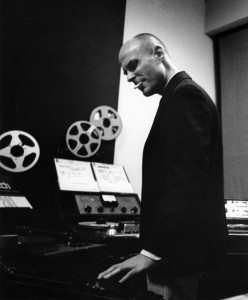
In the 1940s, before magnetic tape was widely available in the United States, electronic music pioneer Tod Dockstader made low-fi recordings on steel wire.
“I loved the idea of the wire singing,” Dockstader said in a recent interview with Wired. As a high school student in the ’40s, he used the end of a lit cigarette to make splices in the thin wire, in a painstaking and risky process.
“You had to tie the wire, which was very fine, in a perfect square knot,” he explained. He would hold the wire up to his nose, with the cigarette perched in his mouth. A single wrong move and the edit could be destroyed.
“I became very adept at editing,” he said. “I really liked editing; I understood it. To me, it was really basic stuff. You could make decisions — take things out, put things in. I liked that you were building something.”
Born in 1932, Dockstader was part of the first wave of electronic musicians, who, before the advent of synthesizers in the early 1960s, worked with whatever hardware they could find: reel-to-reel tape machines, sine wave generators and a wild array of homemade circuits and military surplus gear. In the process, they created a universe of electronic music that still sounds unique and prescient today.
The wire recorder Dockstader used to create electronic music was a piece of used military equipment. “A lot of this [electronic music] happened because, after the war, a lot of the stuff was available,” Dockstader said. “Normally a person, a civilian … wouldn’t be able to get that tube, this device or that device. That fascinated me.”
In the late 1950s, Dockstader worked as a sound engineer at Gotham Recording Studios in New York. At night, he worked on his own music, which eventually led to a series of impressive albums of electronic music, including Apocalypse (1961), Quatermass (1963) and Omniphony (1966).
“I was always working at night — deep night,” Dockstader said. “And I’d be very careful. If they found me in a studio — just me — I would have lost my job.”
LittleGPTracker – music tracker optimised to run on portable game consoles
LittleGPTracker (a.k.a ‘The piggy’) is a music tracker optimised to run on portable game consoles. It is currently running on Game Park’s GP2x & Caanoo, PSP, Dingoo, Windows, Mac OSX (intel/ppc) & Linux (Debian).
It implements the user interface of littlesounddj, a very famous tracker for the Gameboy platform that has been tried and tested by many users over the years, leading to a little complex but yet extremely efficent way of working.
Piggy currently supports 8 monophonic 16Bit/44.1Khz stereo sample playback channels. Additionally, the program can drive MIDI instruments (with the gp32 and gp2x a custom MIDI interface is required).
All versions are available for free ; however, if you like the project and want to contribute, don’t hesitate to do a small donation. If you’d like to see the piggy wiggling on your platform, you can try donation too, DS users can forget about it, the console is not powerful enough to drive the piggy as is. The archive containing executables for all platforms is here:
DATAMASKIN

