
Tachyon and Piano with Jordan Rudess
Jordan demos his latest musical tablet instrument
A little improv showing the magic of having a seamless transition between two sounds (and images) on the playing surface. For more Tachyon information go here: http://itunes.apple.com/us/app/tachyon/id544585980
Jordan Rudess has released Taychon

Wizdom Music is back with their new musical app called Taychon, read all about it below:
Do you want to play an electric guitar and a piano at the same time? What about choosing the electrifying buzz of a drill and blending it into the soothing tone of a human voice? Jordan Rudess and Kevin Chartier’s Tachyon gives you all these options and more.
From the makers of the award winning app, MorphWiz, comes a new creation that allows images and sound to become one as they magically blend under your fingertips. Each note you play is an individual expression, allowing independent control of pitch and tone far beyond that of traditional instruments.
Most instruments only allow you to play one sound at a time, but with Tachyon, you can seamlessly blend between any two sounds as you slide your fingers up and down the screen.
The visual experience of Tachyon is just as mesmerizing. As you move along the playing surface, a field of twinkling stars morphs into the shape of your selected instrument, allowing a direct correlation between sight and sound.
As described by Jordan Rudess, “Tachyon is simple to use and at the same time offers a unique musical expressive power. The sonic core of the app is a custom crafted sound set from my personal library, encompassing sounds as familiar as those you would find in your home toolbox, and as exclusive as the ones I use on tour with Dream Theater.”
Whether you’re a seasoned musician looking for a next generation instrument to further express your creativity, or just a regular Joe browsing the app store looking for a fun and simple purchase that will delight the whole family, Tachyon is the app for you!
Tachyon is priced at $1.99.
Teaser: Muza – new musical instrument and MIDI controller for iPad
Muza is an upcoming musical instrument and MIDI controller for iPad, iPhone and iPod Touch. Will be available August 1st.
All the sounds came from Nord Rack and MFB Nanozwerg.
iPad is connected via camera connection kit to USB MIDI interface.
Four MIDI channels used:
1) Nord Pad (harmony instrument)
2) Nord Drone
3) Nord “Wind”
4) MFB Nanozwerg lead.
Subscribe to channel for Muza news and tutorials.
http://muzamusic.com/
Dazibao : the Arpeggio Sequencer
Create your sounds with colors
Dazibao is a powerful music synthesizer, able to create the most complex tone evolutions but with a fast and easy to use new kind of users interface. This tutorial explains how to use the Arpeggio Sequencer.
Dazibao is sold on the website of Herve Noury for a very friendly price :
www.hervenoury.com
Teaser preview: Endorphin.es Furthrrrr Generator
Background information:
With our good friend Marko Ciciliani we recorded short overview video of the module with main features described.
You can see some scope images to understand what’s going on with the waves.
p.s.: video has a bit crappy youtube quality and related sync/chorus bug however that will be fixed in subsequent presentations.
http://endorphin.es
info@endorphin.es
Tachyon Revealed – New stuff from Jordan Rudess
Teaser time 
An introduction to Tachyon- a new app by Wizdom Music…
Instruments of Robot Repair
From analog drum machines to vintage guitars, orchestral percussion to circuit-bent children’s toys, 1980s Russian synthesizers to Indian harmoniums…these are the instruments of Robot Repair.
Mesh – new virtual synthesizer instrument for Windows
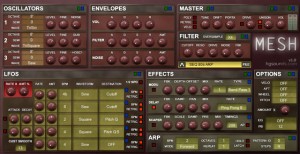
Homegrown Sounds has announced Mesh, a virtual synthesizer instrument for Windows.
The idea behind Mesh was to create a Virtual Analogue mono synth in the style of the Minimoog with the addition of 5 Tempo based LFOs for exploring rhythmic potential. In comparison to previous Homegrown Synths, Mesh is very simple using 3 Oscillators and a Sub Oscillator to shape the sound, a single oversampled Low Pass Moog style filter, and 3 Envelopes. The LFOs can modulate most parameters, and there are several quantized pitch destinations to enable complex one finger sequences to be constructed. Add to this a compact effects section comprising of a Modulator, a Delay and SoundScaper and Finally an Arpeggiator which all adds up to a simple lightweight sonic playground.
The Oscillators provide the usual suspect waveforms such as Sine, Saw, Ramp, Triangle and Square, but also add a large selection of Digital Waveforms to expand it’s sonic capabilities. The filter can be oversampled up to 8 times which improves the quality of the sound as well as providing a different character for each of the modes.
Although Mesh is designed as a non velocity based Mono Synth, it can be used as a Polyphonic instrument, and velocity can also be enabled. There are also a set of modulation parameters for assigning Velocity, Aftertouch, Mod Wheel and Pitch to a wide selection of destinations.
Mesh for Windows (VST) is available to purchase for the introductory price of $20 USD for a limited time (regular $40 USD).
Innovating: Moldover’s Jamboxes
Background info:
Born from the union of a passion for controllerism, and the love of community-collaboration, Moldover’s jamboxes are some of the most radical and innovative instruments he’s ever created. The OctaMasher, The SyncoMasher, and The MiniMasher are completely unique designs; each explores a different realm within the multi-player universe. Like jukeboxes in the 1950s and boomboxes in the 1980s, jamboxes are now playing a crucial role in the new explosion of social music and culture.
audible color – an interesting audio-visual instrument
audible color is an audio-visual instrument. Sound is generated based on color detected by a camera. Red, green and blue correspond with certain music notes. When the colors are mixed, the resulting secondary colors produce different notes. The size of the colors influences the volume and frequency of the notes played. Color detection and sound generation were created and are controlled using Processing code.
Designed by Hideaki Matsui and Momo Miyazaki
Generative Design Workshop 2012 with Joshua Noble and Daviid Gauthier
Copenhagen Institute of Interaction Design (ciid.dk)
Full description:
Audible color is an audio-visual instrument. Sound is generated based on color detected by a web cam connected to a computer. Red, green and blue correspond with certain music notes. When the colors are mixed, the resulting secondary colors produce different notes. The size of the colors influences the volume and frequency of the notes played. Color detection and sound generation were created and are controlled using Processing code.
The system of audible color is based on a marriage between basic color and music theories. The colors of red, blue, and green are the visual foundation for color-mixing and the music notes A, D, and F are the base triad that corresponds to the colors. The secondary colors (colors made when the foundational three are mixed) of purple, teal and brown are tuned to the musical triad C, E and G. The visual of the mixing of red, blue and/or green mirrors the aural output of combined notes.
The ‘painting’ aspect is not restricted to water droplets from a pipette. Numerous experiments were performed using substances such as acrylic paint, food dye in milk with soap, and ordinary household objects. Each investigation created a new type of fun and easy gestural music-making.
Project page:
http://ciid.dk/education/portfolio/idp12/courses/generative-design/projects/audible-color/
DATAMASKIN

