
Switched on Buch la ti doddle
Buchla in full action, enjoy
Buchla System #1 and Roland System 102 (Filter Ringmodulator low drone)
Akai MFC 42 Panning
Alesis Metavox
Line 6 Filter Pro
Make Noise Format Jumper
Moog MP 201 C251 VX 351
The Knas Ekdahl Moisturizer
Yamaha MCS 2
Sequenced by Roland EF 303 (12 steps)
via Logic
“Everything Ends Here” performed by Don Buchla
San Francisco Electronic Music Festival 2010
Alessandro Cortini + Don Buchla, performing the piece “everything ends here”, from Blindoldfreak’s 1st EP, 1.
Buchla formed his electronic music equipment company, Buchla and Associates, in 1962 in Berkeley, California. Buchla was commissioned by avant garde music composers Morton Subotnick and Ramon Sender, both of the San Francisco Tape Music Center, to create an electronic instrument for live performance. Under a grant from the Rockefeller Foundation Buchla completed his first modular synthesizer in 1963. The result was the Buchla Series 100, which he began selling in 1966. Buchla’s synthesizers experimented in control interfaces, such as touch-sensitive plates. In 1969 the Series 100 was sold to CBS, who soon after dropped the line, not seeing the synthesizer market as a profitable area.
In 1970 the Buchla 200 series Electric Music Box was released and was manufactured until 1985. Buchla created the Buchla Series 500, the first digitally controlled analog synthesizer, in 1971. Shortly after, the Buchla Series 300 was released, which combined the Series 200 with microprocessors. The Music Easel, a small, portable, all-in-one synthesizer was released in 1972. The Buchla 400 was released in 1982, which featured a video display. In 1987 the fully MIDI enabled Buchla 700 was released.
Beginning in the 1990s, Buchla began designing alternative MIDI controllers, such as the Thunder, Lightning, and Marimba Lumina. With the recent resurgence of interest in analog synthesizers Buchla has released a revamped 200 series called the 200e.
available on iTunes:
itunes.apple.com/us/album//id304187276
and Amazon:
amazon.com/1/dp/B001RK05OS/ref=pd_bbs_sr_1?ie=UTF8&s=dmusic&qid=1235173416&sr=8-
1
Ghost Rider Modular
Mr. Hand demos a synthesizers.com patch utilizing a CatGirl Synth Sub Octave Divider module. The sequence is a facsimile of Suicide’s song Ghost Rider done with a Synthesizers.com Q119 Sequential Controller. It’s not the complete riff since Marty Rev’s riff is poly-rhythmic and I could only use 8 steps of the analog sequencer. The organ-like tonality is from the CGS Sub-Octave module which can function similarly to the divide down technology used in electric organs.
Exploring something dubbed “moogle”
“Heres a patch me and Big Al made, it’s a random voltage source going into a S&H then into a quantizer so the notes are decided by God / The Supreme Random Being”
Via “It’s full of stars”
Synton 3000 modular synthesizer touchpad test
Background info: “This is a rare Synton 3000 modular synthesizer… a large system with keyboard and touchpad controllers.
In this system there are a lot of amazing modules plus some unique from the old Synton production.
It’s the father of the Synton Fenix and Syrinx … this system can make maaaaaany more… it’s only a short Synton touchpad demo test, It’s currently on sale on Vemia: item# 9170”
Variation on the Largo from Winter by Antonio Vivaldi for Analog Modular Synthesizer
Beautiful capture of a classic composer 
Additional details:
This is my first video since I changed my modular system to all Eurorack. It is done just using step sequencers again. this time it uses the new Modcan Touch sequencer and two Analogue Solutions Oberkorn 3.
By the way I just needed to throw in some Buchla percussions to complement this post:
Enjoy
Open source EigenD (Eigenharp) connected to a modular synth
Background information:
Striving for higher resolution electronic instruments to connect the player to the sound the old-fashioned way.
This is a technical demonstration, meaning, I finished the technical coding, hooked it up, patched the simplest thing I could on the modular and started noodling.
The way this works is that since EigenD (eigenharps platform) is now open source, we’ve (with the help of eigenlabs) been able to crack it open a bit for hacking. We now have an OSC agent which pumps an insane volume of raw data out of the harp ready for some experimental harvesting.
In this demo, I have a MAX patch which sanitizes the data, and makes it expressly fit for translation to control voltage of a modular.
Some data points here. EigenD sends 2000 events per control point per second. Per note there are 3 high res control points per note (pressure, yaw, pitch). So that is 6000 events per sec translated over the wire into voltage. 2 more control points require voltage which are pitch and cv. That means using an audio interface for cv, you need 5 audio outs per level of polyphony. 5 outs for monophonic, 10 outs for duophonic, and up.
Luckily, monophonic is pretty amazing, duophonic is an incredible luxury and 3 levels is showing off.
After I have prototyped this, I could see writing an EigenD agent expressly to do this directly, making the eigenharp modular friendly out of the box.
I however have to mention that this would not be possible without Expert Sleepers Silent Way plugins as the OSC to CV bridge. Nor would it be possible without MAX in this prototype stage.
Corsynth C101 Overview + FM
Corsynth is an small company from the Northwest of Spain dedicated to manufacture modules for analogue modular synthesizers.
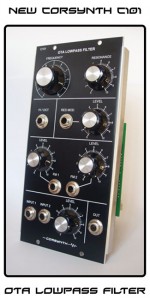
The C101 OTA Lowpass filter is a four pole low pass filter ( 24db/octave ) based on four cascade OTA-stages. The design is similar to the one found in classic synthesizers like Roland System 700, Roland System 100m, Roland SH-1, SH-7, SH-101, Roland Jupiter 8, Jen SX1000 and many more.
When the Resonance control is set at a high value the filter will start to oscillate and the C101 can be used as a sine wave VCO. The filter will track perfectly over at least 5-6 octaves and is also temperature compensated.
In many 4-pole low pass filters the output volume drastically drops when the resonance is increased. The C101 OTA Lowpass filter is specially designed to maintain a constant output level at any resonance value ( with the exception of when the filter is set to auto-oscillation ).
Another important feature is that the C101 has voltage controlled resonance.
C101 main characteristics
- Filter response 24db/octave
- Filter self-oscillate
- Can be used as VCO ( 1V/Octave )
- Voltage controlled Resonance
- Temperature compensated
- Two Frequency Modulation inputs
- Two audio inputs
- 1V / Octave input
Mos-Lab 970 Waveform Processor Demo
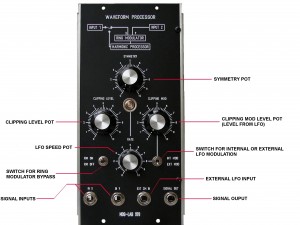
“I think the Mos-Lab 970 is one of the most beautiful panel designs ever for a synth module. It is a combination of several functions in one module. This module was only available for about a year then discontinued so it is quite rare. (I’ve been told I may own one of the only two that exist in North America) I’m going to sell it since I don’t use it a lot and need the room of other modules.”
MOS-LAB 970 HAVE 2 FUNCTIONS :
– HARMONIC GENERATOR (WITH CV CONTROL) / SIMPLE LFO INTEGRATED (TRIANGLE)
– RING MODULATOR
Eventide Stompboxes Controlled From Modular Synth
This video demonstrates using a simple custom cable to enable one to control Eventide stompboxes (or pretty much any digital stompbox) with a modular synth via the expression pedal port.
The cable consists of a mono 1/4″ jack, wired to two jacks of whatever flavor your modular synth is. Just connect the tips only (not the sleeves) of all three jacks. Plug the 1/4″ jack in to the Eventide pedal’s Expression Pedal port, and the two other jacks in to the in and out of a VCA in your modular synth. Then you can send CV to the CV-In of the VCA, and this will control the pedal as if it were an expression pedal.
For more discussion on this, visit:
http://www.analogindustries.com/blog/entry.php?blogid=1319321991586
DATAMASKIN

