
Nova Drone v1.3 – experimental analog synth
The Nova Drone is an open source, analog experimental sound and light synth.
It it can be used to create effects ranging from slowly fading drones to chaotic harmonic sequences. It also functions as a complex visual pattern generator when combined with a digital/phone video camera. See the video below for an example of the color patterns generated by holding a camera up to the LED.
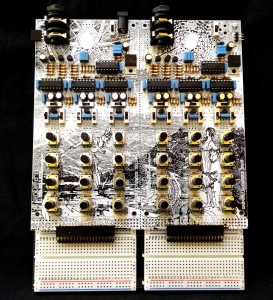
The Nova Drones offers 12 potentiometers, 10 switches, 6 oscillators, 9 oscillator sync inputs, 6 frequency modulation inputs and an epic 15 voltage outputs as well as 3 high current outputs for controlling external LEDs. All of the ins and outs have been routed to a prototyping breadboard at the bottom of the unit which allows for liberal experimentation and development of custom circuits. The prototyping area is especially useful for syncing the oscillators of 2 or more Nova Drones together.
EigenD : Free and Open Music Performance Environment
EigenD is a general purpose music performance environment that is now completely freely available and has been open-source for a few years. It has been created for the Eigenharp instruments, but was from the get-go designed as a common platform for all digital music instruments and controllers.
EigenD can be downloaded from:
http://www.eigenlabs.com/downloads/re…
The Eigenlabs forums are here:
http://www.eigenlabs.com/forum
littleBits performing Auld Lang Syne
Ring in the new year with a classic song played on your synth kit! Happy New Years from littleBits!
littleBits makes an open source library of electronic modules that snap together with magnets for prototyping, learning, and fun. Find out more at littleBits.cc
Lunchbeat groovebox – new 1-bit drum machine
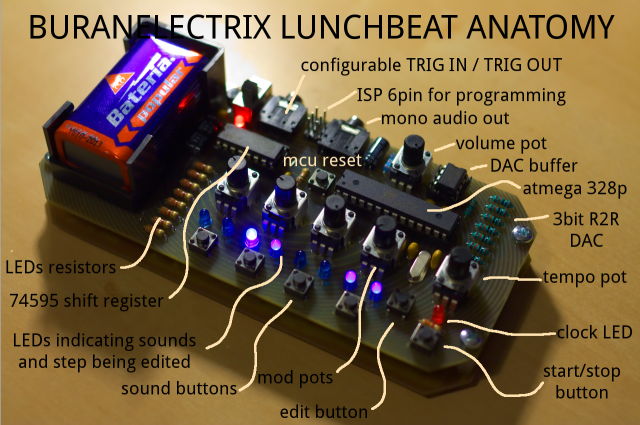
Jan Cumpelik has introduced the Lunchbeat groovebox – an ‘impossibly dirty’ 1-bit drum machine. It’s designed to be a ‘minimalistic groovemachine’ that also offers interesting lo fi sounds.
Features:
- 4 channels with 1 bit realtime generated sounds
- kickdrum, snare, hihat and bass
- 8 step sequencer
It’s an open source project. Cumpelik also plans to offer Lunchbeat kits.
Aleph – new open source all inclusive machine
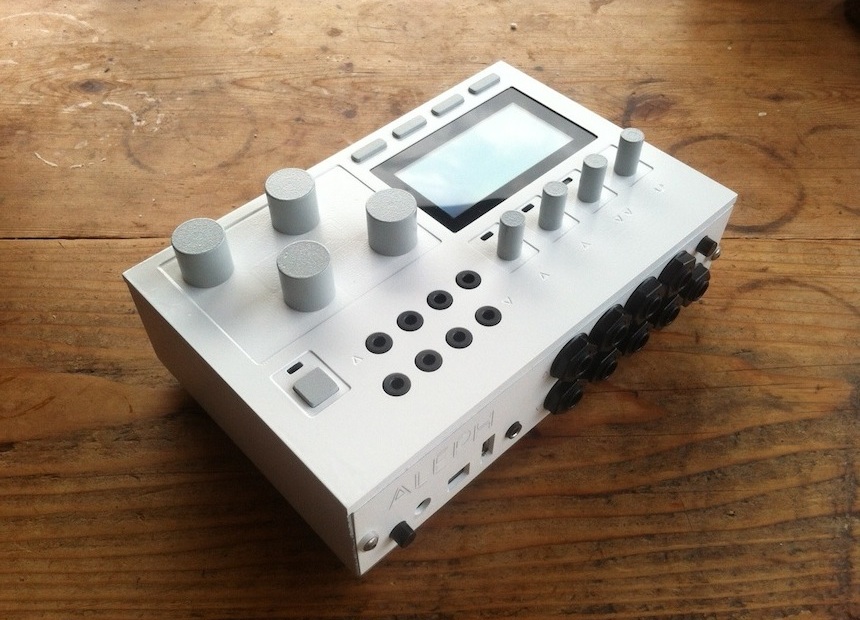
Ezra Buchla (son of Donald) and Brian Crabtree of Monome have made a Linux based open source device for “everything” called Aleph.
with connectors for monome, soundplane and shnth
100 will be made – it will be $1.4k – and it has 4 CV outputs as well.
runs BF533 DSP, programmed in C under Linux –
first in will be:
a looper,
a digital synth,
a sampler and
a drummachine
-> Forum • Aleph Crabtree/Buchla.
-> http://monome.org/aleph
filmed by emily lacy and kelli cain. edited by kelli cain.
performed by ezra buchla and brian crabtree.
microGranny – pocket-sized handmade granular sampler
Standuino microGranny is pocket sized handmade granular sampler. It uses microSD card to store samples. You can adjust many parameters of the samples and trigger them by MIDI.
more info: standuino.eu/devices/instruments/microgranny/
buy: standuino.eu/buy/buy-fraangelico/
Features:
-basic parameters of sound: pitch, crush, volume, start, cut, repeat
-micro sampling parameters of sound: shift speed, loop length, shift direction (forward,backward,random1,random2)
-lfo parameters of sound: rate, amount, destination (pitch, crush)
-instant loop feature
-micro SD card slot (plays monophonic wav samples)
-8 presets (15 sounds each)
-MIDI input (MIDI through by special connector)
-intuitive interface
-3 digit 7-segment display to keep track of editing
-2 pots to tweak the parameters
-mode switching buttons
-4 perfect response trigger buttons
-hold button
-3.5mm jack output
-volume trim-pot
-size: 11 x 7 x 4 cm
-input voltage 9-12 V
BeetBox – touching the beats
BeetBox is a simple instrument that allows users to play drum beats by touching actual beets. It is powered by a Raspberry Pi with a capacitive sensing board and an audio amplifier in a hand-made wooden enclosure.
Concept
BeetBox is primarily an exploration of perspective and expectations. I’m particularly interested in creating complex technical interactions in which the technology is invisible—both in the sense that the interaction is extremely simple and in the literal sense that no electronic components can be seen.
Enclosure
The enclosure was created from .5″x8″ poplar boards, which I cut to size and finished using various hand and power tools. I used a router for both the edge details and for grooves in which to conceal the wires, and a drill press to create the speaker grill and to bore holes for the beets with a hole saw. I then stained the wood and, after assembly with wood glue and a nail gun, sealed the enclosure with polyurethane.
Internals
Touch sensing is handled by an MPR121 Capacitive Touch Sensor from SparkFun, for which I ported existing Arduino code to Python. This board communicates with a Python script on a Raspberry Pi via I2C. The script watches for new touches and triggers drum samples using pygame. Audio from the Pi’s line out is run through a small amplifier I built using an LM386, which is based on a circuit straight from the data sheet. The amp is connected to a salvaged speaker mounted under the holes in the lid.
Source code for the BeetBox is viewable on GitHub.
Learn more at scott.j38.net/interactive/beetbox.
New open source controller
This it’s a simple demonstration of the open source FREE mudit project for more info go to muditmusic.wix.com/mudit
Muditit’s a new open source design, developed by Agustin Augustinoy & Urias Montanaro, for a hand-held music controller that lets you create and control audio using gestures.
It’s part of an explosion in experimental alternative music controllers, that’s being fed by sharing via the Internet.
NovaDroneLights
The NovaDrone was designed (and continues to evolve) in collaboration with experimental musician and epic visionary Lucas Crane aka Nonhorse and with support from Perte De Signal in Montreal.
The Nova Drone is an open source, analog experimental sound and light synth.
It it can be used to create effects ranging from slowly fading drones to chaotic harmonic sequences. It also functions as a complex visual pattern generator when combined with a digital/phone video camera. See the video below for an example of the color patterns generated by holding a camera up to the LED.
The Nova Drones offers 12 potentiometers, 10 switches, 6 oscillators, 9 oscillator sync inputs, 6 frequency modulation inputs and an epic 15 voltage outputs as well as 3 high current outputs for controlling external LEDs. All of the ins and outs have been routed to a prototyping breadboard at the bottom of the unit which allows for liberal experimentation and development of custom circuits. The prototyping area is especially useful for syncing the oscillators of 2 or more Nova Drones together.
Stacking NovaDrones!
Stack your NovaDrones! The Nova Drone is an open source, analog experimental sound and light synth.
It it can be used to create effects ranging from slowly fading drones to chaotic harmonic sequences. It also functions as a complex visual pattern generator when combined with a digital/phone video camera. See the video below for an example of the color patterns generated by holding a camera up to the LED.
The Nova Drones offers 9 potentiometers, 9 switches, 6 oscillators, 3 oscillator sync inputs, 6 frequency modulation inputs and an epic 15 voltage outputs as well as 3 high current outputs for controlling external LEDs. All of the ins and outs have been routed to a prototyping breadboard at the bottom of the unit which allows for liberal experimentation and development of custom circuits. The prototyping area is especially useful for syncing the oscillators of 2 or more Nova Drones together.
The NovaDrone is a new open source hack-able sound and light synth from casperelectronics. Learn more here:
http://casperelectronics.com/finished-pieces/nova-drone/
DATAMASKIN

