
The NovaDrone – Open source synth
The NovaDrone is an open source, experimental sound and light synthesizer available for sale as a kit or assembled unit. For more, build instructions, videos, pictures etc go to
http://casperelectronics.com/novadrone/
Checking out the new arcadish Pianocade – teaser
Demonstrating some of the features of the Pianocade, a chiptunes-style synthesizer and MIDI controller. More information (and preorder information!) at www.pianocade.com
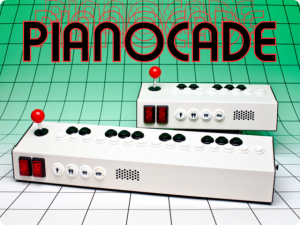
The Pianocade Synthesizer
The Pianocade is a synthesizer designed to sound, look, and feel like vintage arcade games.
The Pianocade’s built-in synthesizer is based on the sound hardware of the Nintendo NES and Game Boy (specifically, one of the square wave channels: it’s a monophonic square-wave synthesis engine with a 4-bit digital-to-analogue converter). Because it’s monophonic, it does what many early games did in lieu of chords: it cycles through the notes of the chord rapidly (arpeggiation).
Pianocade MIDI Support
The Pianocade has traditional 5-pin MIDI ports (in, out, and through) as well as USB MIDI. You can use the Pianocade to control any device with MIDI in, or control the Pianocade via an external controller or sequencer. The Piancade’s arpeggiator automatically syncs with incoming MIDI clock signals, too. You can also reprogram the MIDI messages of the joystick, coin buttons, and player buttons for a totally custom MIDI controller.
- MIDI In, Out, and Through, plus experimental USB MIDI in and out
- Integrate MIDI velocity and aftertouch into sound banks for amazing effects
- Synchronize the arpeggiator to external MIDI clock signals, with adjustable tempo
- Add “extra” controls via pitch and CC messages
- Reprogram the MIDI message sent by each control
SOUNDOR – new free Max4Live FM Synth
A quick demo of SOUNDOR, a free and open source Max4Live FM Synth for AudioCubes by Percussa, smart cubes for sound, music and visuals.
In this video, you can see how you can easily create wind and bubbling water sounds using an AudioCube, the free SOUNDOR application and a simple foot pedal. Press the pedal down to enable control of the synthesizer using the AudioCube, and release the foot pedal if you want to “lock” the sound where it is or stop controlling the sound using the AudioCube. One AudioCube can control up to 4 parameters simultaneously, using your fingers and hands. The sensors are high speed and resolution (1kHz and 10 bit).
Learn more at http://www.percussa.com/soundor/
IanniX – graphical open-source sequencer
From UPIC to IanniX
IanniX is a graphical open-source sequencer, based on Iannis Xenakis works, for digital art. IanniX syncs via Open Sound Control (OSC) events and curves to your real-time environment. This video explains how UPIC has inspired IanniX and what kind of new writings are now possible.
IanniX Features:
- Sequencer – IanniX can be used with a diversity of software and hardware tools.
- Real-time – IanniX can be modified and operated in real-time.
- Space & Time – IanniX’s graphical space spans several dimensions and time scales.
- Open Sound Control – The OSC protocol allows fast network communication.
- Open-source – IanniX is licensed under GPL 3, free and cross-platform.
- Programmable – Scripts for IanniX can be written using JavaScript to create complex and generative scores.
IanniX is available as a free download for Linux, Mac & Windows.
NOVA DRONE sound and light synth
The Nova Drone is an open source, analog experimental sound and light synth from casperelectronics.
It it can be used to create effects ranging from slowly fading drones to chaotic harmonic sequences.
The Nova Drones offers 9 potentiometers, 9 switches, 6 oscillators, 3 oscillator sync inputs and an epic 15 voltage outputs as well as 3 high current outputs for controlling external LEDs. All of the ins and outs have been routed to a prototyping breadboard at the bottom of the unit which allows for liberal experimentation and development of custom circuits. The prototyping area is especially useful for syncing the oscillators of 2 or more Nova Drones together.
*************FUNCTIONALITY****************
The NovaDrone has three separate channels which generate sound and control the brightness of the three colors in a tri color LED.
The sound and light come from the SAME electrical signal. You are literally seeing what you hear.
Each channel has:
a TONE pitch knob,
an LFO rate knob and switch,
a VOLUME knob,
2 SYNC switches and an external SYNC input.
The LFO for each channel modulates the LED brightness and audio wave shape. This uses pulse width modulation, or PWM.
The rate of the LFO can be adjusted (using a knob and switch) from around .008 Hz (around 1 cycle every 2 minutes) to 750Hz (750 cycles per second).
The TONE pitch of each channel can be adjusted from 24Hz to 750Hz. It can also be hard synced to the other channels in order to create harmonic overtones. Interesting (crazy) sync feedback loops can be created by syncing one channel to another and then back to the first (for example). This kind of configuration generates bizarre textures and sequences.
Very interesting effects are achieved by syncing the tone oscillator of one channel to the PWM output of another channel. This results in a modulating harmonic sequence.
The VOLUME adjustment controls both the amplitude of sound and brightness of the LED.
*************HARDWARE****************
Each channel has the following features:
ADJUSTABLE CONTROLS
-volume
-TONE pitch
-LFO rate
SWITCHES
-sync 1
-sync 2
INPUTS
– ext sync 3
OUTPUTS
-TONE square wave
-TONE triangle wave
-LFO square wave
-LFO triangle wave
-PWM square wave
-High current LED out for off board LEDs.
For more info including ordering info and complete schematics email pete[at]casperelectronics[dot]com or go to
casperelectronics.com
Create Digital Music’s MeeBlip SE gets easier to use and MIDI-controllable
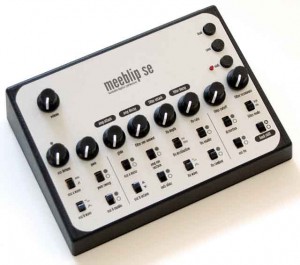
Create Digital Music are building and shipping MeeBlip SE. A spokesperson said, “Whatever the ‘SE’ stands for – seconda edizione, or a meaning of your own choosing – the MeeBlip SE is the original MeeBlip, but better. Building on the first version of our open source synthesizer, we’ve worked with feedback from users to make the MeeBlip more usable and more sonically versatile.”
New in this version:
- A more intuitive, playable control layout. The changes are subtle, but after lots of conversations with users, we worked to make each knob and switch the choice we liked best. (Of course, you can still modify those choices via our open source firmware, if you like.)
- Patch storage. Sure, it was a bit more “pure” never being able to store patches, but this is a digital synth, after all. Now, you can save and recall up to 16 patches right on the MeeBlip, using dedicated front panel load and save buttons. It’s especially nice for live performance.
- Variable pulse width. Instead of a fixed square wave, you can now use the dedicated PWM knob to adjust the timbre of the first oscillator. There’s also a “pwm sweep” switch for enabling an automated PWM envelope, of which we’ve grown rather fond. Hello, thick synth leads.
- Anti-aliasing. You can now use more pristine anti-aliased waveforms, or turn this off for other timbral effects. It gives you another option for coloring the MeeBlip’s sound.
- Control everything with MIDI. It’s simple: if there’s a sound parameter in the MeeBlip, there’s a switch or knob to play with it. And now, the reverse is true, too: if you see a switch or knob, you can control it via MIDI. At last, you can use a tracker or sequencer to program detailed MeeBlip sounds.
Pricing and Availability:
MeeBlip SE Quick Build Synthesizer: $139.95 until March 31st ($149.95 after that)
MeeBlip SE Build Everything Kit; $119.95 until March 31st ($129.95 after that)
MeeBlip micro Kit: $39.95
More information:
DODECAUDION – new audiovisual controller
DODECAUDION
a project by panGenerator / HEDOCO product.
pangenerator.com
hedoco.com
Dodecaudion is a spatial audiovisual controller based on such technologies as infrared distance sensors, arduino, bluetooth, processing and osc.
Most of the sound in this video was recorded live and edited/postproduced later on.
(you’ll find live and uncut performance played during hackdays here: blip.tv/hackdays/dodecaudion-koncert-5556815 – please mind that sound setup and recording weren’t optimal though )
The project is in alpha phase right now but should be ready for production in following months and will be available via HEDOCO online shop.
Dodecaudion is totally opensourced:
MIT license – source code.
Creative Commons (CC BY-NC-SA) – form design, PCB layout & everything else.
You’ll find source code, CAD documentation and PCB schematics on github ( please note however that they still need some cleanup, we’ll post an update soon ).
github.com/panGenerator/dodecaudion
Dodecaudion connects via Blutooth to computers. Messages are translated and retransmitted via OSC (software for Mac OSX and Windows available for download).
Included:
- Arduino Uno,
- Dodecaudion Shield rev. 2.0,
- Alluminium and polymer composites housing,
- Power source (230 V for EU continental outlets)
- USB cable (not neccesary for normal operation but handy for tinkering with microprocessor code)
It’s available now and priced at 5,000 PLN, which translates into around US $1,600.
Introducing the Chomp: the bite-sized, affordable MIDI box for creative music projects
Max Justicz has announced a new DIY MIDI controller ‘brain’, the CHOMP, that looks awesome.
Basically, the CHOMP (Configurable Hardware Open-source MIDI Platform) is a cheap board you plug switches and pots into to create custom MIDI controllers.
Features:
- Completely open-source.
- Affordable ($50).
- Compatible with ANY MIDI configuration.
- 48 Inputs/Outputs!
- Made and assembled in the USA.
- Programmable
- Tiny, only 100mm x 60mm x 25mm
Here’s what Max Justicz has to say about the CHOMP:
It has come to my attention that the world needs an inexpensive (but extraordinarily solid) MIDI controller. That’s where the Chomp comes in. With zero technical skills, you can hook up dozens of buttons, knobs, switches, and sensors to control endless parameters of digital software.
The Chomp is the first open-source MIDI controller that’s been designed right. Other MIDI controllers on the market are proprietary, difficult to use, non configurable, and most of all: expensive. The only other commercial option available ships exclusively from Europe and costs the US equivalent of $240.
But because it’s Arduino powered and completely user programmable, the Chomp is more than an awesome MIDI controller. With new code, Chomp can do just about anything: play Bach on a digital keyboard, or help you along in a live musical performance.
Hack Me Rockit synthesizer – open source analog-digital hybrid synth
Latest update:
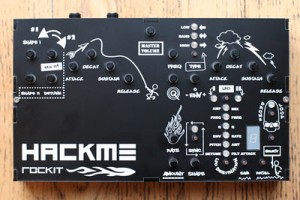
“The Rockit case is finally finished. I got the third and final prototype of the Rockit case in, put it together, and did the happy dance. I’m going to make some small adjustments for the production order, but nothing that will require another round of prototypes. I’m going to put up the case for pre-sale today. I need to hit a threshold of about 50 orders in order to buy it. The lead time from the laser cutter is three weeks, so these should ship in February. The cost will be $50.”
“Rockit is a monophonic, digital and analog hybrid synthesizer. Rockit can make one sound at a time, but it has the capacity to make very simple sounds to very complex and dynamic sounds. Sound generation begins with digital synthesis, moves through analog amplification, analog filtering, and comes out a product of both the digital birth and the analog processing. The digital synthesis is comprised of two oscillators with independent waveform selection. These oscillators can be mixed or played independently and the second oscillator can be detuned from the first in note steps. The analog amplification stage has independent envelope controls for a complete ADSR envelope generator. Rockit’s filter section is an entirely digitally controllable analog filter, meaning all filter parameters are explicitly accessible internally, via knobs and switches, and externally, via MIDI. In addition, Rockit has two Low-Frequency Oscillators for modulating various synthesizer parameters at controllable rates and amounts.
Rockit offers 18 knobs and 8 switches for controlling both the digital synthesis and shaping the analog processing. Rockit is enabled to store and recall 16 patches, storing all knob, switch, and LED settings. Rockit also has a Drone and Loop feature that allows for independent play. For inputs and outputs, Rockit has an audio output and an audio input which routes into the analog filter. Rockit has MIDI In and Out capabilities with all settings accessible via MIDI controller channel numbers. All knob movements are transmitted to the MIDI output on the appropriate MIDI channel number…”
More: http://hackmeopen.com/
MLR in Reaktor!
“The original MLR was written in Max/Msp by Brian Crabtree, inventor of the Monome. I have rebuilt his program in another language, Reaktor for many reasons: to best understand how a program works, bottom up; because I would like to see the program have more functionality, and I am more fond/capable of/with Reaktor over Max/Msp; and because Reaktor adds certain features that Max/Msp does not allow for. For one, the ability to use any program created in Reaktor as a VST, automatically in your favorite DAW.
After I am complete advancing the program the way I would like to in Reaktor, I will code it in C as a standalone program.”
opensource collaboration with no regard for national borders or trade agreements. this is grass roots interaction with the aid of the modern world.
mlrV is fundamentally based on brian crabtree’s mlr
it has been REFACTORED by trent gill with assistance from %
see: vimeo.com/2434050
GET IT > docs.monome.org/doku.php?id=mlr:mlrv
monome.org for the latest updates
DATAMASKIN

