
Moog Little Phatty emulator

Xhun Audio faithful emulators of the Moog Little Phatty VSTi have officially announced the Worldwide release of Little One 2.0. The new version will be available December 13, 2010. The new version is free for registered users. The main improvements are are mostly within the DSP modeling side of things, GUI, and some new sound banks.
Control voltage on the Moog
djnotsomuch has shared this video tutorial Using Ableton to provide control voltage for a Moog Slim Phatty
Seeing the Slim Phatty retaining CV (control voltage) inputs I wondered how well line level voltage would work as a control source. The answer:
Pretty Damn Well!
This is a tutorial/demo on how I pulled this off and everything you need to know! The Moog (notes) are controlled via the MPK25 but the filter and pitch modulation is via the CV inputs.
Yes – Line level (analog) signal has voltage. I learned some of these tricks about a year ago – once thinking CV was far out and not so easy to gain control of – wrong.
The modulation of the SF can be controlled with amazing accuracy and synchronization using an application like Ableton. The possibilities are endless – I am still trying to understand where I would like to go with this idea. For now – you have the basic knowledge – please post back ideas and break throughs! Thx.
Supporting post : http://djnotsomuch.com/moog-slim-phat…
Line level voltage as a control source
djnotsomuch has shared this interesting demo
Seeing the Slim Phatty retaining CV (control voltage) inputs I wondered how well line level voltage would work as a control source. The answer:
Pretty Damn Well!
This is a tutorial/demo on how I pulled this off and everything you need to know! The Moog (notes) are controlled via the MPK25 but the filter and pitch modulation is via the CV inputs.
Yes – Line level (analog) signal has voltage. I learned some of these tricks about a year ago – once thinking CV was far out and not so easy to gain control of – wrong.
The modulation of the SF can be controlled with amazing accuracy and synchronization using an application like Ableton. The possibilities are endless – I am still trying to understand where I would like to go with this idea. For now – you have the basic knowledge – please post back ideas and break throughs! Thx.
Supporting post : http://djnotsomuch.com/moog-slim-phat…
Fender Rhodes + Moog Prodigy
Here’s a nice groove session with a Moog Prodigy, enjoy
Via Sketchboxx
Filatron in place of a modular synthesizer’s filter module
The Filatron in action with a modular synth
The one and only Moot Booxlé (now with less hair) demonstrates how you can use Filtatron, the amazing new iPhone app from Moog, in place of a modular synthesizer’s filter module.
This is made possible by another product – the iRig from IK Multimedia, which finally gives iPhone users a clean, uncomplicated way to input and output signals.
Other upcoming videos include:
– Using Moog Filtatron/IK iRig with guitar through an amp
– Using IK Amplitube + iRig with Rhodes electric piano.
The intro and ending music is “Space Theme” by Moot Booxlé.”

The Thor goes Moog !!!
SoundCells has introduced something that I personally believe will be a classic: Thor Source Version 3 – the Moog Source ReFill

“Thor Source V3” – when Thor first saw the light of day Soundcells couldn’t resist to test his strength by comparing him to a well known classic from Moog: the Source. Thor’s modular design gave them the chance to rebuild the Source’s details with great accuracy. Then Soundcells copied their favorite Source patches with great ease into Thor and after this they managed to take those sounds numerous steps further. The sounding results however stayed amazingly close to the Source’s character. In this ReFill’s documentary folder you’ll find proof of this. Thor makes the Source polyphonic and velocity sensitive as well. By now you’ll understand that this ReFill goes way beyond only emulating the past. Thor Source offers deep and fat basses, retro and nu style leads, wonderfull keyboard sounds, mouth watering pads, analog drums and more. Version 2 added four sampled raw oscillator settings from the original Moog Source, new combinator patches and new backdrops – with version 3 this ReFill comes with even more samples from the Source…
And let´s not forget to mention the 25 new version 3 combinator patches based on those new samples.Those will be there to give your music an extra greasy analog retro-Moog-bite.
Tweak the rebuild Source sounds in whatever direction using Thor´s tools or just “build” your own Moog Source while using the raw oscillator samples and/or the sampled Source sounds embedded within our NNXT patches. Please always take your time to try every button and knob as well as the Modwheel to get a good taste of all flavours these 214 fine combinator patches will present you with!
Thor Source Version 3 Contents:
– The 25 original documentary patches as described above plus 25 contemporary velocity versions of these patches
– 25 legato versions of the documentary patches, and also 25 legato versions of the contemporary velocity patches
– 69 “processed” combinator patches making full use of Reason’s devices like the RV7000, the Scream and other gear.
This folder is subdivided into 4 sections: bass, keys & leads, misc and pads.
– 45 combinator patches based on the sampled raw oscillator settings and the fully sampled Source sounds which were
added to version 2 and version 3.
– 35 new and grooving rex loops.
A web address to link to for more info and “Thor Source V3” only MP3s:
Offering price is 19,90 ,- EUR per Unit (normally 29,90 ,- EUR)
New software synth that offers 3500 ”legendary classic synthesizer sounds”

Arturia Analog Laboratory is a new software synth that offers 3500 ”legendary classic synthesizer sounds’, along with the ability to edit each of them in depth.
Main Features:
- 3500 synthesizer sounds selected from the Arturia Classic Synths (minimoog-V, Moog modular V, CS-80V, Prophet-V, ARP2600 V and Jupiter-8V).
- Full screen preset editing (for owners of Arturia Classic Analog recreations only): Analog Laboratory allows opening any other Arturia Classic Synth plugin for in depth patch edition in a separate window. It is also possible to assign any of the 4 key parameters of the Laboratory to one knob of choice inside the favourite software synthesizer.
- Scene mode: It allows to:
- Combine 2 synthesizer sounds over a MIDI keyboard in either split, layer or multi configuration.
- Assign melodic phrases based on advanced arpeggiation thanks to the library of 200 melodies organized by genres.
- Trigger Drum loops from the pads thanks to a library of 350 Rex files.
- Organize Presets view by Name, Instrument, Type, CPU usage, Favorites, or User Preset.
- Fast filter the presets to meet requirements: by Instrument, Type and Characteristics
- Midi Learn Controllers: 1 clickable encoder, 10 encoders, 8 sliders, 11 switches, 1 modulation wheel, 1 pitch bend wheel.
Arturia Analog Laboratory is expected to be released November 25th. MSRP: $299/Eur269
Chained Moogerfoogers
Quick video of our collection of moogerfoogers being chained together and used as a very basic modular synth, there’s no external signals being used , everything comes from the ‘foogers.
Teaser from the upcoming Moog show
Here’s a sneak preview from an upcoming Moogshow, including some shots of the Filatron
Check out Neon Indian experimenting with multiple filter modulations by running the Moog Filtatron into the external audio input of the Slim Phatty.
Sneak Peak at Moog Sound Lab, the new online show from Moog Music coming soon. Moog Sound Lab features artists from all genres experimenting with synthesis.
The massive wall of Moog
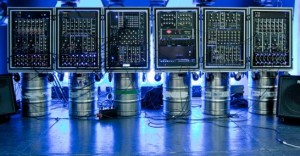
Synthesist Erik Norlander shared this massive shot, from Moogfest 2010, of his massive Wall Of Doom modular synth.
See his Facebook page for more shots of the Wall Of Doom.
Image: Shaun Hollingsworth
DATAMASKIN

