
BEATBOX – Nintendo Drum Looping Cartridge
This video neatly describes how you effectively can turn your Nintendo into a drum machine
For Sale at: http://heavyw8bit.com/nes_drum_machine.php
BEATBOX will turn your Nintendo into a playable drum machine.
Features include:
– Ability to play live and record Drum Loops & Fills.
– Each Loop or Fill can contain up to 99 key presses.
– 4 Recordable Drum Loops
– 2 Recordable Drum Fills
– 2 Drum Kits, 8 samples each
– 4 Sample Frequencies
– TV or Monitor is not required.
– Works with original Nintendo controllers
Teaser: Netduino with MIDI shield and touch screen
This video shows a Netduino connected to a Arduino MIDI shield and a Nintendo DS touch screen. X controls filter cutoff and Y controls filter resonance, that in combination create some quite dramatic effects. Of course and MIDI control can be assigned to X or Y. Just add some software.
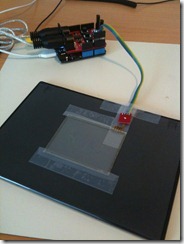
The prototype uses an off-the-shelf MIDI shield and a Nintendo DS touch screen connected piggy back on the shield.
The Netduino runs a simple “convert X/Y touch values to MIDI control changes” application. Right now it sends volume as X and modulation (in practice vibrato) as Y, but that’s easy to change in the code. If no finger is touching the screen the last setting will stay. I also filter so that MIDI data is only sent when there’s an actual change in any direction.
The touch screen is not very sensitive, but works as a demo of what can be achieved with no additional electronics beyond what’s mentioned and very little software too.
Music for a little Robot
KORG DS-10 is a music creation program for the Nintendo DS that emulates the Korg MS range of synthesizers. The DS-10 creates sound with two analogue synthesizer emulators, each with two Voltage-Controlled Oscillators (the Korg MS-10 had only one VCO). The VCOs feature a sawtooth, a pulse (with a non-modifiable pulse width), a triangle and a noise waveform. There is also a four part drum machine that uses the same sound creation techniques as the synthesizers. The sounds made by each of the synthesizer emulators are modified using virtual knobs to change the value of standard synthesizer parameters such as cutoff frequency and waveform shape. Additionally there is a screen where users can patch certain parameters to be modified by an LFO, the envelope generator, or VCO2. Those new to Korg synthesizers may find the original Korg MS-10 Manuals[4] useful in understanding the function of its components.
In this video:
100% Korg DS-10 European version (no PLUS version)
Flipnote Studio on Nintendo DSi XL + Nintendo 3DS
video recording: JVC Everio GZ-HM330
sound recording: Lenovo Laptop + Audacity
Until now I checked out Nintendo DSi music applications like RYTMIK, Rhythm Core Alpha, Music On: Drums and Music On: Retro Keyboard. This time I tried to make music with Korg DS 10.
Playing virtual instruments live with intendo Wii controllers
Organised by composer Ondrej Pochyly, with funding from the National Arts Council and sponsored by Time+Space, The Exeter Classical Music Event will take place on 2nd July 2011 in the courtyard of Exeter Castle, Devon.
For computer musicians, Ondrej Pochyly´s performance of his ´Requiem for the Lost´ will no doubt prove to be one of the most interesting events of the day as he conducts an entirely ´virtual´ orchestra using Nintendo Wii remotes to control the tempo and dynamics.
See how he has created the Requiem and which virtual instruments he has used in this video including Cinesamples VOXOS and Vienna Symphonic Library products…
More information about the event can be found at:
http://www.timespace.com/events
“Nintendo EP” Free Download and Video
AfroDJMac is a persistent man who made a promise to post something every week and so far he’s keeping that promise. Nintendo Entertainment System is the sound source for this cartoon for New York based AfroDJMac’s “Yea Yea Yea.” This animation was created for the Nintendo EP, an album made up of songs created with an NES.
The Nintendo EP is a collection of songs I’ve made over the years, using my Nintendo Entertainment System as a sound source. Some of these songs have since seen many different incarnations, such as the surf rock take that was Psycho Rainbow, but these are the original versions. Sometimes you are inspired to make music because of thoughts, feelings, other songs you like, etc. These songs were inspired by the sound of the Nintendo. Those familiar timbres are what really got these tracks off the ground, and from there the other aspects of songwriting were applied. You’ll hear guitars, basses, and drums, but I don’t think these songs would have come to life without our little grey 8-bit friend. Please feel free to download the EP and show your friends, put it on playlists, add to your blog, and give it to your uncle Otis who happens to have major connections in the music industry

Ableton Live instrument rack created with the sound card of a Nintendo Entertainment System
Chip Tune aficionados and video game lovers rejoice; this weeks Ableton Live instrument rack was created with the sound card of a Nintendo Entertainment System, accessed via WayFar’s MidiNES. (awesome piece of gear… http://www.wayfar.net ) It contains a pulse wave channel and a triangle wave channel. True to the original NES with some extra features. Very warm, familiar, gritty, dirty, and nostalgic.
Dirty, lo-fi, 8-bit, nostalgic. This weeks Ableton Live Rack was created with the sound card of a Nintendo Entertainment System. Maybe it’s just because I grew up spending more time playing video games than I’d ever admit, but the bleeps and blips that come from this magical machine have a warmth and familiarity that hits home. The samples that make up the virtual instrument were made by connecting a MidiNES cartridge to a Nintendo and sampling certain notes.First, allow me to explain how the Nintendo’s sound engine works… There are five channels in total: 2 pulse wave channels, 1 triangle wave channel, a noise channel, and a sample channel. They are all monophonic, but each can play simultaneously, for a total of five sounds at once. Considering the limitations of the NES, listen back to the music from some games (like Super Mario Bros. or The Legend of Zelda for example) and I think you’ll agree, it’s quite a show of the composer’s creativity and songwriting skills.
So, what I am giving you are the Pulse wave channel and the Triangle wave channel. The triangle wave channel does not offer much in the way of expression (not even volume control), but the pulse wave has four different duty cycles. I have sampled all four. I should also mention that there’s a lot of buzz that comes out of the Nintendo, so I applied a De-noiser to clean things up a bit. I personally don’t think that the integrity of the sounds is affected; this synth is still pretty gritty.
Here is the download link for the rack.
Nintendo MAX Synth
Nintendo MAX controller square-wave synth with TURBO modulation.
http://www.HandmadeElectronicInstruments.com
Packy Plays Tetris – with a Nintendo Guitar
Packy Lundholm (lead guitarist for I Fight Dragons) plays Tetris in various locations around Chicago. Then things get a bit crazy.
Also his guitar is made from an actual Nintendo Entertainment System (NES).
“As always, you can get a free song at www.ifightdragons.com/free!
And if you live in the Chicago area, come see us play live @ Lincoln Hall on Thursday, 3/31. It’s all ages, and we’ll definitely be using this guitar 
http://www.lincolnhallchicago.com/
PR8 – pattern-based drum machine that runs on a Nintendo Entertainment System
PR8 is a 6-track, pattern-based drum machine that runs on a Nintendo Entertainment System, designed and created by Neil Baldwin. PR8 is unlike any other NES music application in that it uses ‘virtual’ tracks that are not explicitly linked to any hardware voice. As a consequence, sounds in PR8 (and by association, each Track) are able to simultaneously use any combination of all five of the NES’s sound-generating voices and a simple priority system is employed to dynamically determine which of the 6 tracks have control over them. Even though PR8 is referred to as a ‘drum synth’, it is also possible (and quite easy) to create melodic instruments and patterns, though the entry and editing of musical notes is a little more abstracted if you’re used to traditional sequencers or trackers. Because of this rather radical approach, the learning-curve for PR8 might be a little steep but patience will reward you with a pretty unique and fun way to create NES music.
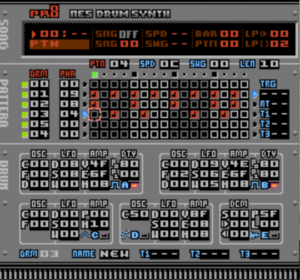
Amazing drum machine-like softare PR8 for the NES has been finally released! Neil Baldwin’s long awaited new software, running on Pulsar’s engine, has seen its first public release in a romantic today. Only two emulators run this baby so you better get your NES and Powerpak ready for proper action!
Square-wave synthesizer built into a nintendo controller
Two square-wave oscillators built into a NES advantage controller with turbo below
DATAMASKIN

