
The Roland SH-2 Experience
The Roland SH-2 analog monosynth was a kind of SH-101 but with an extra oscillator and no sequencer – very much with the livery of the SH-09 – which is a nice bass monosynth
Demo of the Roland SH-2 vintage analogue synth. Driven via cv using kenton midi to cv converter and midi sent from Orion daw. Fx indicator on top left visible when used.
Delexia by AnalogResistance ( System-100m & SH-101 )
Self evolving drone. Was recorded in just 1 shot. Containing a 2 191J system and a SH-101. Effects used during recording are: Eventide H949, Roland RE-201, Fostex 3180, Ibanez AD-202 and a UE-405
Roland MKS 80 Super Jupiter – Overview
The MKS-80 is basically a refined Jupiter 8 in a module. It is called the Super Jupiter and it is very fat and very analog!
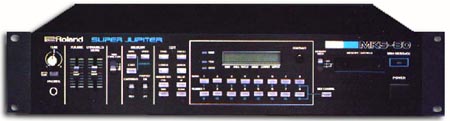
Its great sound is due in part to the classic analog Roland technology in its filters, modulation capabilities and a thick cluster of 16 analog oscillators at 2 per voice. It comes in a 2 space rack-module – no keyboard here. Tons of editing capabilities, although editing is tedious. It’s got all the classic sounds of the Jupiter synths and so much more. An excellent choice for ambient drones, pads, blips, buzzes and leads.!
The Jupiter-8 is an 8-voice polyphonic analog synthesizer. Each voice features two VCOs with cross-modulation and sync, pulse-width modulation, a non-resonant high-pass filter, a resonant Low-pass filter with 2-pole (12 dB/octave) and 4-pole (24 dB/octave) settings, an LFO with variable waveforms and routings, and two envelope generators (one invertible).
Features include adjustable polyphonic portamento and a Hold function for infinite sustain of notes and arpeggios. A versatile arpeggiator can be synchronized with external equipment by using the proprietary Roland DCB interface, clock input via CV jacks on the rear panel, or one of the aftermarket MIDI kits from Encore or Kenton. An assignable bender can be used to control pitch or filter frequency.
From the factory, the JP-8 could store 64 patches. Patches could be stored to, or loaded from, a standard analog tape/cassette. The Encore JP8MK MIDI kit doubles the patch memory to 128 and enables the JP-8 to store and recall patches over a MIDI connection, using a computer with sysex utility software.
Accelerator goes Analog
Here is a Single patch on the Accelerator that attempted to replicate the sound of a Roland Jupiter-8. Chords were played over a sequenced portion of the same patch.
With clever programing a digital synth can sound really analog.
Time machine: Roland SH-101 demo
Vintage synthesizer demo by RetroSound.de
Roland SH-101 and TR-606
FX: EHX Small Stone phase shifter
no delay and reverb added!
I deleted the video last year with some others but my good friend from down-under Michael missed it. 😉
he said: “Thank you Marko for introducing me to the world of analog synthesizers, this was the first tech demo I heard from you and to this day it still makes my ears bleed more than a virgin on prom night!”
😀
here is it in higher audio resolution.
more info: http://www.retrosound.de
AteOhAte Mutant TR-808 Cowbell DIY project — Demo
The AteOhAte Mutant Cowbell is a DIY (do it yourself) TR-808 Cowbell module based on the analogue circuit in Roland’s famous drum machine. The circuit has been adapted for use in a modular synthesizer, and, while being able to create the same sounds featured on the 808, can also create other sounds thanks to the modified tunable oscillators and voltage control over the cowbell’s pitch.
You can build one yourself at home (along with many other x0x-based drum modules) once PCBs are available from me at hexinverter.net
I will be releasing the AteOhAte Mutant HiHats at the same time as this project.
Receive an email when PCBs are available by signing up for the mailing list here: http://eepurl.com/pDf_5
Visit the Muffwiggler forum thread for updates on the project: http://www.muffwiggler.com/forum/view…
Modular synthesizers: Roland 100M in action
The System 100m is Roland’s contribution to professional analog modular synthesis. It was based on the more limited, semi-modular System 100, but is several steps of ahead of its predecessor. The System 100m offers over 20 modular components to pick and choose to design a custom modular set-up. The Main unit is the M-110 which has a single VCO oscillator, VCF, and VCA section. You can then build upon this system adding any number and configurations of the various other modules which include dual VCOs, ring modulators, dual VCFs, eq, dual VCAs, dual envelopes, LFOs, various effects, mixers, sequencers, and control interfaces including 3 different keyboard controllers.
Modules are assembled into racks. The System 100m has 3 rack sizes, the M-190 holds 3 modules, the M-191 and M-191J hold 5 modules. Each rack provides the necessary 8-pin DIN power connectors and internal CV/gate connections between the modules. You still need to do some external patching, however, to send your signal through the modules of your choice to create any sounds. As for sounds, the System is basically monophonic, unless you get several racks of them for lots and lots of money! Its sound is not as warm as the System 100 before it, but it offers much more capability.
analog delays on the roland 100M. see http://myblogitsfullofstars.blogspot…. for more
ROLAND MC-4 performing YMO’s RYDEEN
MODULAR SYNTH MC-4 LINN LM-2 ULTSOUND DS-4
The Roland MC-4 MicroComposer was an early microprocessor-based music sequencer released by the Roland Corporation. It could be programmed using the ten key numeric keyboard or a synthesizer keyboard using the keyboards control voltage and gate outputs. It was released in 1981 with a list price of US$3,295 (¥430,000 JPY) and was the successor to the MC-8, which in 1977 was the first microprocessor-based digital sequencer.
This sequencer was released before the advent of MIDI, and viewed by some composers to have more accurate timing. The MC-4 has an output patchbay to the right of the control panel, allowing you to patch the MC-4 to a synthesizer using 3.5mm patch cords. There are four channels of outputs containing CV-1, CV-2, Gate and MPX (multiplex) to control four separate synthesizers.To the left of the output patchbay there are two switches and a control knob. The control knob alters the tempo of the sequencer. The first switch is for cycle mode (which allows the programmed sequence to repeat continuously until the sequencer is stopped), the second switch is for sync control. The MC-4 can be synced to other Roland equipment such as a drum machine or another MC-4 MicroComposer (offering eight separate channels of sequencing).
Hands on with Jupiter-50 – Pads & Synths
A demo of some of the pad and synth presets in the Roland Jupiter-50 synthesizer.
See some of ‘keybdwizard’s’ other demo videos for examples of other patches such as pianos, electric pianos, organs, bells, guitars, etc.
Roland Jupiter-50 demo videos are here:
http://www.youtube.com/playlist?list=…
Yamaha MOX6 demo videos are here:
http://www.youtube.com/playlist?list=…
Omnisphere demo videos are here:
http://www.youtube.com/playlist?list=…
DSI Prophet 08 demo videos are here:
http://www.youtube.com/playlist?list=…
Access Virus TI demo videos are here:
http://www.youtube.com/playlist?list=…
Moog synthesizer demo videos are here:
http://www.youtube.com/playlist?list=…
Korg Micro X demo videos are here:
http://www.youtube.com/playlist?list=…
Korg M3 demo videos are here:
http://www.youtube.com/playlist?list=…
Roland XV-5050 demo videos are here:
http://www.youtube.com/playlist?list=…
Roland JV-1080 demo videos are here:
http://www.youtube.com/playlist?list=…
Various software synthesizer demo videos are here:
http://www.youtube.com/playlist?list=…
DSI Mopho demo videos are here:
http://www.youtube.com/playlist?list=…
Time machine: Demo song featuring the Roland Juno-106
Vintage synthesizer demo track by RetroSound
“Analog Days”
all synthesizer sounds: Roland Juno-106 Analog Synthesizer (1984)
drums: Roland TR-707
recording: multi-tracking without midi
fx: a bit reverb
more info: http://www.retrosound.de
Info about the synth:
The Juno-106 is a very common and widely used analog polysynth. It continues to be one of the most popular analog synths due to its great sound and easy programmability. It was the next major incarnation of the Juno-series, following the Juno-60. While it has virtually the same synth engine as the Juno-60, the 106 added extensive MIDI control making it one of Roland’s first MIDI-equipped synthesizers. There was also increased patch memory storage, up to 128 patches instead of the 56 patches available in the Juno-60. However, the Juno-60 is often said to have a slight sonic edge over the more advanced 106. The 60 had the ability to modulate oscillator pulse from its envelope and has a “punchier” sound quality.
The Juno-106 is a six-voice polyphonic and programable analog synth with one digitally controlled oscillator (DCO) per voice. While classic monophonic synths used two or three oscillators to create a fatter sound, the Juno-106 uses built-in Chorus to fatten up its sound to dramatic effect. The nature of its DCO meant it was stable and always in perfect tune but still warm and analog. There is an excellent 24dB/oct analog lowpass filter with plenty of resonance and self-oscillating possibilities and a non-resonant highpass filter. The programable pitch/mod bender can be assigned to control the DCO pitch, VCF cutoff, and LFO amount all at once or individually.
The Juno-106 was the first MIDI equipped Juno and its implementation is quite good. There are 16 MIDI channels available and MIDI SysEx data can be transmitted/received from all the sliders and buttons for total remote control and sequencing capability. A switch on the back of the keyboard, next to the MIDI ports allows the user to switch between three types of MIDI modes: Keyboard and Hold data only; Keyboard, Hold, Bender, Patch selection data; or All data (including SysEx). Most users simply set it to MIDI Function mode 3 and forget it.
This synth is incredibly straightforward and very powerful. It’s SH-series derived panel layout is easy to understand and very hands-on. Use it to generate lush pads, filter sweeps, and funky bass lines and leads. The Juno-106 is an awesome learning tool for anyone new to analog synthesis, as well as an electronic musician’s dream for its warm analog sounds coupled with modern features like MIDI and memory – all at a very reasonable price. And still the Juno-106 has an even cheaper alter-ego in the form of the HS-60 – a hobbyist version with built-in speakers.
DATAMASKIN

