
Aligning the Deamon – Monolake
Track taken from Monolakes new album Ghosts released on February 27.
Robert Henke explains:
“The album was composed, edited and recorded and mixed entirely in Ableton Live and the synthetic sounds are the results of tweaking the Operator, Simpler, Sampler and Live’s audio effects, my Max4Live synthesizer ‘Granulator’, a bit of convolution reverb and a lot of Live’s own reverb. An important role in the sound design also played the creative usage of Live’s various time stretch algorithms. The ‘Tension’ synthesizer’s physical model of a violin string bombarded with rapid parameter changes sent from a Max patch is responsible for the odd sounds on ‘Phenomenon’. Other important contributions to my sonic universe come from my collection of vintage hardware synthesizers: Resonant timbres of a Sequential Circuits Prophet VS on ‘Afterglow’, bell-like sounds of a NED Synclavier II on ‘Foreign Object’, various timbres from a Yamaha DX-27 piped through an Alesis Quadraverb and a Lexicon PCM-80 reverb, pads from a Oberheim Xpander and more I forgot about. Very essential for my creative process and for the incredible fun whilst working on this album were my newly acquired Strauss SE NF-3 studio monitors. One of my best purchases ever. The entire album was recorded in 96kHz and only the final master files were down-sampled to 44.1k for the CD / mp3 releases.”
Longing for summer: Vladislav Delay – Levite
Track Levite taken from Vladislav Delay’s latest album Vantaa. Released by Raster-Noton.
Even though complex electronic manipulations are used, Vladislav Delay wants to sound like a piece of nature, resulting in a mixture of techno/dub and organic textures. The tracks oscillate between a decadent, greyish, post-industrial sound cloud and the intimate atmosphere of a vast and desolate finnish landscape. Vladislav plays with tiny rhythmic bricks that drift and collapse, but nevertheless create spaces that radiate calmness and tranquility. Being an experienced producer, he uses his know-how to layer compact sound fabrics in unusual ways. In this case, these elements arouse associations with gushing water, crackling wood, or growing grass. The tracks on Vantaa merge into each other and their density escalates with „lauma“ into an energetic climax, which is all at once the ecstatic, shamanic and truly moving peak of the album.
New album by skweee wizard Daniel Savio – Daniel Savio
In 2012 the news are worse than ever. Yet among the last of the non-detuned hardware synths available to man, Daniel Savio remains restless and full of artistic zeal. From the sometimes-open window of his studio apartment in Stockholm, a humming and hissing sound brings the promise of spring. Indoors, the air lies thick with sequences reminiscent of turn of the century Flipmode Squad and some of the coldest waves to ever have spread from the Arctic Circle. All from the mind of what his management team and label still consider the third original member of Kraftwerk.
With the coupling of Sweden’s most beloved synth wizard, a Norwegian fast-forward thinking label and a Finnish mastering team – the release of Daniel Savio’s self titled, third album is a Pan-Scandinavian cultural event. With two critically acclaimed solo albums already behind him, Daniel Savio has grown a reputation as perhaps the finest, most mind shocking electronic beatmaker to come out of the Nordic countries. Widely regarded as the inventor of skweee music (as in “squeezing” as much as possible from lo-fi instruments), Daniel’s music continues to find paths beyond conventional hip hop arrangements.
– Stefan Kragh
 ”
”
Check it out on Spotify!
Propellerhead Software – Closer look at Figure
This iPhone app is like a mini-Reason. The combination of super-bright screen in a dark room freaked out my camera, but the description and audio get the point across.
All the details on the new workstation – AudioStation
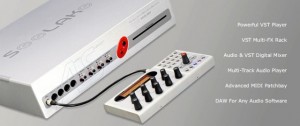
The Seelake AudioStationis a all-in-one audio workstion, combining a powerful CPU, multiple audio and MIDI inputs and outputs and microphone preamplifiers in one device. AudioStation can be used in many situations both live and in the studio, thanks to the integration of a powerful CPU, multiple audio and MIDI inputs and outputs, microphone preamplifiers and an operative system expressely built and tailored for real-time audio signal processing and compatible with every audio application written for Windows.
AudioStation functions:
- Powerful Multi-Instrument VST Player
- VST Multi-FX Rack
- Advanced MIDI Patchbay
- Performance Digital Audio Recorder
- VST and audio Digital Mixer
- Multi-Track Digital Audio Player
Main features:
- Powerful processor
- Large RAM memory
- 1 or 2 large hard disks
- DVD writer
- Main Operative System expressely built and optimized for audio signals, based on Microsoft Windows kernel and compatible with any musical application written for Windows.
- AudioStation software Audio and VST Mixer-Host integrated in the operative system.
- Completely independent additional operative environment, to use AudioStation like a traditional computer for word processing, graphics, web or any other, with no risk to the AudioStation audio/musical functionality.
- operative environment for the maintenance of the device, where users can: restore factory defaults; clone installations into the (optional) backup hard disk and vice versa; wipe the file system in case of shocks or free falls
- Audio system with 10 I/Os and high quality converters
- MIDI system with 8 I/Os and ultra precise timing
- Live Control remote controller for controlling AudioStation in live performances with no need for monitor, keyboard nor mouse
Specifications below. See the Seelake site for details.
Features
CPU:
- Quad-core latest generation processor (updateable)
- 4 GB RAM Memory
- 1TB SATA 3 Hard disk, 7200 RPM (updateable)
- Dual layer DVD writer, with slot-loading mechanisms
- PS/2 connector for PS/2 keyboard and mouse (not included)
- 3 Video connectors for hooking up 1 or 2 displays (not included):
- 1 D-Sub 15 for VGA connections
- 1 DVI-D for digital monitor with resolution up to 1920×1200 (DVI to VGA adapter not supported)
- 1 HDMI for digital monitor with resolution up to 1920×1200
- 6 USB connectors:
- 4 USB 2.0 type (USB 1.1 compatible)
- 2 USB 3.0 type (USB 2.0 compatible)
- RJ45 connector for Gigabit LAN.
Optionals:
- 1TB or 2TB Backup hard disk, can be used in case of fault of main hard disk (must be factory installed)
- 2TB main hard disk (must be factory installed)
- 256 GB or 500 GB Solid State Disk (SSD) (must be factory installed)
Audio/MIDI System:
- 4 high quality microphone preamplifiers (in analog inputs 1-4), each one with:
- Adjustable gain over 60dB
- Signal and clip LED
- 48V Phantom power with activity LED
- 8 analog inputs:
- Inputs #1-2 with combo connector XLR+TRS 6.3mm jacks
- Inputs #3-4 with combo connector XLR+TS 6.3mm jacks
- Inputs #5-8 with TS 6.3mm jacks
- 8 analog outputs with 6.3mm TS jacks
- +4dBu/-10dBV signal level can be adjusted via software individually, for inputs and outputs
- Stereo digital coaxial S/PDIF input
- Stereo digital coaxial S/PDIF output
- Word Clock I/O for sample-accurate syncing of external digital audio devices
- 8 MIDI I/Os (2 I/Os on front panel and 6 I/Os in rear panel), 128 MIDI input channels and 128 MIDI output channels
- LiveControl safe connection plug
Live Control:
- Alpha-numeric backlighted 2×20 characters display
- 10 encoders:
- 9 endless rotative
- 1 endless rotative with push
- 22 enlighted buttons
- Main unit safe connection plug
Time Machine: Roland Jupiter 4
A voyage into the heart of the Roland Jupiter-4 from the year 1978.
The first Jupiter synth. It was among one of the first poly synthesizers (4 individual voices which could be synced together for one fat monophonic lead), it had a pitch wheel that could be assigned to the VCA, VCF, VCO or all together, there are 8 memory locations and a cool arpeggiator – the arpeggiator can in the Duran Duran classic, “Rio”. It also has a very slow LFO for those ever-so-long filter sweeps. Pretty good for 1978!
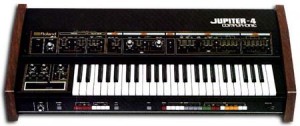
Not so cool however, are the 10 preset sounds which sound nothing like the piano, brass or strings they claim to be. The placement of all the preset buttons below the keyboard can be inconvenient, especially while playing it. And as with most old analog synths, the Jupiter 4’s tuning can go out often. Still it is a nice analog synth for creating weird trippy analog sounds.
4 Voice Polyphonic and Unisono Mode
1 VCO I 1 Sub-VCO
LFO – 1 LFO
Filter – lowpass with ADSR envelope
2 Envelopes
Arpeggiator
Chorus
It has been used by Vince Clark, Depeche Mode, Vangelis, Human League and many more!
Introducing the BASE Pack for Animoog
The BASE Pack is born from a quest Moog engineers embarked on with help from researchers at The University of North Carolina at Asheville to discover the most primordial sounds known to man. The result is the Biomimetically Augmented Synthesis Expansion Pack (BASE Pack) for the Animoog synthesizer. The BASE Pack is a collection of timbres and presets that radically extends the sonic capabilities of Animoog from the purely electronic realm of its Moog ancestry into a richly organic world of biological sound.
In addition to the over 40 new Timbre files, Moog recruited top sound designers to craft 25 powerful new presets which demonstrate the range of BASE sounds that Animoog can now emit. Some of the Presets included are Extravasation, Eructations, Bad Beans, Bathtub Bubbles, and Oops Sorry Excuse Me. Some of the Timbres included are Sploot2, WetGas1, Dribbly, WetSquish2 and Excuse Me.
Animoog is available for the iPad, iPhone 4, and iPod Touch in the iTunes Store. Animoog version 1.0.2 includes the new “Animoog Store” where users can purchase new Timbres and presets from within the app itself. The BASE Pack is only the first in a series of wide-ranging, boundary-pushing sonic updates to come.
For more information on the BASE Pack go to:
http://www.moogmusic.com/products/apps/base-pack-animoog
MixEmergency – What’s new in 2.0
http://www.inklen.com/mixemergency – Introducing MixEmergency 2.0.
MixEmergency is a unique visualisation application capable of being controlled by Scratch Live. It allows the user to mix, scratch and record video and visualisations in real-time. MixEmergency’s powerful controls and high-performance rendering engine allow users to quickly and easily add stunning effects and transitions to their mix. A free time-limited demo version is available for download. Download and try the demo today.
DATAMASKIN

