
Moog Source – the 15 classic factory patches
Moog’s Source was their first to offer patch memory storage as well as some other new features. It boasted 16 memory locations so you could finally save and recall your synth patches. A casette-tape jack was also implemented to transfer your patches to and from an external tape and free up the on-board memory for additional new patches. But in an effort to modernize with the eighties, the Moog had replaced all buttons, knobs and sliders with flat-panel membrane buttons and a single data-wheel assignment format. At the time, this may have seemed far-out, but in all actuality it is the Source’s downfall.
Parameters are edited not with hands-on sliders and knobs but by assigning a selected parameter to the dedicated data wheel. This is very tedious and does not allow for true hands-on tweaking during performances nor can you adjust different parameters simultaneously or while playing. These days, the membrane buttons don’t always seem to work quite right either. However, those famous monophonic Moog sounds are still inside this synth which has two fat analog oscillators and the legendary 24 dB Moog filter.
The factory patches of the Moog Source, classic mono from 1981
0:10 Program 01 – LEAD 1
0:32 Program 02 – LEAD 2
1:00 Program 03 – HORN
1:31 Program 04 – FLUTE
2:04 Program 05 – CLAV BASS
2:24 Program 06 – VIBES
2:46 Program 07 – STRING BASS
3:07 Program 08 – HARPSICHORD
3:30 Program 09 – ORGAN
4:05 Program 10 – TRILL VOICE
4:54 Program 11 – TAURUS
5:36 Program 12 – SYNTHEVOX
6:29 Program 13 – SAX
6:55 Program 14 – WIND
7:22 Program 15 – SNARE DRUM
7:40 Program 16 – Bonus – modern Electro House synth sound
Buchla 100: Eighty Seconds
First exploration with an original Buchla 100. For better audio go to:
https://soundcloud.com/user7621213/bu…
The first major synthesizer by Buchla was the modular 100-series produced from about 1963 to the early 1970’s. The system usually consisted of a large wood case with room for a bunch of modules (up to 25 modules on a single power-supply). Although the modules consisted of your basic collection of voltage controlled oscillators, filters, etc. the unique keyboards on this and other models to follow were flat capacitance-sensitive touch-plates. Although they may feel awkward to play, they are pressure sensitive and individually tuneable. There were also 8- and 16-step analog sequencer modules available. Patching and programming a Buchla 100 was a monstrous task since lots of patch cords as well as synthesizer knowledge were a requirement to even get a sound to be heard, and the oscillators usually drift out of tune! These are extremely rare systems but they can make some awesome and unique analog music, if it still works! About the only places where Buchla 100’s can be found nowadays are at the The Audities Collection and a few scattered Schools and Universities across the US.
Waldorf Pulse 2 Demosong
All sounds are from the new Waldorf Pulse 2, except the Kick and the HiHats.
Virtual ANS: Drawing the Music on iPad (with MIDI Keyboard)
Virtual ANS is a software simulator of the unique Russian synthesizer ANS – photoelectronic microtonal/spectral musical instrument created by Russian engineer Evgeny Murzin from 1938 to 1958.
The app is cross-platform and available for iOS, Android, Windows, Linux and OSX.
More info: http://warmplace.ru/soft/ans
Duelling iPhones – DAW app
Demo of Looptical Music Studio for iPhone, available from the App Store. For more information see: www.moocowmusic.com
Looptical is the complete music production solution for your iPhone. Record your musical ideas on the go, and mix them into a finished track there and then, or use them as the basis for a new project back at your studio.
Closer look at 70s Stringensemble Trilogy
Vintage gear demo of “70s Stringensemble Trilogy”
0.08 – 1.23 Roland VP-330 Vocoder Plus (1979)
1.24 – 2.32 Crumar Performer (1979)
2.33 – 3.53 Logan String Melody II (1979)
Used the special functions (human voices, brass filter, lfo, tone colour, chorus…) on the stringmachines.
bass: Moog Taurus 1 basspedal (1976)
drums: Keio Minipops Junior (1972)
recording: multitrack without midi
fx: a bit reverb and delay
Tabletop Inter App Audio demo
A quick look at some of the iOS 7 inter app audio (IAA) features coming to Tabletop!
Todd Barton “Unfolding the Buchla Music Easel”
http://youtu.be/U6kPTszTxvo
A recording of a lecture by Todd Barton, Musician, Composer and Buchla Guru. Filmed at Knobcon 2013. Special thanks to Todd Barton and all the sponsers at Knobcon.Sound and Video by Raul Pena.
Therevox ET-4.1 – new analog continuous pitch instrument
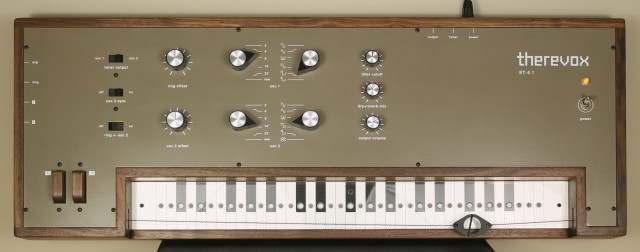
The Therevox ET-4.1 is an analog continuous pitch instrument inspired by the interface of the rare Ondes Martenot.
Each oscillator has six different waveforms, including the classic sine wave of the Electro-Theremin and the Ondes Martenot’s unique octiviant and white noise settings. Each oscillator can be tuned separately, or synched to create intervals or interesting harmonics. Oscillator 2 can also be set to a consistent note or used as an LFO to modulate the filter. The internal low-pass filter with variable cutoff frequency is used to shape the sound and this can also be controlled with an external expression pedal or CV source.
Details and Specifications
- Two independent temperature compensated analog oscillators with sync function
- Six octave positions for each oscillator covering C0 to C8
- Six waveforms (sine, triangle, rectified sine/octiviant, 50% pulse, 30% pulse, 10% pulse (white noise on Osc 2)
- Adjustable ring with metal reinforced wire
- Replaceable reference keyboard with alternatives available (ex: lapsteel, specific scales, microtonal)
- Dual wooden pressure-sensitive intensity keys with approx. 3/4″ travel
- Low-pass filter with adjustable cutoff frequency (can be controlled by expression pedal or external CV)
- Internal spring reverb with dry+wet mix control
- “Silent” tuner output, switchable between oscillators
- Line-level (+3db) output with volume control
- Control Voltage (CV) outputs for ring position (1V/octave) and both intensity keys (0 – 10V)
- 16VAC power input
- Dimensions: 30 x 11 x 4″
- Includes: Printed manual, power supply (110-120V and 220-240V Available) and extension cable.
- Made in Canada
The Therevox ET-4.1 is priced at US $1475.
Still recommended to hold of upgrading to iOS7

Althoug we all been waiting for Inter-app audio, big players like Native Instruments and Audiobus are still urging people to hold of updating to iOS7. So, reports are still coming in stating that some (not all) apps are exhibiting audio performance issues and glitches, and that there may also be teething problems with the new Inter App Audio standard.
What’s more, one of the developers of Audiobus, the groundbreaking app that enables you to use multiple iOS music making tools together in a single project, has taken to the Audiobus forum to urge users who rely on music apps not to update yet.
Not ready
“iOS 7 audio is not ready,” he says. “There are a wide variety of bugs that are causing performance problems, crashes and other problems in a large number of music apps.”
Of course, it may transpire that if you do upgrade to iOS 7 right now, all your music making apps will work just fine. However, the best advise is to wait until your favoured apps are explicitly listed as iOS 7-compatible (which may only occur after iOS 7 has had a point release update or two) before making the jump.
As far as Inter App Audio itself goes, Create Digital Music also says that not many apps currently support it, and that it seems likely that Audiobus and JACK will remain the best options for iOS musicians who want to route audio between their apps for some time to come.
UPDATE: Native Instruments has now advised users of its apps not to upgrade to iOS 7 at this point.
DATAMASKIN

