
Yamaha RX7 Drum Machine
Quick play of the RX7, little brother of the RX5 and almost as good. First is some preset patterns and then all the sounds.
About RX7 and RX5:
Out of the eighties comes this hugely underrated drum machine—in 1986, the RX5 was Yamaha’s flagship drum machine. Although its vintage appeal may be diminished by the Roland R-8 (as well as the resurgence of the TR-808 and TR-909 machines), if you’re on a budget, this one could be for you.
The RX5 has many features that other drum machines simply do not have. Aside from all of the basics, such as pitch adjustment, level control, etc., this machine also features “Attack” and “Decay” envelope controls and two levels of “Accent” for each sound, allowing you to really change the character of any of its 24 built-in sounds. The sounds range from surprisingly real and punchy kicks and snares, to gunshots, door slams, even guitar and bass samples.
The RX5 features a RAM/ROM cartridge slot for storing custom edited sounds and loading in new sounds as well (adding an additional 28 sounds to the 24 built-in). Any sound can be assigned along the top row of pads (the bottom row are preset to the usual suspects—kick, snare, toms, hats, etc.), allowing you to customize your drum kit. Make an orchestra of handclaps, bass drums, or guitars! You can create and store up to three custom drum kits.
Another interesting feature of the RX5 is its pitch envelope. There are two simple parameters: “Bend Amount” and “Bend Rate”. With this feature, you can make any sound pitch-bend downwards or upwards, across several octaves. This effect can be stored as part of your custom edited sound at the touch of a few buttons.
Also overlooked but extremely useful are the “Reverse” and “Damp” functions. You can record a reverse crash cymbal at one point in a drum pattern, and switch back to a regular crash cymbal elsewhere in the same pattern. The “Damp” function emulates the dampening of a drum head or a cymbal choke. Many drum machines overlook these useful functions, which can really help add a touch more authenticity and nuance to your drum patterns.
The sequencer section can record up to 100 patterns with time signatures ranging from 01/32 to 99/2 in either Real Time or Step Time record modes. Real Time recorded patterns can be quantized to the nearest 1/2 to 1/48 note. Patterns can be arranged in up to 30 Songs. And Songs can be chained together to form complete performance sets. All sequence data can also be offloaded to external RAM cartridge or cassette tape interface.
It is also worth mentioning that the RX5 has a 12 channel mixer with stereo out plus 12 individual outputs. Along with full MIDI Implementation, it’s a snap to integrate into your studio. Use it as a stand-alone desktop drum machine, or hook it up to your MIDI keyboard or DAW system like a sound module for some serious drums! Sounds can be arranged for a MIDI keyboard however you please, and the RX5 will save the keyboard mapping—even if the sounds are coming from an external sound cartridge.
The RX5 was shipped by Yamaha with one additional cartridge of sounds—the “RX5 ROM”. Three additional Waveform ROM Cartridges were made to suit various genres: WRC-02 “Jazz/Fusion,” WRC-03 “Heavy Metal,” and WRC-04 “Effects.” There were also a few third-party cartridges made, containing TR-808 and TR-909 samples, but they are rather rare. If you’re looking for an RX5, try to find one with all the ROM cartridges, and maybe a “RAM4” cartridge too, as they may come in handy.
Overall, a very unique and in-depth machine, capable of a huge variety of sounds. From the nostalgic sounds that defined 80’s drum beats, to rock, metal, and electronic music. Programming a beat may not be as easy as a Roland TR machine, but it’s still intuitive tap-based recording. You will have no problem finding a place for this beast in your studio.
Nocturne for Moog Voyager
A quick improvisation. Tools used: Moog Voyager, Camel Audio Alchemy Player, Logic Pro X (sequencing and effects). Audio captured direct to camera. More at www.experimentalsynth.com
Experimental: It’s not a kettle, it’s a sound machine, boilophone
Background video description:
I get pretty into playing the kettle here, didnt realise i was in the shot.
“This is not a kettle, it is a synth. It’s a drone synth / sound machine with 3 oscillators, combined by 2 different methods of signal heterodyning to produce interstellar cosmic electronic sounds! This device makes some of the most analogue, yet raw sounds, I’ve ever made with any variations of this circuit! (my patented C493 circuit).
It has two light sensors (on each side of the kettle, towards the front) and two touch contacts on the top. Careful manipulation of these simple control methods yeilds vast and complex vistas of sonic anomalies. Wails like tuning old radios, bleeps like a gameboy, hums like a genuine analogue synthesizer; This drone synth has vast capabilities!”
Chip64 Rack Extension has been released
Chip64 brings the sound chips from vintage computers and video game consoles to the Reason rack.
Music by Tune Cooks.
Ochen K has released Chip64, described as a new synth Rack Extension that’s an emulation of audio chips from vintage computer and video game consoles.
A spokesperson told us, “Chip64 brings the sound chips from vintage computers and video game consoles to the Reason rack. Chip64 includes mathematical modeling of 5 chips: the TIA used in the Atari 2600, the SID chip used in the Commodore 64, the TA0x series used in the NES and Gameboy, the Vic-I used in the Vic 20, and the SN76489 chip used in the ColecoVision and Sega consoles. With an on-board sequencer, as well as a multi-mode filter, LFO, modulation envelope, and more, Chip64 brings true chip emulation to your rack.”
Pricing and Availability:
Available at the Propellerhead shop.
€32.00
More information:
Electro act Sadman with their new video Drama
7th July 2014 Memento Materia proudly release “Drama” EP from artist Sadman.
This EP is a brief look back at what has been with a number of remixes of their most loved tracks, together with new music providing a taste of what is to come on their new album released later on this year.
This is the video of the title track.
LinnStrument Slide Guitar and LinnStrument Cell
Roger Linn shared another sneak preview of his newLinnStrument in action – doing ‘blues slide guitar’.
The demo highlights the malleability of notes on the LinnStrument. Linn stretches and slides individual notes around the instrument, articulating the sounds expressively in ways more familiar to string musicians than keyboardists.
The LinnStrument is currently under development. Release date and pricing is still to be announced.
http://youtu.be/odk98v588rg
In this video, Beethoven’s “Für Elise” is playing in Logic Pro X as a MIDI file.
The LinnStrument is connected over USB and receives the MIDI notes in real-time. MIDI channel 1 is shown in the left split and channel 2 in the right split. Each note highlights all the possible cells that can be played to perform the same piece.
The LinnStrument automatically takes the layout, octave and transposition settings into account.
This feature provides an excellent teaching aid since it works with any existing MIDI file. By varying the speed at which the MIDI notes are sent to the LinnStrument, the piece can start slow at first and be gradually sped up.
Obviously, this can also be used for cool light effects, it’s not necessary to make the MIDI notes play sound. A separate method using MIDI CC messages is also available to directly control cell colors by coordinates without them being related to MIDI notes
Oxygene Live In Your Living Room
Enjoy
Semester – 64 Presets for iSEM – Sunsine Audio
Sunsine Audio is pleased to announce the release of Semester – 64 new presets for Arturia iSEM and SEM.
This release features thick leads, basses, creamy pads, keys and tricky arpeggios. In addition organ, brass, strings, percussion, synth patches and sequences are included as well.
Semester utilizes all the knowledge and insight gained from my personal experience beta testing iSEM with the Arturia and Tempo Rubato teams.
Contains:
• 14 Arps
• 10 Basses
• 1 Brass
• 2 FX
• 8 Keys
• 11 Leads
• 3 Organs
• 5 Pads
• 2 Precussion
• 2 Sequences
• 4 Strings
• 2 Synth
Format:
• 64 Presets for iSEM and SEM
• 1 Bank (.obsx file)
• Easy Installation Instructions
Price: $2.49
Product link – www.sunsineaudio.com/Semester-046.htm
“Shinto” – ethnic synth jam
New “ethnic” style composition using the Yamaha Motif-6 flute with delay and reverb as well as Motif-6 cymbals. Roland JV-880 is used for a classic analogue string patch and Roland D-50 patch “Juno clav” is used for the accompaniment.
Synths: Yamaha Motif 6 classic
Roland JV-1080 and JV-880
Roland S-10 sampler- midi controller for JV-880
Atom – free filter with focus on dynamic, tempo-synchronised modulation
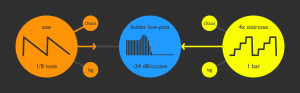
Sinevibes has released a free Audio Unit plugin –Atom. Atom is a filter with focus on dynamic, tempo-synchronised modulation. It features five different resonant filter types each with three slope settings – up to super-steep -48 dB/octave.
It has two modulators which feature multiple waveforms and run at rates from 1/128 note to 16 bars. Thanks to the chaos function which randomises the amplitude of each modulator cycle, as well as lag switch that smoothens the waveform curves, Atom allows a user to create lively, elaborate filter effects.
Atom is the first Sinevibes plugin to feature a new interface design language that is designed to cleanly present internal components and logical or audio connections between them..
Features:
- Multi-mode filter with five types and –12/24/48 dB/octave slope steepness.
- Dual modulators with eight waveforms, per-cycle chaos function and shape lag on/off switch.
- Advanced transport sync algorithm with support for tempo and time signature automation.
- Extensive use of OS X Core Animation and Accelerate frameworks for hardware-accelerated graphics and audio processing.
Price: Free.
DATAMASKIN

