
Color chaser
Who wouldn’t want the color chaser
Colour Chaser detects and follows black line whilst it reads the colour and translate the colour RGB data into sound.
Sonic Terrain will be a portal for the art, science, and craft of field recording
Sonic Terrain is a new site brought to you by the endlessly inspiring team who created Designing Sound. “Sonic Terrain will be a portal for the art, science, and craft of field recording. It will aggregate information and publish exclusive content focused on sounds recorded outside the studio. Topics will be cross-disciplinary and focused on the use of field recordings in a variety of contexts, including sound design for visual media, music, fine art, scientific research, phonography, and much more.”
Check out the first post by Nathan Moody, Portage I, discussing various scenarios for transporting and protecting your field recording equipment….

How do you generate the perfect whoooosh sound
The Kung Fu Panda Sound Team recording different types of whooshes for the film.
More at: http://designingsound.org
The mystery behind the sounds of Star Wars finally revealed in a new book
Sound designers, editors, mixers, geeks and Star Wars fans. Our day has come! Ben Burt has presented “The Sounds of Star Wars“, a new book written with J. W. Rinzler. Inside the book you’ll find all the secrets behind the making of the sound effects of Star Wars, and also includes a sound module with speaker and out connection for playback of 250 different sounds.

Guests at Celebration V in Orlando were honored with a rare appearance by legendary sound designer Ben Burtt. Burtt should be a familiar name to fans from his iconic work on all of the live-action Star Wars and Indiana Jones films. His accolades include academy awards for A New Hope, Raiders of the Lost Ark, E.T., Indiana Jones and the Last Crusade, and nominations for many more. As panel moderator Pablo Hidalgo puts it, “He’s the reason so many of us have high-end surround sound systems in our home theaters.”
Burtt came to discuss his latest book project, The Sounds of Star Wars. Written with New York Times best-selling author J. W. Rinzler, Sounds tells the intimate details behind your favorite Star Wars sound effects. From the majestic hum of a lightsaber to the lowly chitter of a Jawa, every effect has a story. This lavishly illustrated tome is more than just a book, it includes a sound module that lets you listen to over 250 original sounds from the Star Wars series in high-quality stereo as you read along.
This book has more than just sounds from the films; it also includes sounds taken from the original recordings that are only available here. It includes all of the growling and snarling recorded for the reptilian bounty hunter, Bossk, most of which was not used in The Empire Strikes Back. Burtt mixed recordings of himself growling into a microphone for most of the effects. “Paul Hirsch, editor on the film, was up to that scene where the bounty hunters are briefed by Vader. He just needed something quickly so I just went down and made that sort of snarly, vomit-producing [growl].”
It’s not just the sound designers themselves being recorded, often it’s the sound designer’s friends and family. After playing a booming, growling sound that reverberated through the auditorium, Hidalgo explained, “That is the sando aqua monster, one of the largest creatures in the Star Wars movies. Where did that sound come from?”
“That’s my lovely daughter, Emma,” Burtt beamed. “When she was about three months old, she had a growly, little cry. Of course, I recorded it because it was interesting. I thought, ‘I have to use this for a monster,’ so I slowed it way down to match the size, the mass of the creature. It’s a performance, it’s her wanting milk… or maybe a diaper change.”
Well, more than a must-have for me. What about you? Do you want to get it? If so, It’s only $60 and it’s available to buy right now at Chronicle Books.

R2D2 PHRASES
Initially, the idea was to record babies and then somehow alter their sounds. But it was hard to persuade babies to perform properly. “Once you put a microphone on a baby, they usually cry, go silent, or fall asleep,” says Burtt. “So, out of necessity, I started making the sounds myself. I started imitating babies and babylike noises, and then combining those sounds with the electronic noises that I’d been making.”
Burtt spent many lonely days isolated in the sound design basement of Park Way huddled over a warm Movieola, endlessly chopping and splicing 35mm magnetic film into R2-D2 phrases.
“I would close my editing room door and curl up in a quiet corner with the tape recorder and mic and generate baby talk,” Burtt says. “I put myself into the mind of an infant and acted out a scene with a droid’s intentions. I’d whistle and coo, I would sigh and groan, and at the same time I’d move the oscillators of the synthesizer. But I was periodically interrupted by noisy footsteps on the kitchen floor above my room. In fact, many of the sounds in Star Wars contain low-level footsteps if you listen closely—the refrigerator door opening and closing, plates of cheese puffs being carried off…”
Generate sound from running sorting algorithms
This particular audibilization is just one of many ways to generate sound from running sorting algorithms. Here on every comparison of two numbers (elements) I play (mixing) sin waves with frequencies modulated by values of these numbers. There are quite a few parameters that may drastically change resulting sound – I just chose parameteres that imo felt best.
After making this video I found that someone already tried to audibilize sorting algorithms:
http://www.pillowsopher.com/blog/?p=116
– he mentions other older attempt: http://www.math.ucla.edu/~rcompton/mu…
And someone in comments metions similar attempt on different aproches to Towers of Hanoi problem in 1982; there was also attempt on trying to hear minimax search in chess engine in 2009: http://www.krazydad.com/blog/2009/05/… .This is my first attempt on making algorithms audible. For some time I was wondering what would it sound like if cpu made different noises for different instructions. It all started while trying to play raw files (texts, images, programs…), then I heard few “raw” tracks on Alva Noto CD… and then I did one strange audio-visual simulation http://vimeo.com/6711459 and then I tried to play out voltage potentials simulated by spiking neural network implementation – it worked out really cool so I wanted to try something with algorithms – thats how I got here. I know this work is not novel but I feel it isn’t explored enough. I see future uses of similar techniques in monitoring and debuging, teaching and gaining insight of more complicated algorithms, science (as an extension to ploting tools)… and arts.
Tour the old Disney sound production facilities
SoundWorks Collection has just released a new video (on top) with a tour of the post production facilities on Walt Disney Studios.
http://vimeo.com/12563377
Take an exclusive tour of the Walt Disney Studios located in Burbank, CA hosted by Gil Gagnon, VP of Post Production Services.
The Walt Disney Studios Post Production Services has a rich history in Dubbing dating back to the early 1940′s when Fantasia was mixed in the Main Theatre. Fantasia went on to win several technical achievement awards from the Academy as it was one of the first to mix in “Stereo” and it actually incorporated an early form of surround sound termed “Fantasound”.
The Sound Editorial department is staffed by a talented crew including two-time Oscar-winner George Watter II along with Robert Sephton, and Thomas de Gorter. The facilities include Pro Tools Digital Audio Workstations and 5.1 sound design rooms that are truly state-of-the-art. In addition, this world class facility provides complete sound integration and compatibility with the mixing stages in a conveniently located campus-like environment in Burbank, CA.
Summer NAMM: Zoom Announces the H1 Digital Recorder
Reaper: split the audio into various bands and process each independently
Thanks to AGZ for providing this tutorial

The source audio track is sent (master send disabled) to 6 other tracks, each with a ReaFIR plugin to define the bands. Subs, Lows, Low Mids, High Mids, Highs and Ultra Highs. After that is a simple compressor for each band. You can insert any other plugins you want for each band: Saturation, stereo width etc. You may find this to be a good starting point for mastering.
Here’s the Project File: http://dl.dropbox.com/u/1053122/multiband%20template.RPP
Summer NAMM

The R24 digital multitrack recorder adds a sampler/drum machine, eight additional recording tracks and six channels of phantom power to the company’s R16. The R24 offers 24-track playback and 8-track simultaneous recording, an audio interface, a control surface and a drum pad sampler.
The R24’s new sampler function comprises 24 built-in voices that can be triggered using eight pads and three bank keys to assign sounds to each track and create loops. Also, the unit’s drum machine and its 400 rhythm patterns can be used to create original backing beats or output a metronome for tempo control. As a bonus feature, exclusive loops by Grammy Award–winner Peter Erskine are included.
The R24 records on SD memory cards and supports cards up to 32 GB for more than 100 track hours of recording. More than 100 built-in studio and mastering effects can be used to enhance recordings.
In addition, the R24’s USB audio interface allows users to record tracks to any Mac or PC and use the system’s control surface capabilities to manage the functions of most DAW software programs, most notably the included Cubase LE 5.
Sun audio experimenting
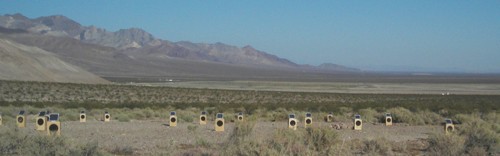
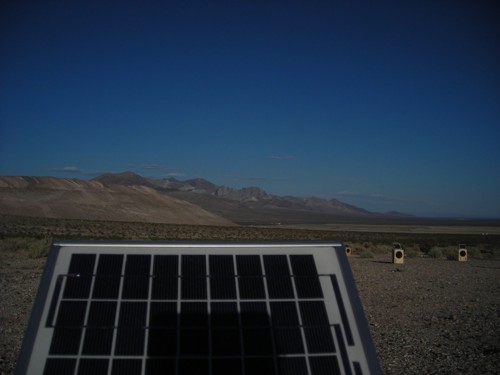
Sun Boxes is a sound installation consisting of 20 speakers, independently operating. For those of you who have not seen it on the many other sites who showed this: each speaker has a built-in solar panel and contains a guitar sample.
The speakers are spread around so visitors can enter the installation to enjoy the ever changing composition from various sides. The installation, created by Craig Colorusso is completely solar powered and the music stops when the sun sets. A great way of showing we can create beautiful things only using natural resources.
Listen to it here:
DATAMASKIN

