
Modcan Super Delay & Digital Delay Comparison
People have been wondering about the difference in sound between the Modcan 30B Super Delay (which is a true analog delay) and the Modcan 59B Digital Delay, so I set up a simple audio demonstration. It’s not meant to be an analog vs. digital contest — as you’ll hear, both of them sound beautiful but have very different tonal characteristics as well as unique reactions to control voltage manipulation.
The Modcan Sequencer is triggering a Modcan 58B VCDO that is passing through a Modcan 68B Matrix Filter (using the 4-Pole Bandpass output). In the first half of the video, that signal is passing through the analog Super Delay — which is a mono device. I twiddle the knobs throughout and then eventually let triangle waveforms from the Modcan 61B Quad LFO take over the invisible finger chores.
The second half of the video is the same sequence and signal chain passing through the Digital Delay, which has been engaged to output the audio in stereo mode. Again, after some manual twiddling I put the 61B Quad LFO to work once more and send a slow-moving triangle waveform into the control voltage inputs.
As may be apparent from the studio configuration, I do love the Modcan modules for their sound, aesthetic beauty and a user interface that squeezes myriad functions per module into a reasonably-sized space. I hope you find this a useful and entertaining video.
Shared by scootermccrae
Creative delay effect
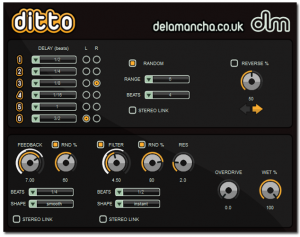
Ditto is a creative delay effect, using randomised tempo-sync modulation to provide a constantly changing but musical delay effect. You can randomise the delay time, feedback and filter cut-off, with independent left and right channel modulation if you wish. Reverse delay can also be randomly set to change things up even more.
All delay times are tempo-synced to your host, with up to 6 different selections that can be randomly selected. The randomisation is also set to change in tempo-sync, so the results always sound musical and rhythmic (unless you don’t want that, there are some unusual sync patterns too).
You can use ditto for subtle variances in repeating patterns, constantly evolving soundscapes or just some good old random craziness. It is very suited to drum patterns and rhythmic / percussive loops, but is also great on pads, leads, basses and just about anything you’d like to randomise for effect.
• Tempo-sync, randomly-modulated, stereo delay for adding variance and randomisation to patterns
• Randomisation of delay time, feedback, filter cut-off and delay direction
• All randomised parameters can independently change in tempo-sync with host (1/32 beat to 32 beats)
• All randomised parameters can also be made static independently
• Random selection of up to 6 different delay times (1/32 beat to 32 beats)
• Delay time can be independent for the Left and Right channels
• Feedback and Filter cut-off amount of randomisation can be controlled and smoothed
• Feedback and Filter cut-off can be independent for the Left and Right channels
• Feedback direction amount of randomisation can be controlled
• Filter resonance control
• Overdrive control on the feedback signal
• Wet / dry control on the feedback signal
• Developed with SE 1.1
Multidelay effect tailored for ambient music
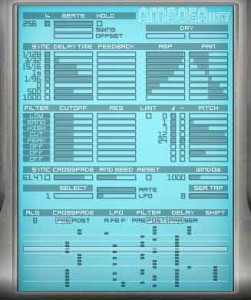
Xoxos has released Amboea VST plug-in for Windows which they tell us arranges eight filtered stereo delay lines in serial or parallel with algorithmic crossfading to create a multidelay effect tailored for ambient music.
Twenty algorithms allow the crossfading and filters to be applied before or after the delay lines with optional randomised modulation and pitchshifting. Xoxos says that one instance of Amboea can turn any sound into a dense, continuously varying soundscape, or be used as a straightforward multitap or parallel multidelay.
Pricing and Availability:
Amboea has an introductory price of $10 which will increase to $15
More information:
Create advanced stereo delay images in your mixes

Vesco FX tell us that Cross Delay allows you to create advanced stereo delay images in your mixes all in a single plug-in. Here’s what they have to say about it…
Say goodbye to configuring multiple plugins in parallel with complex routing schemes. The controls to allow echo output to be directed between channels is at the unique heart of this VST plugin. Each echo can be sent to the opposite channel from the source signal (echo of the left channel is heard on the right) or subsequent echoes can ping pong between channels. A modulation section allows tweaking the delayed sound with a dynamic combination of depth and speed all on a single control with realistically usable settings through its entire range. Throw in the independent output controls and an adaptive damping and what you end up with a VST delay plugin able to deliver lively and exciting delays for all your mixing needs from home studio to pro studio.
Features:
- 64-bit internal processing resolution.
- Lots of built in presets to get your mix jumpstarted.
- Full automation support of all controls for VST compliant hosts (additional extensions for REAPER).
- Sample accurate, zero-latency algorithm.
- Delays can be routed to the opposite channel or ping pong between channels.
- Single knob, adaptive modulation brings life to the delayed signal.
- Single knob, adaptive damping gives the delayed signal extra depth.
- Delays can be biased to either side for a wider image
- Turns mono tracks into stereo.
- Output can be summed to mono for chorus style effects or to check mono compatibility.
- Eliminates complex routing required to create stereo delay effect
- Works with both mono and stereo input.
- Works with 64-bit and 32-bit audio hosts running on 32-bit Windows OS.
Pricing and Availability:
Introductory price: $19
More information:
Light Sensitive Delay with Drum Machine
The LSD module can take a simple beat and morph it into something entirely new. You can hear the “glitch mode” in action, when i turn the rate knob past 2:00. It also makes some spectacular vibrato/delay effects. Freak out on LSD ~ only from chamberofsounds.com
Diatonic granular pitch shifting delay effect
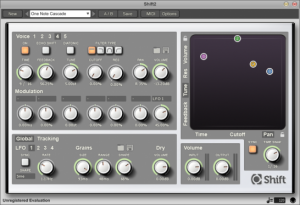
Loomer has updated Shift,its diatonic granular pitch shifting delay effect for Mac OS X, Windows, and Linux, to version 2.0.
Details on Shift 2.0 below.
Features:
- Five independent true stereo delay lines, with discrete delay, feedback, pitch shifting, filters, pan, and volume.
- Pitch shifting comes courtesy of a powerful granular synthesis engine: with a few simple grain parameters, you can create the perfect granular sound, be it for guitar, synth, drums, loops, or anything else.
- Fast and accurate monophonic audio analysis component extracts pitch information, in real-time, for intelligent in-scale pitch shifting and harmonies. Calibrate the tracker to your sound and style using the built-in tuner.
- Perfect your preset design: use the XY grid to maneuver the seven main delay line parameters in real-time or to get at-a-glance feedback on the overall preset shape.
- A comprehensive modulation matrix allows each delay voice parameter to be individual contoured. Modulation sources come in the form of four tempo-syncable LFOs, each producing five modulation shapes: sawtooth, sinus, triangle, square, or stepped random noise.
- Over 100 presets included, from the simple to the exotic, each tagged ready for searching, and annotated with playing suggestions. Listen to a preset in context with ‘hot-swap previewing’. Create partial presets to build up a library of delay voices, grain engine, and diatonic tracker settings.
Shift is available for £45 GBP (+ VAT). It’s a free upgrade for registered owners of Shift 1. A demo version is available.
Demo of the Synthetic Sound Labs 1310 Digital Delay module
This is a demonstration of the Synthetic Sound Labs 1310 Digital Delay module. The $199 device is capable of subtle doubling, hard timed delays and super flanging.
Details below.
Synthetic Sound Labs 1310 Digital Delay Description
The SSL 1310 Voltage Controlled Digital Delay is a single width 5U/MU module for producing short to medium audio delays. For shorter delays, short room like slap-backs are killer. At medium delays, you can emulate vintage tape echos. You can even force the module for longer delays, but digital quantizing noise becomes audible – but who’s to say what’s musical and what’s not?
It’s based on the ubiquitous Princeton Technologies PT2399 delay chip which is used in countless effects pedals. The really cool part is that delay times are voltage controllable, allowing everything from a little chorusing effect to a grinding, gurgling mass hysteria.
RECIRC-ulation (repeats) are controlled manually and can go way beyond self-oscillation! The MIX control smoothly blends dry, undelayed signal with the delayed, all the way through delay only (no original signal), thus saving a mixer at the output. Using an external VCA, filters and mixers, you can also create your own feedback patches. Cool and simple. Use two 1310s for cool stereo effects and through-zero-flanging!
CV AMT controls how much of the DELAY CV control voltage input is mixed with the manual DELAY setting. Go from Rockabilly slap to literally audio clicks in a single bound.
INPUT and OUTPUT levels are designed for the hot signals a synth produces, so for minumum noise and best performance, external audio devices such as microphones and guitars should be preamplified before being fed to this module.
See the Synthetic Sound Labs site for more info.
via davidryle:
I mostly am using it as a gentle flanger in this demo but it is far more powerful than what I demo here. You can get one for your 5U MU modular synthesizer by checking out the website at http://www.steamsynth.com/
I also finished a project where I was modifying a stock Q111 Pan/Fade module from Synthesizers.com. I added an attenuator pot to the control input and added an inverter circuit to the output #2. This enables the Panning portion of the module to output audio to two channels of my mixer in stereo. I have control over how wide the panning is and both output channels are normal (un-inverted) so there is no cancellation when sending to effects etc..
I am using several other delay units as well in this demo. TC Electronics D-Two is way in the background so it isn’t really a factor. Strymon ’s Blue Sky Reverberator is the heavy plate reverb in the background. The Korg Kaoss 3 pad is used to have some looping fun, but I tried to keep it low level so not to interfere with the demo of the 1310 delay module.
There are four separate voices playing in this piece from the modular. The sequencers are generating various time signatures and loops but all of the distorted flanging effect is the 1310 Digital Delay. This is one fun unit and a great addition to my modular synth.
The title is about the amount of time since I got serious about building a modular synth to work with. It has been a little over two years (9 seasons) since I made the commitment. No looking back and I am very happy with the move away from dedicated keyboards and soft synths (although I still use them for other things).
Thanks to Doug Slocum at Synthetic Sound Labs for the great delay module. He has other ideas in the works and I am very excited about the future of his endeavor.
New vocal plug-in called Nectar
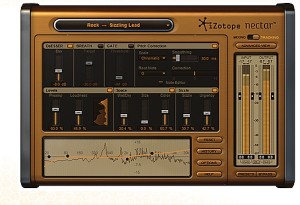
Izotope will be releasing a vocal plug-in this month called Nectar. The software will have Pitch Correction, Breath Control, Compressors, a DeEsser, Doubler, Saturation, EQ, Gate, Limiter, Delay and a Reverb. It will be $199 at launch then jump to $299 shortly after. As with other Izotope plug-ins there will be an extensive preset browser too.
“Nectar offers dozens of professionally designed vocal production styles powered by eleven processing modules. Users will select an included style and then customize it with faders tailored to that style. For further customization of their vocal sound, users can switch to the Advanced View and access all of the controls of the underlying modules that power the plug-in… iZotope Nectar is ideal for audio engineers, voice over artists, singer/songwriters, recording enthusiasts, podcasters, and anyone else who records sung or spoken vocals. Its dozens of styles cover genres including: Alternative & Indie, Blues/R&B, Classical, Country, Dance & Electronica, Hip Hop & Rap, Jazz, Pop, Rock, and Spoken Word.” – izotope.com
For more info: izotope.com/products/audio/nectar/
Maplin voice digital delay/chopper
Out of production Maplin Voice Vandal Kit in 5U modular format. Uses a Holtek delay chip and has a chopping section, that when swept, can give you a nice cross modulation/ring type sound. Noisy, yes, but unique and colorful also a yes. More info and schematics here for this rare, out of production module.
http://www.mediafire.com/?a9dgz3gzxje
PS. Was heavily used by Dr. Who geeks to simulate the Dalek voices. Here it is heavily used by me, a different type of geek… Synthesizer Geek! More and less geeky at the same time somehow.
Introducing Synthetic Sound Labs 1310 Digital Delay module
This is a demonstration of the new Synthetic Sound Labs 1310 Digital Delay module. The device is capable of subtle doubling, hard timed delays and super flanging. I mostly am using it as a gentle flanger in this demo but it is far more powerful than what I demo here. You can get one for your 5U MU modular synthesizer by checking out the website at http://www.steamsynth.com/
I also finished a project where I was modifying a stock Q111 Pan/Fade module from Synthesizers.com. I added an attenuator pot to the control input and added an inverter circuit to the output #2. This enables the Panning portion of the module to output audio to two channels of my mixer in stereo. I have control over how wide the panning is and both output channels are normal (un-inverted) so there is no cancellation when sending to effects etc..
I am using several other delay units as well in this demo. TC Electronics D-Two is way in the background so it isn’t really a factor. Strymon ‘s Blue Sky Reverberator is the heavy plate reverb in the background. The Korg Kaoss 3 pad is used to have some looping fun, but I tried to keep it low level so not to interfere with the demo of the 1310 delay module.
There are four separate voices playing in this piece from the modular. The sequencers are generating various time signatures and loops but all of the distorted flanging effect is the 1310 Digital Delay. This is one fun unit and a great addition to my modular synth.
The title is about the amount of time since I got serious about building a modular synth to work with. It has been a little over two years (9 seasons) since I made the commitment. No looking back and I am very happy with the move away from dedicated keyboards and soft synths (although I still use them for other things).
Thanks to Doug Slocum at Synthetic Sound Labs for the great delay module. He has other ideas in the works and I am very excited about the future of his endeavor.
DATAMASKIN

