
Building DIY SammichFM 2011
Background data:
This year I build a Wilba SammichFM DIY synthesizer kit. It is bases on the famous Yamaha OPL3 sound chip that was also used on the famous Sound Blaster Pro 2.0 and SoundBlaster 16 ASP sound cards. It is a 4 voice FM synthesizer that sounds a lot like the famous Yamaha DX series. During the construction of the synthesizer I filmed the whole process. This movie is an excerpt of the 4 hours total build time. I made the 3D animations myself in Cinema 4D. The music you hear in the background in a track called ‘thermosphere’ from my ‘AtmoSphere’ album that I released in 2008. More information on the album on http://www.synth.nl/AtmoSphere. If you are interested in the whole build process of the SammichFM you can read that back on my blog on this URL: http://synthnl.blogspot.com/search/label/sammichfm
StyloBuzz prototype
http://www.etsy.com/listing/86494081/
This kit is now avaliable for preorder.
This is a preorder kit for one of the first five units produced. The kits will ship next Friday.
This kit provides you with the components and instructions that you need to build a small handheld styus synth. All you need to do is build the kit.This is a great synth kit for those getting started in electronics, but some basic knowledge of electronics and soldering is required.
If you want to hear what the StyloBuzz sounds like, I have uploaded a small YouTube video: http://www.youtube.com/watch?v=45TayI1JCqI
The kit includes:
*StyloBuzz custom Circuit board
*Programmed micro controller
*Electronic components( resistors, capacitors, voltage regulator, 9v battery clip, switch, potentiometers, 3.5mm socket and LEDs
*Enclosure
*detailed instructionsYou will need:
*Soldering iron and solder
*Wire cutters
*Cross head screwdriver to fit the pcb to the enclosure.
*Basic electronics skills(resistor colour codes etc)
*Basic soldering skills.
Rockit DIY 8bit synth is now launched
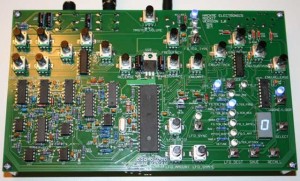
HackMe Electronics has announced that the Rockit synth – their DIY 8-bit synthesizer project – has shipped.
Rockit is an open source analog-digital hybrid synth, created by Matt Heins. Heins says that he’s shipped about 175 Rockits in some for (assembled, kits or PCBs). The Rockit is now available assembled for $229, or as a kit for $139.
Features:
- Two Mixable Oscillators with 16 Waveshapes/Sounds and Detune
- Analog Voltage-Controlled Amplifier with ADSR controls
- Digitally Controlled Analog Filter with Selectable Low/Band/High Pass and External Audio Input and Independent Envelope
- Two LFOs with 16 Waveshapes and 6 Destinations Each
- MIDI In and Out
- Open Source C Code with an AVR Microcontroller
- 16 Slots for Patch Save and Recall
You can preview the sound of the Rockit synthesizer below:
Rainboard – Honeycombs and Snowflakes Performance
This video is an original composition and performance (Steven Maupin) using the Rainboard. The Rainboard is a DIY dynamic isomorphic keyboard. It can interface the Musix iOS app in order to change layouts and adjust settings. As well, it can be played on its own after a layout is set. More details can be found at http://rainboard.shiverware.com
Details:
An isomorphic keyboard is a musical device where a grid of notes is displayed to the user and the interval change between notes in constant for any given direction. The end result is the ability to move a musical passage between keys without learning a new fingering or spatial relation (transpositional invariance). What this means is that once you have learned a pattern, say a chord or a scale, that pattern is the same for all keys.
Songwriters benefit by discovering new melodies and musical relationships. Novices find it easy to learn to play. Songwriters benefit by discovering new melodies and musical relationships. Novices find it easy to learn to play. Experienced musicians are rewarded with an intuitive interface.
Quick check to see what the buttons are going to look light when lit by LEDs
Make music with your voice, or any sound!
Background info: Everyday Looper allows you to record 4 musical phrases – 6 on an iPad – and loop them right away. You can then mix and merge them on the fly. Your Adventures Into Sound begin here – Live Looping on any iOS device! Perhaps the easiest introduction into this DIY music style which is taking the world by storm.
New In Version 1.5
STEREO TRACKS
• Pan your tracks. Compatible devices : iPhone 3GS, iPod Touch 3G, iPad and newer.
MIDI CONTROLLERS
• Record, Play/Pause and Stop can be triggered by a MIDI controller through Core MIDI.
2 INPUT CHANNELS
• Record channel 1 or 2, both simultaneously or as a stereo source. Require an audio device that provides 2 input channels such as the Alesis iO Dock.
“Can ANYONE guess what the Mystery Object is, near the end of the video? “
The DIY 8-bit synthesizer project – is ready for launch
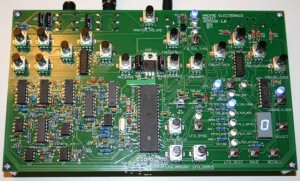
Hack Me Electronics has announced that that the Rockit synthesizer – a DIY 8-bit synthesizer project – is ready for launch:
The PCBs have arrived. I built Rockit #1 and it worked the first time I powered it up. It just doesn’t get any better than that!
I’m getting ready with shipping materials (not sure why none of that occurred to me before now!). Look out for a notice from Kickstarter because I’ll need to get people’s address.
I don’t want everyone to get too excited to fast because I’ve got a lot of work to do to get it to you. I’m going to mix in all three versions into my schedule, shipping some bare bones, some kits, and some assembled units as I go.
The software for version 1.0 is pretty much a wrap. There will be future versions with upgrades and updates, but like my friend says, “At some point in a design, somebody’s gotta shoot the engineer.” Well, that time has come. Time to put on my manufacturing hat and let these beasts out in the world. Cheers again and thanks for all the support.
The Rockit synth is a DIY synth designed to be “a source of gnarly full-blown synth sounds and, for hackers and electronics enthusiasts, Rockit will be an engaging electronics project and a platform for synth exploration.”
Pricing for the Rockit 8-bit Synth ranges from $25 for a barebones kit to $200 for an assembled synth.
Details are available at the projects’ Kickstarter site.
Specs:
- Fully Open Source Hardware and Well-Commented C Software Design
- Digital Analog Hybrid Circuitry
- 2 Digital Oscillators with 16 waveshapes, updateable to more
- 2 Low Frequency Modulation Oscillators with 10 destinations
- Innovative Digitally-Controlled Analog Filter with Low-Pass, Band-Pass, and High-Pass with Envelope Control and External Audio Input
- Analog Voltage-Controlled Amplifier with Envelope Control
- Drone/Loop Mode for Playing by Itself
- 19 Knobs to Twiddle and 8 Switches
- Full MIDI Input and Output
- Sound Patch Save and Recall
Collin’s Lab: Atari Punk Console
http://bit.ly/prZRJ1
“A true classic for DIY synth makers & circuit benders, the Atari Punk Console can kick out some ear-catching square waves. It’s easy to build and a lot of fun to play around with. It may be challenging to make traditional music with an APC, but hey – there’s enough of that around already, right?”
Here’s a schematic for the APC I built in this video:
(The 556 timer chip is shown in two parts in order to emphasize the two separate timers included in the IC.)

Hackable digital synth

More details has been announced on the upcoming Meeblip SE synthesizer – an updated version of the Meeblip open hardware synth. The design retains the basic interface of the original, with the addition of features that make it more powerful (like an adjustable PWM waveform) and easier to use (patch storage).
New Features:
Sixteen patch memories (accessed by tapping the save/load button and flipping one of the sixteen front panel switches)
Two envelopes – a dual-mode A/D or A/S/R amplitude envelope and an A/D envelope for the filter
Bandlimited oscillators (with optional raw waveforms, if aliasing is your thing)
Dual-mode PWM waveform on oscillator A. Select either a pulse wave with user-programmable width, or sweep the pulse width with user-programmable sweep speed
New triangle waveform on oscillator B
Filter envelope amount has been added to the front panel
Extended MIDI parameter control
A redesigned front panel
There are also a few board tweaks to reduce noise.
Meeblip SE will be available in two versions:
A new front panel and pre-programmed microcontroller for existing MeeBlip owners — all the new features except programmable patch storage (there are no save/load switches on the original). Available August 8th for $25.
New meeblip se hardware that includes patch save/load and midi channel buttons, power switch on the front panel, and an easier-to-assemble design (the I/O board now mounts directly to the back panel and connects to the main board with a single ribbon cable).
The Meeblip SE synth will be available in a few weeks for the same price as the original — $139, including multi-volt power adapter. See the Meeblip site for details.
Get ready for the Bent Festival in NYC
The 2011 Bent Festival will be held at 319 Scholes in Brooklyn, June 23rd – 25th. Bent Festival is an annual art and music festival celebrating DIY electronics, hardware hacking, and circuit bending. Each year we invite artists from across the country and around the globe to perform music with their home-made or circuit bent instruments, teach workshops to adults and children alike, create beautiful art installations and to generally come together, face to face, and showcase the state of the art in DIY electronics and circuit bending culture.
Featuring the work of some chip artists: Rosa Menkman, Jeff Donaldson, Burnkit 2600, Gijs Gieskes and Loud Objects.
Links
Web: http://bentfestival.org
Schedule: http://bentfestival.org/2011/schedule
Twitter: @bentfestival (#bent11)
Facebook: Bent Festival Facebook
Tickets: http://www.brownpapertickets.com/event/178498
Photo stream on Flickr: http://www.flickr.com/photos/bentfestival2011/
Enjoy this mega synth drum test
Here’s a demo of some drum sequences using a new analog/digital DIY modular synth. A lot of the rhythmic control is coming from electric Druids tap tempo LFO. It’s an amazing chip. read about it here:
http://www.electricdruid.net/index.php?page=projects.taplfo
DATAMASKIN

