
ATARI POKEY 8-bit Computer Sound on PIC32
Background information:
I successfully compiled the ASAP (Another Slight Atari Player) library [1] for a PIC32MX795F512H. ASAP emulates a 6502 CPU and the famous POKEY sound chip [2] used for example in the ATARI 400/800 and XL/XE 8-bit computers. To say it with Wikipedia’s words: POKEY’s sound is distinctive 
About 60 tunes (worth about 2.5 hours of music) taken from ASMA (Atari SAP Music Archive) [3] are included and stored in the PICs flash memory. D0 is the left and D1 the right PWM channel.
The source code is available here: http://dangerousprototypes.com/forum/viewtopic.php?f=56&t=3944
[1] http://asap.sourceforge.net/
[2] http://en.wikipedia.org/wiki/POKEY
[3] http://asma.atari.org/
Retro Joy – Serial Serendipity DIY
Some fun with an old joystick and a sampler made from an Arduino + the Adafruit Waveshield.
Curious about what the Adafruit is? Here’s a description:
Adding quality audio to an electronic project is surprisingly difficult. Here is a shield for Arduinos that solves this problem. It can play up to 22KHz, 12bit uncompressed audio files of any length. It’s low cost, available as an easy-to-make kit. It has an onboard DAC, filter and op-amp for high quality output. Audio files are read off of an SD/MMC card, which are available at nearly any store. Volume can be controlled with the onboard thumbwheel potentiometer.
This shield is a kit, and comes with all parts you need to build it. Arduino, SD card, tools, speaker and headphones are not included. It is fairly easy to construct and anyone with a successful soldering project under their belt should be able to build it.
The shield comes with an Arduino library for easy use; simply drag uncompressed wave files onto the SD card and plug it in. Then use the library to play audio when buttons are pressed, or when a sensor goes off, or when serial data is received, etc. Audio is played asynchronously as an interrupt, so the Arduino can perform tasks while the audio is playing.
http://adafruit.com/products/94
New browser based controller for modular synths
Patchwerk is a new web browser-based application that lets you control a massive modular synthesizer, housed at MIT, and hear the results:
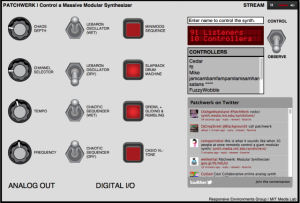
Patchwerk lets you control a massive analog synthesizer from your browser, and streams the results back to you and everyone connected. The interface on this site is linked to a physical synth cabinet connected to the world’s largest homemade modular synth, currently housed at the MIT Museum.
Turn a knob here, and Patchwerk will turn a motorized knob on the cabinet. If someone at the Museum grabs a knob, you’ll see it turn too.
The synth that you can control is the giant DIY modular synthesizer of Joe Paradiso:
Enjoy
Yusynth Modular – First Flight
Background information:
This is a quick video of the maiden voyage of my DIY modular synth.
Most of the modules are Yusynth designs, but it also includes a few Paia, CGS and Ian Fritz designs.
The patch is fairly straight foward. The two randomized sequences are generated by Reaktor (via a Paia MIDI2CV). A Kurzweil Mangler is adding a small amount of Delay.
About 2:05 you will hear the second VCO frequency modulated by an Ian Fritz Chaos module.
A big thanks to all of the DIY synth community, but especially the Yusynth designer Yves Usson. His designs are brilliant and sound unbelievably good! Hopefully this video does them justice.
Rainboard: Rebang
This video is an original composition and performance (David Gerhard) using the Rainboard. The Rainboard is a DIY dynamic isomorphic keyboard. It can interface the Musix iOS app in order to change layouts and adjust settings. As well, it can be played on its own after a layout is set. More details can be found at http://rainboard.shiverware.com or sign up for the Rainboard newsletter: http://eepurl.com/g3G0r
Voltage Controlled FM Radio Module
Simple DIY module built around a Franzis FM Radio board from Conrad Electronics
Lur presents The Big Bug
Lur is a livelooping duo from Malmo, Sweden. They record and loop all instruments and sounds live on stage.
The Big Bug is a liveact that starts where ordinary club acts ends. With bombastic beats, DIY instruments, interactive projections and musical magic tricks, they will offer a liveloopingshow for all party animals in the urban swamp.
For more info visit:
lurlurlur.com
Introducing the Chomp: the bite-sized, affordable MIDI box for creative music projects
Max Justicz has announced a new DIY MIDI controller ‘brain’, the CHOMP, that looks awesome.
Basically, the CHOMP (Configurable Hardware Open-source MIDI Platform) is a cheap board you plug switches and pots into to create custom MIDI controllers.
Features:
- Completely open-source.
- Affordable ($50).
- Compatible with ANY MIDI configuration.
- 48 Inputs/Outputs!
- Made and assembled in the USA.
- Programmable
- Tiny, only 100mm x 60mm x 25mm
Here’s what Max Justicz has to say about the CHOMP:
It has come to my attention that the world needs an inexpensive (but extraordinarily solid) MIDI controller. That’s where the Chomp comes in. With zero technical skills, you can hook up dozens of buttons, knobs, switches, and sensors to control endless parameters of digital software.
The Chomp is the first open-source MIDI controller that’s been designed right. Other MIDI controllers on the market are proprietary, difficult to use, non configurable, and most of all: expensive. The only other commercial option available ships exclusively from Europe and costs the US equivalent of $240.
But because it’s Arduino powered and completely user programmable, the Chomp is more than an awesome MIDI controller. With new code, Chomp can do just about anything: play Bach on a digital keyboard, or help you along in a live musical performance.
DIY Orchestra plays Kraftwerk
In this video featuring hackmeopen rockit (lead), xoxbox (acidic solo), meeblip se (arpeggio) & shruthi-1 (bass)
C-MOnSter Sound Demo
“This is a sound demo of a CMOS based polyphonic synthesizer that I made. A keyboard controlled top octave synth that uses almost exclusively simple CMOS circuits to create and modify the sound. The full explanation is here. This is the technical explanation of a CMOS based top octave synthesizer. Check out my other video for a sound demo. The synth uses mostly CMOS chips to generate a the top octave twice, then divides it to get the rest of the notes. The sound is then shaped and processed uses more CMOS circuits, before finally going through dual Wasp filters.”
Enjoy
DATAMASKIN

