
Doepfer A188-1 BBD Basics
Overview of functions and features of the Doepfer A188-1 BBD Delay module.
Video, voice, and sound by Raul Pena.
Module A-188-1 is a so-called Bucket Brigade Device module (abbr. BBD). BBDs have been used to delay audio signals before digital delays dethroned the BBD based effect units. But BBDs have some very unique advantages (or disadvantages dependent on the point of view) over the digital counterpart which result from the special properties of the BBDs. BBD circuits can be treated as a chain of Sample&Hold units (S&H) which pass on their voltages to the next S&H in the chain at each clock pulse. A more detailed explanation – including the different types of BBDs – can be found in following chapter.
In any case the sounds generated by module A-188-1 are very special. Typical applications are: Flanger, Chorus, Analog Delay or Karplus/Strong synthesis. But as the A-188-1 has a lot of very unique features (voltage controlled clock rate / delay time with extreme range, polarity switches for the CV inputs, feedback and BBD out/mix, clock and CV output of the high speed VCO, BBD clock input, feedback insert, feedback up to self-oscillation) a lot of unusual applications can be realized with the module (e.g. delay controlled by ADSR, envelope, random or sequencer with positive or negative effect). The A-188-1 also has no built-in anti-alisaing filter in order not to limit the possibilities of the module. For this the CV out is intended.
Sounds of the Doepfer A188-1
A more chaotic and noisy take this time. Demo with sounds processed with the Doepfer A188-1 (4096) BBD Delay. Sounds and Visuals by Raul Pena. Modules used: Doepfer A-188-1(4096) BBD Delay, Wiard Noisering,Make Noise Maths, Make Noise Wogglebug, Doepfer 2x A110,149-1 and 2, Synthesis Technology/MOTM E560 Deflector Shield,Plan B Model 24,Bubblesound uLFO.
Featured hardware:
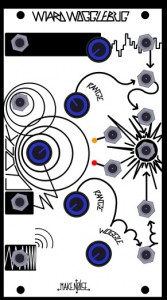
The “WoggleBug” is a random voltage generator, originally designed by Grant Richter of Wiard Synthesizers. The Wogglebug’s sole purpose is to overtake the control voltages produceded by your keyboard during performance, and to give voice to your synthesizer’s ID. It is your synthesizer’s ID MONSTER.
A continuation of the “smooth” and “stepped” fluctuating random voltage sources pioneered by Don Buchla, the core of the circuit is based on the Buchla Model 265 “Source of Uncertainty” module, which many consider to be the most musical of all random voltage generators. Like the 256, the Wogglebug utilizes a vactrol based low frequency smoothing filter, VCO and Sample & Hold to produce Stepped and Smooth (or lagged, slewed) control voltages in the range of 0 to 10 volts. Grant’s Wogglebug design expands on this system to include the other-worldly Woggle CVs (stepped voltages with decaying sinusoids at the edges), which must be heard in action to be truly appreciated.
In a moment of considerable noise, Richter decided to tap into the sound sources at the uncertainly beating heart of the Wogglebug, and bring them forth to the instrument’s panel. He then figured a clever way to “ring modulate” these sounds, and that output now graces the panel of all Wogglebugs.
Thus, the Wogglebug is a complete system, no external modules are necessary… however, all voltage controlled systems long to be tickled, bitten, plagued and eventually destroyed by the Wogglebug.
All you can eat synths – live studio performance by Bruno Ender Lee
VELVET VOYAGE – “Music Of The Spheres” – Performed live by Bruno Ender Lee, July 10. 2011
ARP Odyssey (& Doepfer MAQ-Sequencer), MacBeth M5N (Bass), Synthesizers.com Studio-88 (Leads & FX), Moog Little Phatty & Absynth 4 (Leads), Roland Juno-60 (Wind-FX), Roland D-70 & Korg MS2000 (Pads), Moog Etherwave Theremin
Roland System 100 study
Roland System 100 doing a Buchla impersonation (in the style of Douglas Leedy, Michael Czajkowski, Morton Subotnick). Random voltages are being produced by the Doepfer A118 Random Voltage module and shaped by an A140 ADSR, then fed into the System 100 oscillators and filters.
Shared by mrmdshaw
Sportmodular in action
In this video you will find (among other things a Doepfer A 143-1 – Complex envelope generator comprising of four paralell AD-envelopes. They can be chained in order to form a complex multistage envelope and are output at a common mix output. You can decide at which point of the recent envelope´s decay phase the next envelope is going to be fired. Each envelope can be mixed positively or inverted to the summing output.

Modulat A 143-1 to sportmodulator & quantimator (hold)
sportmodulator to 2 x quantimator (3x anti osc & RS 360)
Juno 60 and Doepfer in perfect harmony
The Roland Juno-60 is a popular analogue 61-key polyphonic synthesizer produced by Roland Corporation in the early 1980s and a successor to the slightly earlier Juno-6. Like its predecessor, the Juno-60 has some digital enhancements, used only for clocking the oscillators and for saving/loading patches. The Juno-60 synthesizer is a six-voice polyphonic synthesizer. The single digitally-controlled oscillator (or DCO for short) per voice gave the Juno-60 a high degree of stability in maintaining tune; most analogue voltage-controlled oscillators (VCOs) of the time would tend to drift in pitch and require re-tuning of the oscillator. The DCO provides sawtooth and square/pulse waveforms as a sound source, in addition to white noise and a square-wave suboscillator pitched one octave beneath the key played. Both of these additional sources can be mixed in with dedicated sliders.

The filters and envelope on the Juno-60 rely on control voltages sent by depressing the keys on the keyboard and were thus analogue. The Juno-60 features a rather distinctive-sounding 24 dB/octave lowpass filter with resonance. Unlike other VCF’s of the day, the Juno-60’s is capable of self-oscillation and thus could be used to some degree as a tone generator in and of itself. The filter section also features controls for envelope amount and polarity, LFO modulation, and keyboard tracking. In addition, a three-position non-resonant highpass filter is provided to thin out lower frequencies.
The signal is then sent through a voltage-controlled amplifier (or VCA) and a simple four-stage ADSR filter envelope. The Juno-60 provides limited options for modulating the audio signal. A single triangle-wave variable-rate LFO is provided as a modulation source; this can be mixed into the DCO to create vibrato or into the lowpass filter to generate a tremolo effect. The LFO can either be triggered manually by the left hand using a large button above the pitch bend lever or set to engage automatically whenever a key was pressed.
In this video:
Various Roland Juno 60 chords are being sent to the Doepfer A 119 module and then shaped and processed through the A121 Multi Mode Filter, which in turn is being modulated by the A 115 Sequencer.
Kraftwerk sounding tunes from the Doepfer Dark Time sequencer
An uptempo synthmusic. Again de Doepfer Dark Time sequencer with a 16 step sequence triggering the Moog LP (with the punch of the moogerfooger CP 251) and the Waldorf micro Q. The piano is a combination of the Roland E15 and the Kurzweil micro piano with the accent to the E15. Strings from the Roland Juno 106 and the Korg Lamda. Solo synth also from the 106. Some e-piano from the Yamaha DX 27. A lot of echo’s amd reverb.
The title had to do the nice wether today after a rather cold and wet period.
Continental Shuffle with a Doepfer
Here’s what they have to say about it:
Just finished adding speaker carpet and protective corners to my Doepfer A-100LC9 Low Cost Case so it’s more durable for portability and gigging (these are the cases that come with a raw wood finish). I also attached 4 thick rubber door-stops (please don’t laugh) on the back so that it can be played while laid flat. The stoppers elevate it enough to get a right-angled IEC cable in under there and also so I can reach under to the on/off switch on the back.
PATCH NOTES (well, some highlights of what I remember…):
Hi-hats are created with the 6 oscillator output of a Doepfer A-117 Digital Noise/808 Sound Source going into the high-pass input of an Elby Designs CGS735 Synthacon Filter (while an MFB Drum-05 Snare Drum goes into the band-pass input). I’m using the Analogue Systems RS-60 as the Envelope Generator for the hi-hats. I ‘play’ the one-shot switch and also hit the gated repeat switch for out-of-time bursts of hi-hat. The other noise output from the A-117 (2 oscillators) is going into the Frequency Modulation input of the Harvestman Piston Honda. I only just discovered using noise as a FM source which is probably old hat to some (no pun intended).
A clock source is feed into the B input of a Malekko Switch and the Pittsburgh Timetable is ‘cued to play’ with the manual push-button on the Switch. The Doepfer A-166 Dual Logic Module is doing trigger/gate combining with various outputs of the 4MS Rotating Clock Divider and the Timtable to create shuffled rhythms for the hi-hats and the MFB Drum-04 Bass Drum.
2 X STG .mix are used like 2 halves of a stereo mixer
sent in to a newly arrived Flame FX-6 Multi-Effect module.
Analogue Synths & Sequencers
The most strange lady in the world of synths are back with a new video together with her Bob Moog doll 
Hi lovely Synthfreaks, this is a new inspiration from me with my analogue instruments. The lead comes from the Minimoog, the Sequences comes from the Dot.com Modular & GPP A 8 Synth, Voices are from the little Doepfer Dark Energy and the Roland Juno 60. Welcome to the analogue Sound Universe.
Modular Synths in the Morning
Dotcom and Doepfer System playing together. Self playing patch with a drone from the Flame Talking Synth, Wogglebug doing the honors of random note triggers to the cv of the Borg Filter. Doepfer A149-1 sending cv via a VC LFO to another couple of oscillators. Dotcom system serving accompaniment with cross-modulating Waves.
DATAMASKIN

