
Astral Landscape performed by Bruno Ender Lee
http://youtu.be/QbgdF_idbgg
VELVET VOYAGE – “Astral Landscape” – performed live by Bruno Ender Lee; December 27. 2011
Synthesizers.com Studio-88, MiniMoog Voyager (OS), Moog Little Phatty Stage II, MacBeth M5N (& Doepfer MAQ-sequencer), ARP Odyssey, Analogue Solutions Vostok, Roland Juno-60, Korg Delta, Korg Polysix, Korg MS2000, Korg DS-8 & MoonSonoSx (VST)
…please take a look at the video-response “Surreal Landscape” by JampyKeys
100 /// (A-100 Doepfer Modular System)
Background data:
“Simple title, because it’s the video no.100 which i upload to YT. What else maybe a better choise to produce the basic track with the A-100 Analog Modular System for this time?
More about this i included 2 samples which i’ve created with the Virus C and also a loop which i created with my new Boss RC-30 is running in the background.
Btw. creating the videos is much mor work than producing the sound. Maybe it’s time for myself to relax a while with chilling and watchig my own stream at a big flat tv.”
Short improvisation featuring the Phaedra
Short improvisation. Yamaha CP80B, DSI TETR4, Korg Monotribe, Eventide Space and TimeFactor, Doepfer modular, Roland RE-201. Sequenced from Naught Panther Phaedra running on an iPad.
“Since there will be an inevitable question, I’ll go ahead and say now that the CP-80B is running through the TimeFactor and Space, and the Space is set to its Shimmer algorithm. These are the only effects on the piano. … Anyhow, sequenced by Phaedra, as is proper for music like this.” – Chris Randall
Time for modular – PinkRoxyGabriel
PinkRoxyGabriel:
Doepfer: Dark Energy (supplying the arp)
Moogerfooger: CP-251 (LFO controlling the DE-VCO PW and Voyager Wave via Mod2)
Moog Voyager (audio in of DE via the Moogerfoogers)
Moogerfooger: MF-101-Lowpass Filter (effecting the DE only)
Moogerfooger: MF-102-Ring Modulator (effecting the DE only)
TC Electronic: Hall of Fame
Melodies:
Pink Floyd: On The Run arp’s first 5 note. (The DE arp is tough to program using more than 5 notes)
Roxy Music: My butchered Ladytron intro
Peter Gabriel: Of These, Hope (Reprise)…kind of…ish
Test Monomachine Modular Doepfer
“Doepfer synchronized to monomachine with midi2cv, 2 inputs fx rev/delay/chorus from mono
bad video and it’s not perfectly mixed but it’s a proof of concept and yes it works 😉
They fit nicely together the monomachine delay is perfect and the step fx sequencer can do nice things on modular sounds”
Buchla Odyssey
Background information on this great video below:
Buchla System #1& Arp Odyssey
Akai MFC 42 (mixer)
Art OPL tube preamp
Boss SL 20
Doepfer R2m
Kenton Pro 2000 II for cv Odyssey
Maestro Ringmodulator
Moog CP 251
Roland EF 303 Sequencer 14 steps to Logic
Yamaha MCS 2
Audio : 261e to Odyssey (out 1 to Maestro Ringmodulator out2 to SL20)
to Art OPL to 292e to Akai
Compost Cats by Ohmforce AU
Logic
Phaedra iPad Sequencer First Look…
Last week we got a teaser of the upcoming Phaedra iPad sequencer, now the developers gives us some more details:
This is a quick overview of the highlights of Phaedra, the “analog” style four-channel MIDI sequencer for iPads, coming soon from NaughtyPanther.
In this video, Phaedra is driving a DSI TETR4, a Doepfer modular synth, a Korg Monotribe, and an Eventide Space and TimeWorks. No DAW is used in the sequencing. Everything is being clocked from Phaedra.
Modular taking: DOEPFER A-100, OBERHEIM DMX, KORG KAOSSPAD3
Modular first steps, please listen with headphones.
Sample taken from an FM radio with the A-112 Sampler module.
Dual VCA gated by A-149-1 (source of uncertainty) for a crazy stereo pattern.
Nothing special, just testing and messing around.
One Hundred
Background information: Uploaded my first video to YouTube in May 2008. And now 3 years later I upload the hundredth video. I was a little worried after doing video 99 because I wanted video 100 to be something special. And I think it is. Hope you will like it to.
At first you hear a 5-step sequence on row 1 of the Doepfer MAQ16/3 driving the Ian Fritz Teezer Through-Zero VCO and the Blacet Miniwave. The percussive noise sound comes from the self-built Modular and is driven by a 16-step sequence on row 2 of the MAQ16/3.
After that the CS Saw Pad from the Roland XP-80 comes in where after the 4 step sequence from the Synthesizers.com Q960 is introduced but only steps 1 and 3 are active on the Q963 at first. The Q960 sequences drives the Synthesizers.com Modular. The Q962 sequential switch is triggered by row 2 of the MAQ16/3 to alter the sequence between the 3 rows of the Q960. Row 1 contains an Em, row 2 an Am and row 3 a Bm sequence. But the chords played on the Roland XP-80 don’t follow those chords exactly which gives interesting variations. After that the arpeggiated sound on the Waldorf Q Keyboard is added, varying the sound with the modulation wheel. Somewhere along the line steps 2 and 4 on the Q963 are activated so you hear the full 4 step sequence from the Q960. The sequences:
Doepfer MAQ16/3:
Row 1:906: E3 B3 A3 G3 D3
Row 2:924: X . . . . . . . X . . . . . . .
Row 3:906: X (Gate output shifts the Q960)
Synthesizers.com Q960:
Row 1: E3 E2 F#3 E3
Row 2: A3 A2 B3 A3
Row 3: B3 B2 D4 B3
The Sunrizer App on the iPad is used to add some chorded sounds using the Lifeforms [JD] patch. The solo is performed on the Nord Lead 1. The audio is recorded with Pro Tools 9 using the Alesis MultiMix16 FireWire. Again my friend Anne used my iPhone 4G to video this session; thanks for that.
I dedicate this video to you, my dear YouTube friends, subscribers and channel watchers. Your comments and support encouraged me to go on. Thank you.
You can download/see/hear the video and music from my website.
Wheel Ring
Gear used:
Wiard AO Uncle
Toppobrillo Quantimator TWF
Make Noise René Brains PP Wogglebug QMMG Math
4ms Noise Swash RCD
Analogue systems RS 110
Doepfer A 117
A 134 cv from Moog MP 201
Featured hardware – RS 110:
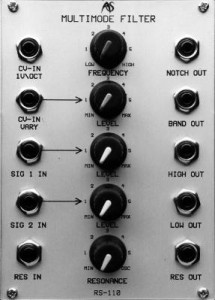
The RS110 consists of a two channel audio mixer followed by four, parallel, resonant filters with voltage controlled frequency and a unique “insert” point in the feedback path that generates and controls resonance.
Filter Modes
The RS110 offers four filter modes. These are 24dB/oct low-pass, 24dB/oct high-pass, 12dB/oct band-pass and 12dB/oct band reject (often called ‘notch’) filtering, with the cutoff frequencies (Fc) of the high-pass and low-pass outputs being the centre frequencies of the band-pass and notch outputs. Each of these filter characteristics is described in appendix 2.
There is no switch to select between the modes because all four are available simultaneously from the appropriate output sockets. However, the cut-off and resonance can not be defined individually for each, and the controls act upon each mode equally
Cutoff Frequency
You can control the cut-off frequency manually using the FREQUENCY control. In its fully anticlockwise position, Fc is approximately 30Hz. As you rotate the knob clockwise Fc will increase until, it its fully clockwise position, it exceeds 15kHz. These extreme positions are called ‘closed’ and ‘open’ respectively. You may also control Fc using one or both of the CV inputs:
If you apply a CV conforming to the 1V/oct standard, Fc will track the CV in exactly the same way as an RS90 VCO would if you applied the same CV to its CV-IN 1V/OCT socket. If the CV is supplied from a keyboard then, in common parlance, the filter is tracking the keyboard 100% and, with the resonance at maximum, you can ‘play’ the filter as if it were a conventional oscillator. You can also use this facility to make a notch or band-pass filter “track” the notes you are playing, and this can be used to create many special effects.
You may wish Fc to track incoming CVs differently, so the CV-IN VARY input is provided. This socket and its associated LEVEL control allow you to specify the filter’s sensitivity to CVs within the range ×V/oct to approximately 0.4V/oct. The former of these makes the filter invariant to incoming CVs, while the latter makes it over-sensitive compared to CV-IN.
You can determine Fc in the range 3Hz to 50kHz using combinations of the frequency control knob and the voltage control inputs.
Resonance
The filters have a common resonance, ‘Q’, that you can control using the RESONANCE knob. In its fully anticlockwise position, Q is approximately zero, and there is no emphasis of the signal at Fc. As you rotate the knob clockwise Q will increase, whereupon every mode of the RS110 will accentuate the harmonics that lie close to the cut-off frequency, Fc. Increasing Q further, the filters will exhibit ringing, and will severely colour any signals passed through them. Finally, if you continue to increase the resonance beyond a certain point, the filter will itself begin to oscillate, even in the absence of an input. Each mode will now produce a stable tone at the cutoff frequency determined by the various controls. This oscillation takes the form of (approximately) a sine wave, and it is produced by all four of the conventional audio outputs. The exact nature of the wave varies slightly from mode to mode, and you can use these subtle differences to create tonal variation when using the RS110 as an oscillator.
DATAMASKIN

