
Raul meets Wogglebug, Noisering, Doepfer A149-1 and 2, Borg and Dotcom
The “WoggleBug” is a random voltage generator with application in voltage controlled electronic music synthesizers. It is a continuation of “smooth” and “stepped” fluctuating random voltage sources pioneered by Don Buchla. Additional research was done by Serge Tcherepnin, who coined the terms “smooth” and “stepped”. The core of the circuit is based on the Buchla Model 265 “Source of Uncertainty” module. The design is expanded by using a CD4046 phase locked loop chip as a voltage buffer for Sallen-Key very low frequency smoothing filter. This adds a free linear VCO and ring modulator for your 40 cents. A novel method is used to get a 0-10 volt sawtooth out of the 4046. This is the source for the sample and hold, which makes the circuit “recursive” in some sense. The correlation control allows resampling of the S/H output and is another recursion level.
A new circuit, basically a phase locked loop which is tracking the “smooth” tone, is “kicked in the ass” every so often to cause the PLL to readjust the voltage for loop lock. The phase lock mechanism is a closed loop control system, and the lock voltage “rings” during readjustment, forming damped sinusoidal signals. At fast lock rates the ringing tones sound like plucked bass strings, at slow lock rates the voltages “woggle” and simulate string player vibrato.
Thanks to Don Buchla for inventing such a cool circuit, Dr. Mabuse for making RVGs so interesting, Bjorn Julin for the tip on the 4046 sawtooth output and Dan Slater for discussions of patching “lossy” FM telemetry systems, which lead to the “woggler” circuit.
An mp3 of two of the circuits feeding a mixer and Knight Kit spring reverb. WoggleBugDemo.mp3 (1.5M)
In this video:
excerpts from a compelling self playing patch. Recorded a good 3 hours worth. This is an excerpt.
Wogglebug VCO out mixed with Dotcom modular. Dotcom is modulated with random voltages from both the Wogglebug and the Doepfer A 149-1 and 2.
Eurorack with Doepfer Modules mixed and modfied with Doepfer A149-1 and 2, Borg Filter, Noise Ring , and Wogglebug.
Acid on the Buchla
Just a bit of fun, here’s the details. Impressive set up from DinSync. DinSync is a blogger focusing on vintage analog Roland “x0x” musical instruments. Primarily focusing on the SH-101, MC-202, TB-303, TR-606, TR-808, TR-909. Also featuring eurorack modular synthesis and DIy projects.
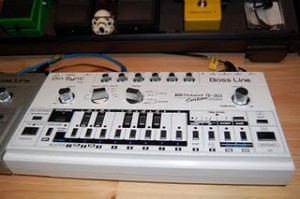
DinSync.info TB-303 Special Edition
MPC1000 TR-707 kick
Bongo #1 Doepfer A-111-5 fm’d internally -> Makenoise QMMG Ch4,
Bongo #2 DinSync.info OSC303 fm’d by Makenoise Maths -> Makenoise QMMG Ch3
Hats Doepfer A-117 -> Doepfer A-106-5
Cowbells Doepfer A-117 -> Doepfer A-106-1
Additional drums Boss DR-110
FX Boss RE-20 Space Echo, Boss PH-3, Behringer VD400
Getting deep in to the power of LFO
Dark Energy, a monophonic desktop synthesizer conversant in Volts, MIDI and USB. With a single oscillator, low-pass filter and ADSR envelope plus two LFOs, its feature set looks fairly basic, but to encourage modular fraternisation, it adds a cluster of patch connections. The Dark Energy has three internal sources of modulation: two LFOs and an ADSR envelope. The LFOs offer just triangular or rectangular waveforms and each has a red/green LED, the colours shifting to track the phase of modulation. Low, medium and high frequency ranges may be selected, the latter hoisting LFO frequency to around 5kHz. Modulation at audio rates is your ticket to pseudo-ring-mod atonality, whilst the slowest (“up to a minute”) LFO speed is ideal for those slothful moments. The envelope is entirely conventional, with just one slight twist. It has three operational ranges scoped for precise, short envelopes, envelopes suitable for solos or general performance, and long drone-type settings. Droners everywhere take note: the maximum attack time is almost a minute.
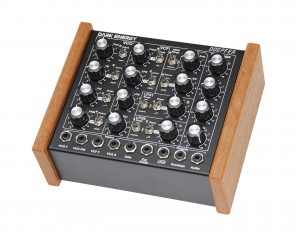
In this video:
Controlling Analogue Solutions Telemark’s filter with Doepfer Dark Energy LFO. Dark Energy has an incredibly high LFO rate and can make for some interesting sounds when paired with the Telemark.
Gear used:
Analogue Solutions Telemark
Doepfer Dark Energy
Vermona DRM1 MkIII
Telemark filter modulated by 2 Doepfer A-155 sequencers
The wonderful Analogue Solutions Telemark filter modulated by 2 Doepfer A-155 sequencers, gate by Telemark, triggered by Cubase 6;
accompanied by a pad from the Roland JX 8-P, bass by A-100 modular and drums by Vermona DRM1 MKIII.
All done with a friendly wink at rezfilter who inspired me a lot …. (still waiting for my Oberkorn)
Doepfer A-189-1 Voltage Controlled Bit Modifier
About 2 weeks ago I bought a second hand Doepfer A-189-1 Voltage Controlled Bit Modifier. I build a +/-15V to +/-12V converter to power the module (though not necessary I understood) and now it’s working. And yes, I now can reproduce that beautiful Mark Shreeve bass sound with that metal edge to it. Anyway, this is a new improvisation but I heard some elements of the Warriors Theme I did before.
The Synthesizers.com Modular , which is connected to the Doepfer A-189-1 module, initially does a 4-step sequence and after a while I switch that to an 8-step sequence. The sawtooth output Ian Fritz Teezer Through-Zero VCO is modulated by the GCS Steiner filter and drives the Blacet Miniwave. This produces a modulated sound. This procedure is described on the Muff’s forum by Bob Borries/VOLT and is called ‘MiniWave Table Tilting’. The self-built Modular does a 4-step sequence. The theme is played on the Roland XP-80 doing the Mellotron strings. The Waldorf Q Keyboard produces some agonizing sounds and the odd solo is performed on the Clavia Nord Lead 1.
You can download/see/hear the video and music from my website.
Via attorks
The Doepfer “Dark Combination”
Synth Project has released this video featuring the Doepfer. A short overview. 2 Dark Energys, one DarkTime and a 3 Octave Keyboard in a selfmade wooden Case. It works all together via Midi.
More Information visit:
http://www.synth-project.de/Dark_Combination.html
Doepfer Improvisation with Sample & Hold Moog Voyager
http://www.intensemusic.co.uk
Sunday afternoon improvising a groove on the Doepfer Modular with live Minimoog. The Old School version links so well with the Doepfer Coltrol Voltages.
There is a type of Japanese painting where you paint with water on a special stone. It can look beautiful but after a short time it dries and is gone forever. A doepfer modular is a bit like that. I’ll never get this sound again – you just have to live in the moment.
Modular Drum Programming
Zoog is working on new Angelspit material. In this video Zoog explains in detail how he processed the drums (played by Chris Kling) his Doepfer Modular Synth and a Metasonix D-1000 Valve Drum Machine.
Zoog Uses: Doepfer A-190 MIDI-CV SYNC Interface, Doepfer A-160 Clock Divider, Doepfer A-154 Sequencer Controller, Doepfer A-155 Analogue Sequencer, Doepfer A-174 Joy STick Controller, Doepfer A-132-4 Quad VCA, METASONIX D1000 Valve Drum Machine, KORG Kaoss Pad 3
DOEPFER.DE
METASONIX.COM
ANGELSPIT.NET
Feast your eyes on the The MC-20 Controller for Korgs iMS-20 App
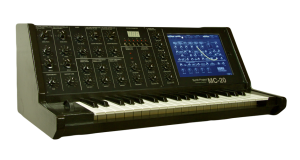
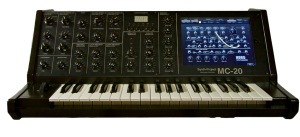
The MC-20 Controller for the iPad has a 3 Octave Full Size Keyboard. So the size of the Case is nearly 1:1 of the original MS-20 Synthesizer.
The case has a iPad Slot to let the iPad inside the Case and you don´t need any place beside the case for the iPad.
The normal parameters are controlled by the USB64 Midi Interface from Doepfer, via Knobs and pots like the real Hardware Synth. To handle the patch cords, i use the iPad. I think, this will be a good way, because the patch sockets of the App and the VST Instrument too, have no Midi CC´s.
The Advantage is, that i can use with iPad App, the Sequencer and the Drum Machine of the App too. So i have a little so-called MS-20 „Workstation“. ;o)
Intellijel μscale – quantized symmetry
The μscale module is a cv quantizer and musical interval generator. In this simple patch I am using four VCO’s. Cwejman VCO-2RM, VM-1,harvestman piston honda, and hertz donut. Everything is being CV sequenced by the output of the μscale. Clocked from one mini ELF LFO to a Doepfer 160, 161 then out to a-151 quad sequential switch controlling the MakeNoise Brains, and two pressure points doing long slow sequences back into the CV and Shift input on the Intellijel μscale. The drums are coming from the cwejman BLD and NS-04 for the white noise snare, and high hats. Effects used TipTop Z5000, Z-DSP, and Doepfer A-187
DATAMASKIN

