
Soundplane Demonstration at Robotspeak
Here’s a new video from synth.me featuring a demonstartion of the Soundplane device:
Thanks to Robot Speak for hosting Randy Jones and his Soundplane controller. He was really great sharing the intimate details on his controller and the technology behind it. Get a look at the controller, calibration software and other details presented by Randy himself.
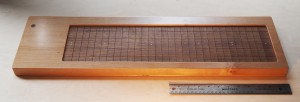
The Soundplane A is a computer music controller with the sensitivity and feel of an acoustic instrument. It detects a wide range of touches on its walnut playing surface, from a light tickle to a very firm press. The Soundplane A can be configured as either a 150-note keyboard with position and pressure sensing on each key, or as one continuous surface.
The playing surface is a material custom developed for us, an articulated sheet of walnut veneer bonded to a fiber backing for strength. The case is milled out of alder, a sustainably harvested Northwest hardwood. We have sourced all of the construction locally and test and assemble Soundplanes by hand here in Seattle. The entire instrument is about 28 inches wide by 8 inches deep by 1 inch thick.
Included with the Soundplane is Aalto for Soundplane, a custom, signal-driven version of our patchable software synthesizer. The Soundplane client software can send MIDI and OSC messages to control other software and hardware.
See this Soundplane onesheet PDF for specifications: [3 Mb PDF]
Slow-Scan TV meets Monotribe
By matching the Monotribe’s LFO speed to the sync speed of an SSTV capture program, I am able to generate abstract imagery, and by controlling the pitch, LFO speed and filter cutoff / resonance, I have rudimentary control over the colors and shapes generated.
Wikipedia – Slow-Scan Television:
en.wikipedia.org/wiki/Slow-scan_television
Slow-scan television (SSTV) is a picture transmission method used mainly by amateur radio operators, to transmit and receive static pictures via radio in monochrome or color.
A technical term for SSTV is narrowband television. Broadcast television requires 6 MHz wide channels, because it transmits 25 or 30 picture frames per second (in the NTSC, PAL or SECAM color systems), but SSTV usually only takes up to a maximum of 3 kHz of bandwidth. It is a much slower method of still picture transmission, usually taking from about eight seconds to a couple of minutes, depending on the mode used, to transmit one image frame.
Since SSTV systems operate on voice frequencies, amateurs use it on shortwave (also known as HF by amateur radio operators), VHF and UHF radio.
Ambitron – new experimental electronic synth

M-RGT launches Ambitron, an experimental electronic synthesizer for Windows. “Ambitron is an experimental electronic synthesizer that employs granular synthesis in two separate and programmable layers each with extensive FX and Modulation Matrix modules which provide the user with maximum control over unique sound creation.
Ambitron comes with scores of samples built in but can also support the import of user samples in .wav format for sound creation that can be customized to user preferences and musical styles. As an experimental synthesizer it radically departs from standard “bread and butter” type instruments and is meant to be used as a laboratory for the exploration of new sonic and timbral creations that would be difficult to achieve any other way.
The nature of Ambitron is that it allows for sonic evolution over time and with the use of the various granular controls allows the user to create sounds that have a life of their own and do not repeat in any kind of expected or predictable manner. It is ideal for ambient soundscapes or virtually any type of experimental genres. When used with a midi controller or host these various controls can be manipulated in real time thus further enhancing the sonic possibilities.”
Price: $33
Fun stuff – Sonic business cards
Ritornell’s business cards are inspired by the project’s live show. The improvised concerts evoke a lively atmosphere by the combination of filigree electronics with playful timbres of diverse acoustic instruments and utensils such as egg whisks, toilet brushes, chopsticks or sewing needles. As an integral part of their set list, Ritornell invites the audience to bring along their private musicboxes. Arranged in a big circle, the players’ speed of turning levers is conducted: the results are as shimmering as you would expect.
Katharina Hölzl designed very special business cards to recreate this playful sonic universe. With the aid of laser assisted milling, nine micro compositions consisting of circles, triangles and Ritornell’s contact information were applied onto a long musicbox paper stripe. Before handing out the cards to interested adressees, each individual subdivision is played back via an especially designed musical box – thus providing every business card receiver with a tailor made musical experience.
Pictures and information:
richard.ritornell.at/index.php?show=musicbox_cards&w=1
Fun stuff – Feats Per Minute
What if you would be able to generate music by the simple act of riding your bike? This project started with that question. We have build the first prototype and thanks to Jeffry Sol and Vincent Beijersbergen we were able to do so in a month. And yes it was pretty difficult, but loads of fun…. the idea is pretty simple; basicly, a wheel and dynamo work the same way as a record player. But it was not as easy as it looks. First, we had to come up with a solution for the wheels; how can we change the records? The forfork was blocking the wheel. That’s why we changed a 30 year old bike into a lefty bike; and build a construction that would still support the weight and would be strong enough for people to ride on it. The biggest challenge of all was to make sure that the needles would stick to the record and follow the grooves, without skipping too much. Therefor we bought two vertical record players and took them apart, to see how they worked. Also; we wanted our bike to be as low tech as possible; that’s why the only “extra” energy we used was a 9 volt battery to support the amplifier. In order for the records to run smoothly, we also had to change the crank of the bike and the chain. After that, we build our own horn, to have some extra volume, and we sprayed the whole bike black. We had some sponsors like bikestores, handy people and DJ’s and that’s how our dream in progress turned out to be real… Here’s to the crazy ones; thank you guys, you rock. – Merel, Pieter and Liat
Eigenharp built-in synth experiment
This is a quick unfinished experiment with hooking up the internal synth agents of EigenD to create a virtual modular synth.
The audio recording without compression can be downloaded from SoundCloud:
http://soundcloud.com/gbevin/eigenharp-built-in-synth
This sound uses two rectangle oscillators with one heavily detuned and one sine oscillator for a little more body. One envelope generator handles the volume of the oscillators and a second one handling the frequency cutoff of a ladder filter into which all oscillators are patched. The key pressure modulates the entire volume of the filter envelope generator. Finally, this is sent into the multi-tap delay agent.
It’s worth noting that all these agents are designed for multi-timbral playing and that all expression signals are separate for each key that is played. From the signal coming out of the keyboard all the way through to the ladder filter, all data is separate. After the filter, everything is summed together before going through the delay and the console mixer.
Open source EigenD (Eigenharp) connected to a modular synth
Background information:
Striving for higher resolution electronic instruments to connect the player to the sound the old-fashioned way.
This is a technical demonstration, meaning, I finished the technical coding, hooked it up, patched the simplest thing I could on the modular and started noodling.
The way this works is that since EigenD (eigenharps platform) is now open source, we’ve (with the help of eigenlabs) been able to crack it open a bit for hacking. We now have an OSC agent which pumps an insane volume of raw data out of the harp ready for some experimental harvesting.
In this demo, I have a MAX patch which sanitizes the data, and makes it expressly fit for translation to control voltage of a modular.
Some data points here. EigenD sends 2000 events per control point per second. Per note there are 3 high res control points per note (pressure, yaw, pitch). So that is 6000 events per sec translated over the wire into voltage. 2 more control points require voltage which are pitch and cv. That means using an audio interface for cv, you need 5 audio outs per level of polyphony. 5 outs for monophonic, 10 outs for duophonic, and up.
Luckily, monophonic is pretty amazing, duophonic is an incredible luxury and 3 levels is showing off.
After I have prototyped this, I could see writing an EigenD agent expressly to do this directly, making the eigenharp modular friendly out of the box.
I however have to mention that this would not be possible without Expert Sleepers Silent Way plugins as the OSC to CV bridge. Nor would it be possible without MAX in this prototype stage.
TimeFactor Self Oscillation Drone
Background information:
This is a drone created with an Eventide TimeFactor and a Roland SRV-3030. Sound was generated by the TimeFactor’s self oscillation – nothing was plugged into the input. The output of the first delay unit was connected to the second, and mono output of the second was connected to the A input of the SRV-3030. All adjustments were performed live by hand.
Hardware feature:
The SRV3030 is a smartly styled 1U processor with stereo analogue I/O on both balanced jacks and XLRs. MIDI In and Out/Thru sockets are fitted, and on the the SRV3030D model only, there is digital S/PDIF I/O on phono connectors (but no AES-EBU on XLRs). Control jacks are available for an optional footswitch (bypass) and an expression pedal for controlling input level.
Though the SRV3030 is a highly sophisticated digital reverb unit, the front-panel controls are mercifully few and are mainly dedicated to single tasks rather than being multi-function. The display makes use of instrument icons to show what category a reverb belongs to, and all the editable parameters may be accessed as a single list — there are no forking menus.
At the heart of the SRV3030 are two reverb processors, A and B. These may be used separately as mono in, stereo out processors, or combined in series or parallel. In addition, there’s a pre-reverb compressor within the normal reverb algorithm, plus two further processing blocks, one for the RSS stereo width expansion (based on the algorithms used in Roland’s dedicated RSS 3D sound processor) and an effects block based on modulated delay effects. The effects block may be placed after either or both reverb blocks but, oddly, it can’t be positioned before the reverb input to add ‘spin’ or ‘swirl’ to the reverb.
Smart TNRi iPad glitch experiment
This is a nice experiment by VJFranzK, I believe I know what is going on here, but can you figure it out?
“Can you figure it out? This strange track uses a nonstandard technique to produce sonic glitches at several points through the song. Hint: It’s not changing the tempo ( which I only do at the very end. ) I think I am the first to discover, or film this trick on YouTube? It’s called a Valse because it ( at least begins ) in 12 beat timing.
Sorry my hands are blocking the view in some parts, but I can’t exactly make them transparent 😉 This requires multiple fingers to do it well, and can’t easily be done on the Hardware Tenori due to the difference in menu systems.”
Scratch Sensor using the Android Smartphone
Scratch is an interpreted dynamic visual programming language. Being dynamic, it lets code be changed even as programs are running. It has the goal of teaching programming concepts to kids and teens and letting them create games, videos, and music. It can be downloaded for free and is being used at home and in a wide variety of in-school and after-school settings around the world.
Connections between Scratch and other programs are made using the Scratch networking protocol. With this feature turned on, Scratch automatically sends all broadcasts and values of global variables out to any program connected to it. That program can also send broadcasts and global variables into Scratch. The Scratch Sensor is an Android app that uses the Scratch networking protocol to turn the Android Smartphone into a DAQ module and sends its accelerometer and compass sensor information and broadcast two states (jump and walk) to Scratch.
DATAMASKIN

