
Sewing Machine Orchestra
Not new but well worth watching 
Sewing machine orchestra is the first version of a performance created by martin messier. the basic sounds used in this performance consist entirely of the acoustic noises produced by 8 sewing machines, amplified by means of microcontacts and process by a computer.
the microcontroller system also enable to use the sewing machines to affect certain parameters of the acoustic sound. the wheel, for exemple, can be assigned to the output volume, etc. machine’s mechanism can be activated by remote, using microcontrollers and a computer, without the need for any other human intervention.
these old objects has the effect of taking the imagination further, primarily through their evocative power. whether they remind of specific incidents or recall the relationship to such objects, few people remain indifferent when they see them.
this creation was made possible with the support of the canada council for the arts.
audio, light, performance : martin messier
electronic: samuel st-aubin
SITAR STYLE MONOTRIBE
Analog Drone Tones from Cosmic Zones
Live Ambient Version featuring the Monotribe, the Kaossilator and a ginat red diamond
EM-Tronic Digital Synth kit
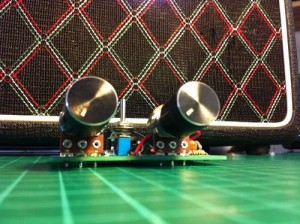
This kit provides you with all the components you need to make a small handheld digital synth. All you need to do is build the kit and find an enclosure to fit it into.
About the EM-Tronic:
With the combination of pitch, speed and mode controls, giving endless combination of sounds this Synthesizer packs quite a punch for it’s size. The best thing is I’ve included the basic software file so you can hack the sound to your hearts content.
The information in this Instructable is all you need to build this synth but if you would just like a kit to put together I have made a few up. EM-Tronic KIT
You will need:
*Circuit board ( get one made or just use strip board)
*The ability to program a Picaxe 08m2 Microcontroller.
*Electronic components( resistors, capacitors, voltage regulator, 9v battery clip, switch, potentiometers, 3.5mm socket, knobs,Picaxe 08m and LEDs
*Soldering iron and solder
*Wire cutters
*Allen key to fit the knobs
*An enclosure to fit the kit into if you want one.
Apart from these instructions I’ve included the circuit board schematic(eagle), circuit board layout(eagle) and the software file EM-tronic.BAS. This gives you all the details you need to build your own EM-Tronic. If the files don’t download or I’ve left something out please let me know and I will sort it out.
Reaktor Monolite 1.0
Experimental noise/drone/fx generator
Purchase it for 10€ here >>
Technical info:
4 sine oscillators +
tone cut filter + soft clipper saturation +
grainer unit (granular processing) +
fx unit with 17 different effects +
automizable X-Y controller for fx +
high-quality reverb.
Object oriented music and visuals

The series Object Oriented is a specially commissioned work created for MINI for the IAA 2011. The hidden music of objects is made perceptible by means of an alchemical transformation which occurs in videomusical time. The resulting rhythms and harmonies allow us to experience our surroundings with a newly heightened appreciation for the audiovisual dynamics of the world around us. Curated by Meiré und Meiré.
—
Conceived, Directed, Edited and Composed by Gabriel Shalom
Synth-maestro Morton Subotnick on tour in Europe
Electronic music pioneer Morton Subotnick performs at Berlin’s 11th Transmediale, a festival of Experimental sound and visuals.
Subotnick combines the famed Buchla synthesizer, which he helped develop in the 60s, with Ableton Live, to reach what he says is, “a performance that is made of gestures, and that is completely immediate.”
The American Morton Subotnick is one of the great pioneers of synthesizer music. His most famous piece Silver Apples From The Moon is a classic of the new electronic music. In Bremen, accompanied Tony Martin, who experimented since the 60s with abstract images projected light from the concert with his projections. In the opening act of the Belgian Jurgen de Blonde with his project Koehn is heard.
Concert and Lecture Tour 2011
October 14 and 15
Morton Subotnick performs and lectures
at the Unsound Festival in Krakow
October 17
Morton Subotnick performs at Bozar
in Brussels, Belgium.
October 18
Morton Subotnick performs
in Paris, France.
October 19
Morton Subotnick performs at Worm
in Rotterdam, Holland
October 20
Morton Subotnick performs
in Bremen, Germany.
October 21
Morton Subotnick lectures
and workshops at the University of Bremen,
in Bremen, Germany.
October 22
Morton Subotnick performs at ZDB,
in Lisbon, Portugal.
Rolling in the beats
24 Video APC40 Mashup created by Chris from Ithaca Audio
Ithaca Audio is a music composition and sound design company
ithacaaudio.com
twitter.com/ithacaaudio
facebook.com/ithacaaudio
soundcloud.com/ithaca-audio
To download a free audio copy go to: soundcloud.com/ithaca-audio/rolling-in-the-beats
Tracks used:
The Prodigy – Mindfields
Ludovico Einaudi – Nightbook
Haddaway – What is love
The Streets – Turn the page
4th Avenue Jones – Move on
Layo & Bushwaka – Love story
Adele – Rolling in the deep
The Killers – All these things that I’ve done
Death in Vegas – Aisha
Beyonce – Crazy in love
Felix Mendelssohn – A midsummer night’s dream
DJ Shadow – Organ donar
Destiny’s Child – Bug a boo
DJ Shadow – The number song (T La Rock – Breakdown / Don Covay – Bad Luck)
Daft Punk – Around the world
Queen/David Bowie – Under pressure
Aretha Franklin – Deeper love
Peter Carpenter – The theme from Magnum P.I
Klaxons – Gravitys rainbox (Soulwax remix)
Michael Jackson – Scream
The Verve – Bittersweet symphony
Run DMC/Aerosmith – Walk this way
Basement Jaxx – Do your thing
Faithless – Take the long way home
Experimental music from very short C programs
How all this came about:
Noisolation Headphones CTRL
An invention for mechanically transforming the relationship between a person and the noise that immediately surrounds them. This project is part of the graduate thesis “Listening Instruments” by Alex Braidwood. Additional experiments, collaborations, research and writings are available at
listeninginstruments.com
Sunrizer + SoundPrism Pro Expression Tutorial
How to use the accelerometer based expression feature of SoundPrism Pro to control Sunrizer Synth for iPad
More info here:
SoundPrism Pro is available at http://soundprism.com/pro
Get Sunrizer here: http://beepstreet.com/
You can find the SoundPrism Expression Tutorial here: http://soundprismhowto.com/howto2/index.php?show=expression
Version 1.4 of SoundPrism Pro turns your iOS device into a 3D MIDI controller. Watch the following video for setup instructions. (Please note that since SoundPrism Pro version 2.2 the expression menu is now located within the preferences menu).
SoundPrism Pro 1.4 now supports Accelerometer Input.
This video explains what that means and how to use it.
SoundPrism Pro turns your iOS device into a wireless 3D MIDI controller.
DATAMASKIN

