
Buchla 200e modular synth Cubism
Complex Buchla 200e patch combined with Hertz Donut and ATT4. Ableton Live Reverb and Filter FX. Visualizer by David Tin Nyo
Awesome synth video with Nerd Revolt
Really cool ambient synth blip video coming your way from Nerd Revolt
Download track here: http://soundcloud.com/nerd-revolt/wor…
Original version of “Working Title” can be found on our “Haze of introspection…and sh*t.” EP.
Available on Innerflight Music.
O-Bow 1 – the first optical bow prototype
Demonstration of O-Bow 1, the first optical bow prototype. Uses a single sample for synthesis. Bow speed controls gain, bow angle controls vibrato.
The O-Bow is a bow controller consisting of an optical flow sensor mounted to measure the bow speed and horizontal angle with high resolution. The bow can be anything with a grained surface, such as a wooden stick.
Development of the O-Bow was prompted by the lack of robust, and inexpensive bow controllers. Synthesized string instruments frequently appear in recordings, yet the quality of articulation is very limited for such expressive instruments. Bowing is a fairly easy skill to aquire, whereas fingering and vibrato are very difficult. Combining the keyboard with bow allows a musician previously unskilled with string instruments to quickly produce much better articulation than using a keyboard alone.Controlling vibrato with bow angle or key pressure avoids the need to control vibrato directly.
From a less utilitarian viewpoint, bowing is a very natural and expressive mode of control. It deserves to be integrated better into the modern world of electronic sound, including that which is more removed from authentic strings.
So far the O-Bow has been used with a simple one-sample synthesiser as shown in the following video. More sophistocated synthesis is being developed, including physical modelling. A related patent application has been filed.
Halcyon – a new Generative Musical Instrument
Zach Gage has shared a new instrument with us called Halcyon, Zach is the creator of Bit Pilot, Unify, and SynthPond
Here´s what he has to say about it:
– A Unique Action Puzzle Game –
Halcyon is named for the mythological bird of ancient Greece, said to charm the winds and seas into a calm during the Winter Solstice. Gameplay is one part spacial action puzzler and one part interactive stringed instrument combined in an experience designed specifically for the iPad. Colored currents travel inexorably toward each other. Strum the strings to match the currents, creating both phonic and visual harmony. Take on the role of the Halcyon, conducting nature, untangling currents, and bringing calm to the wind, sea, land, and stars.
– A Generative Musical Instrument –
Halcyon features a complete generative soundtrack that becomes an instrument when you play the game. Since its designed to accompany you while you play, you’ll create tranquil sonic landscapes as you travel along.
– Tons of Gameplay –
: 36 Levels through Four Environments
: Two Endless Modes that dynamically adjust difficulty based on how you are doing
: A Twelve Song Generative Soundtrack
: OpenFeint + Game Center
If you enjoyed Unify, you’ll love Halcyon
Demo of the experimental Manta
Rasmus Nyåker of the Copenhagen Noise Lab has shared these two videos on Youtube. Speaking with webzine CDM he explains; The Manta only supplies me with one continious controller per finger/zone/hexagon. It’s much like any polyphonic aftertouch keyboard in that way (I have a Roland A80 which is a marvellous controller as a keyboard). The Manta has two great things going for it, though: it is much more compact and I can route a separate CC-number from each of its hexagons.
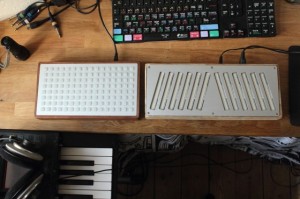
In this video I just route CCs from the hexagons to the Nord Modular G2. I control FX for rhythms on the top row and toggles Delay/Reverb too. On the very left I use CCs to control pitch and amplitude of 4 oscillators. On the other buttons I just control amlitude of 36 different tuned Sinus oscillators. The second and forth row from the bottom is just detuned oscillators of the ones controlled in the row below.
First thing I did with my new Snyderphonics Manta. Using a standard midi-patch in MAX/MSP to control the Nord Modular G2. The sound is just a pad with some extended control for the manta.
CHEAP, FAT and OPEN – open source platform for musical exploration
Jacob Sikker Remin of www.campingsex.org shows off his new open source synth/sequencer Cheap Fat and Open.
CHEAP, FAT and OPEN is an open source platform for musical exploration, composition and performance.
The platform is CHEAP, and OPEN – welcoming you to experiment.
A combination of the old and new: the raw 8bit / chip tune approach combined with wireless connectivity, state of the art open source hardware, and expandability – gives us that FAT sound.
It is portable, allowing you to make music on the go.
The platform is a performance instrument, giving a full 1½ octave keyboard control in compact packaging, through a classic stylophone interface. It is also a sequencer, allowing you to program rhythms and melodies, and play them back in sync with other platforms and instruments.
This is NOT a finished product. It works as is, but inside the platform rests an atmega328 processor, which can be programmed in the Arduino environment. This means that the platform can be modified, expanded, and tweaked to meet your exact needs.
CHEAP, FAT and OPEN is designed for geeky musicians, the chip tune community, the makers, the circuit benders, the interaction designers and the musical programmers, and anyone else who wishes to experiment with sequenced / networked / low-level musical exploration.
This project is based on knowledge and inspiration from many different communities. I hope that by bridging these different creative communities, we can create something beautiful together.
See http://tthheessiiss.wordpress.com/ for more details
An audio-visual self-organized performance space
“Empty Rooms” instances itself as an audio-visual self-organized performance space.
The paradigm itself discloses a synesthetic approach between the “aural” and “visual” experiences.
A Movie made of algorithmically generated “inactive spaces” is projected on a screen.
An overlapped stream of pre-recorded “sound activities” is then diffused from a record player and from 4 different iPods running in shuffle mode, creating recombinant “invisible actions” to fit into the Movie.
A self organizing link between sound and visuals is established via cybernetic procedures defined as interconnected spin networks, produced by a video camera “observing” the movie and by one microphone “listening” to the space placed inside the performance Locus.
The Kyma sound design environment (accelerated by the Pacarana sound computation engine) is then engaged in order to compute the data and perform real-time evaluations between the different types of numerical information (audio-video), producing a “sonorous response” to the asynchronous stream of audio-visual contents.
The synthesized information is then diffused in the performance space again through 4 loudspeakers.
Various types of feedback will take place during this highly dynamic process implying a self regulating behavior that will establish new connections between the pacing of the movie locations and the “sonorous” content produced by the processing of the iPod sound streams.
The Observer will then experience the following layers of information:
– a Real-Time recombinant Movie made of “inactive” locations.
– an Overlapped Stream of “possible actions” diffused by the iPods that fits into the Movie.
– a Sonorous link between the above domains of activities via 4 full range loudspeakers.
The Observer can take into account one or more layers of information (even all of them) in order to create himself a cinematic experience via a correlation process.
usoproject.com/video/Empty_Rooms_eng_booklet.pdf
usoproject.com/video/Empty_Rooms_Technical_Rider.pdf
Jam with the monophonic synthesizer Kraftzwerg
Via traumaduo
“A 4 Voice!!!-Jam with the monophonic synthesizer Kraftzwerg
4 “Midi to CV”-Tracks were used for controlling the 3 Oscillators individually.
The 1st Midi-Track controls the Frequency of Oscillator 1 and sends the appropriate Trigger Signal to Envelope 1. Env. 1 is connected with the Filter.
The 2nd Midi-Track contains also Frequency- and Trigger-Signals. But this ones controls Osc. 2.
Osc 2 is connected to the VCA who is controlled by the Envelope 2.
This produces the higher Percussive Effects.
The 3rd Midi-Track sends the Frequency (Pitch) to Osc. 3.
Because the Kraftzwerg has not more Envelopes or Mixers left, Osc. 3
is modulated by the Autofilter of Ableton Live with a Sample&Hold.
This Midi-Track plays the lower Bassline.
The 4th Midi Track contains very short Frequency-Voltages for Osc. 3. This Notes plays the higher Melody.
Due to the fact that Osc. 3 is processed by a Reverb and a Delay and the Pitch changements are very short, you got the impression of hearing a duophonic Melody sorting out from Oscillator 3!
Also a separate Midi Track was recorded with CC-Datas from the Kaosspad.
The Kaosspad is processing OSC 1 and 2 from the Kraftzwerg nearly like a random-processor.
I added also some connections from both LFO’s to the Oscillator 1 and 2.”
Using a checker board as a step sequencer
Josh Silverman has provided us with this interesting demo featuring a checkerboard sequencer
This is a demo video to demonstrate the use of a checker board as a step sequencer. This video should make obvious the relationship between the position of the checkers pieces and the noises they represent and trigger. It’s still a work in progress, but for now I won’t subject you to the cacophony that is the sound of an actual game of checkers.
Aside from the kick drum, which just keeps pace on every beat, all other drum samples are triggered off the board.
In this version, I’ve implemented a Mute Region that surrounds the board. When the application sees activity in the mute region, it disables the updating of the sequencer. This way, my hand doesn’t trigger a cacophony when I move the pieces.
More details at prettyextreme.com/?p=124
Built with openFrameworks and Ableton Live.
Tim Kaiser: Live @ ESS
If you have missed Mr Tim Kaiser during his last tour of the Steel Belt you may still hear his set. On the way up north Tim recorded at the Experimental Sound Studio in Chicago.
Tim Kaiser – Live @ ESS 10.30.2010 by Experimental Sound Studio
More Info:
experimentalsoundstudio.org
spacetimesessions.blogspot.com
timkaiser.org
DATAMASKIN

