
Tal-U-No-LX – Roland Juno Emulation now released
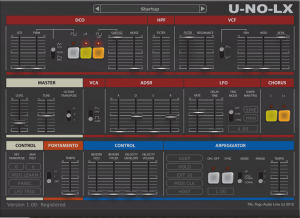
TAL-U-NO-LX is a fully rewritten emulation of the popular hardware with a new engine and GUI. Up to date zero feedback delay filters and carefully calibrated controls make this synth a good replacement for the analog device with all the advantages software plugins have. As an addition, the TAL_U-NO-LX also supports portamento and different filter LFO waveforms and some more useful features. An arpeggiator with different sync modes and hold function is also included. A very fast envelope with a smooth roll-off and emulated inaccuracy gives this synth the typical sound. The synth was calibrated after a hardware device that’s property of TAL.
Special Features:
- Self resonating zero feedback delay filter (24dB LP).
- Filter range up to ~40kHz (depends on the sample rate).
- Calibrated and tuned after TAL’s hardware device.
- Midi learn / automation for all controlls.
- Improved alias free oscillators for an authentic sound also @ 44’100Hz sampling rate.
- Arpeggiator with different sync modes (host, midi clock, not on).
- Portamento and mono mode.
- LFO manual trigger button.
- Sustain pedal support.
- Up to 12 voices.
- New file based preset system for transparent preset management.
- More than 300 factory presets by different sound designers (FMR, Particular – Sound, TAL).
- Original hardware “Factory Bank A” included.
Demo / Full Version:
It’s not possible to save presets in demo mode.
Price USD 35.00 70.00 – 50% introductory price for a limited time!
Roland Juno-60
BRUNO ENDER LEE – “Roland Juno-60” – recorded February 2007, every sound is made with Roland Juno-60, on three stereo-tracks, just added some delay & chorus, taken from the CD “Analogue_Syn”
Among the first in Roland’s amazing Juno family! Six analog voices of polyphony and patch memory storage!! The Juno-60 sounds great, however, like the Juno-6 it lacks MIDI control. The Juno-60 includes 56 patches of memory storage. The Juno-60 is still popular due in part to opinions that it sounds better (punchier) than the Juno-106. The Juno-6 and 60 are very rich sounding synthesizers and are great analog machines as long as you can withstand the absence of MIDI control. The JSQ-60 sequencer is an external sequencer controller for the Juno-60 and is usually worth acquiring. Of course nobody can deny that the wooden side panel look is a true sign of Vintage status!
Epic Synth – nice little Juno emulation
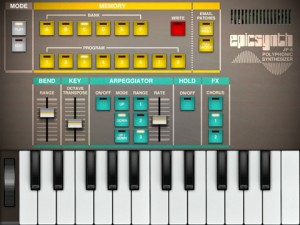
Epic Synth is a polyphonic synthesizer inspired by classic synths of the 1980s. Its beautiful and straightforward interface lets you focus on the essential: the pleasure of creating new sounds! The goal is to explore sound, not interface pages.
Epic Synth’s simple and effective sound architecture stood the test of time. It’s simple enough for beginners to learn about synthesis yet powerful enough to satisfy experienced sound modellers. Epic Synth’s sound engine provides tons of room to create great sounds, from classic leads to juicy acid basses, from 8-bit-like effects to complex evolving sonic textures.
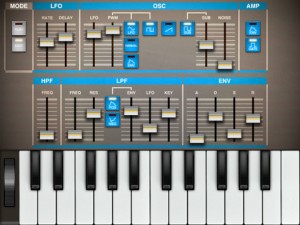
FEATURES INCLUDE
- Universal all: works on iPhone, iPod and iPad
- Takes advantage of the gorgeous Retina display on iPad and iPhone/iPod
- Classic time-tested sound architecture
- Five voices of polyphony (Six on the iPad)
- Arpeggiator with key hold
- Patch memory stores 6 banks of 8 programs
- Single patch sharing via email
- Full memory backup via email
- Pitch bend on iPad and via MIDI
Time machine: Roland Juno-106
Time for a new trip with the time machine. A voyage into the heart of the Roland Juno-106 from the year 1984.
Exploration by Marko Ettlich
1 Osc per Voice + Sub osc
6 Voice Polyphonic
LFO – 1 LFO
Filter – analog lowpass with ADSR envelope
Chorus
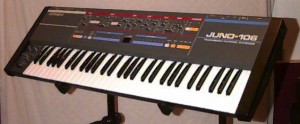
The Juno-106 is a very common and widely used analog polysynth. It continues to be one of the most popular analog synths due to its great sound and easy programmability. It was the next major incarnation of the Juno-series, following the Juno-60. While it has virtually the same synth engine as the Juno-60, the 106 added extensive MIDI control making it one of Roland’s first MIDI-equipped synthesizers. There was also increased patch memory storage, up to 128 patches instead of the 56 patches available in the Juno-60. However, the Juno-60 is often said to have a slight sonic edge over the more advanced 106. The 60 had the ability to modulate oscillator pulse from its envelope and has a “punchier” sound quality.
The Juno-106 is a six-voice polyphonic and programable analog synth with one digitally controlled oscillator (DCO) per voice. While classic monophonic synths used two or three oscillators to create a fatter sound, the Juno-106 uses built-in Chorus to fatten up its sound to dramatic effect. The nature of its DCO meant it was stable and always in perfect tune but still warm and analog. There is an excellent 24dB/oct analog lowpass filter with plenty of resonance and self-oscillating possibilities and a non-resonant highpass filter. The programable pitch/mod bender can be assigned to control the DCO pitch, VCF cutoff, and LFO amount all at once or individually.
The Juno-106 was the first MIDI equipped Juno and its implementation is quite good. There are 16 MIDI channels available and MIDI SysEx data can be transmitted/received from all the sliders and buttons for total remote control and sequencing capability. A switch on the back of the keyboard, next to the MIDI ports allows the user to switch between three types of MIDI modes: Keyboard and Hold data only; Keyboard, Hold, Bender, Patch selection data; or All data (including SysEx). Most users simply set it to MIDI Function mode 3 and forget it.
This synth is incredibly straightforward and very powerful. It’s SH-series derived panel layout is easy to understand and very hands-on. Use it to generate lush pads, filter sweeps, and funky bass lines and leads. The Juno-106 is an awesome learning tool for anyone new to analog synthesis, as well as an electronic musician’s dream for its warm analog sounds coupled with modern features like MIDI and memory – all at a very reasonable price. And still the Juno-106 has an even cheaper alter-ego in the form of the HS-60 – a hobbyist version with built-in speakers.
Roland Juno 2 iPad controller with Arduino Ethernet demo
Demo of a custom device build around Arduino in order to control the Roland Alpha Juno 2 via Wifi.
The Arduino connects the Juno2 to the Wifi network of the iPad via an Airport router, an Arduino Ethernet shield and a midi shield.
I used Touch OSC to design the controller.
Touch OSC sends OSC messages (e.g /jun/DCO_Range 2.000) which are translated by the Arduino into Midi SysEx messages.
But the Arduino also translates Midi sysex messages from the Juno 2 into OSC messages (sort of loopback) so that when you change the patch on the Juno2, faders automatically move to the right position !
The code and detailled instructions will soon be published on http://4colors.free.fr
The control design mimics Roland PG300, but better !
TAL-U-NO-LX – new Juno-60 synth emulation plugin
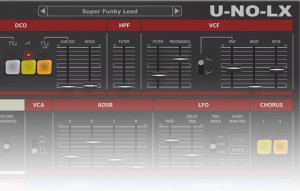
Togu Audio Line has announced the TAL-U-NO-LX, a new Juno-60 emulation with a fully rewritten new engine and GUI.
Up to date zero feedback delay filters and carefully calibrated controls make this synth a good replacement for the analog device with all the advantages software plugins have. It’s even possible to recreate old Juno patches from an existing patch sheet. As an addition, the TAL_U-NO-LX also supports portamento and different LFO waveforms and some more useful features. An arpeggiator with different sync modes and hold function is also included.
This new version will also be available as 64bit OSX AU and VST plugin. It was hard to calibrate a synth that has different envelope times on every voice, but we even copied this to some degree

TAL-U-NO-LX will be available to purchase within a few weeks. People who donated $17 USD or more (up to June 11th, 2012) will get a free license.
Taste of the Juno: Ableton Live Pack
Ableton Live Pack of 22 instruments created with the Roland Juno 106 Polyphonic Analog Synthesizer. Each instrument was sampled from a custom patch on the Juno 106 and contains 8 macro knobs with its own unique effects to further twist and manipulate this diverse collection of sounds.
Available at http://afrodjmac.spinshop.com

The Roland Juno 106 is a classic analog synthesizer. It is capable of a wide range of sounds loaded with warmth and character. Within the digital domain, it can be hard to emulate the electronic circuitry responsible for the subtleties that give an old analog synth its charm. However, thanks to the sampling power of Ableton Live, those characteristic tones and sonic potential are now in your hands.
Time machine: Roland Juno-60
A voyage into the heart of the Roland Juno-60 from the year 1982.
Exploration by Marko Ettlich
1 Osc per Voice + Sub osc
6 Voice Polyphonic
LFO – 1 LFO
Filter – analog lowpass with ADSR envelope
Arpeggiator
Chorus
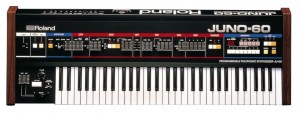
It has been used by The Cure, Howard Jones, Flock of Seagulls, Eurythmics and more. Among the first in Roland’s amazing JUNO family! Six analog voices of polyphony and patch memory storage!! The JUNO-60 sounds great, however, like the JUNO-6 it lacks MIDI control. The JUNO-60 includes 56 patches of memory storage. The JUNO-60 is still popular due in part to opinions that it sounds better (punchier) than the JUNO-106. The JUNO-6 and 60 are very rich sounding synthesizers and are great analog machines as long as you can withstand the absence of MIDI control. The JSQ-60 sequencer is an external sequencer controller for the JUNO-60 and is usually worth acquiring. Of course nobody can deny that the wooden side panel look is a true sign of Vintage status!
Closer look at the Roland Juno 6 synth
Background info:
The Juno 6/60 is a popular synth that is the subject of a lot of discussion, and much of it is negative. I am a huge fan of the Juno 6/60 and think it gets and unfair amount of criticism, primarily behind the veil of the internet. This demo showcases its amazing sound and some of it’s capabilities.
Below is the link to the original uncompressed demo:
http://soundcloud.com/briancastro/roland-juno-6
Juno 106 Ableton Live Pack
Ableton Live Pack of 22 instruments created with the Roland Juno 106 Polyphonic Analog Synthesizer. Each instrument was sampled from a custom patch on the Juno 106 and contains 8 macro knobs with its own unique effects to further twist and manipulate this diverse collection of sounds.
Available at http://afrodjmac.spinshop.com
The JUNO-106 is a very common and widely used analog polysynth. It continues to be one of the most popular analog synths due to its great sound and easy programmability. It was the next major incarnation of the JUNO-series, following the JUNO-60. While it has virtually the same synth engine as the JUNO-60, the 106 added extensive MIDI control making it one of Roland’s first MIDI-equipped synthesizers. There was also increased patch memory storage, up to 128 patches instead of the 56 patches available in the JUNO-60. However, the JUNO-60 is often said to have a slight sonic edge over the more advanced 106. The 60 had the ability to modulate oscillator pulse from its envelope and has a “punchier” sound quality.
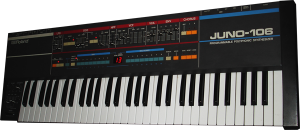
The JUNO-106 is a six-voice polyphonic and programable analog synth with one digitally controlled oscillator (DCO) per voice. While classic monophonic synths used two or three oscillators to create a fatter sound, the JUNO-106 uses built-in Chorus to fatten up its sound to dramatic effect. The nature of its DCO meant it was stable and always in perfect tune but still warm and analog. There is an excellent 24dB/oct analog lowpass filter with plenty of resonance and self-oscillating possibilities and a non-resonant highpass filter. The programable pitch/mod bender can be assigned to control the DCO pitch, VCF cutoff, and LFO amount all at once or individually.
The JUNO-106 was the first MIDI equipped JUNO and its implementation is quite good. There are 16 MIDI channels available and MIDI SysEx data can be transmitted/received from all the sliders and buttons for total remote control and sequencing capability. A switch on the back of the keyboard, next to the MIDI ports allows the user to switch between three types of MIDI modes: Keyboard and Hold data only; Keyboard, Hold, Bender, Patch selection data; or All data (including SysEx). Most users simply set it to MIDI Function mode 3 and forget it.
DATAMASKIN

