
Sounds of the JUNO-60

pure Roland Juno-60 (1982) by RetroSound
Among the first in Roland’s amazing JUNO family! Six analog voices of polyphony and patch memory storage!! The JUNO-60 sounds great, however, like the JUNO-6 it lacks MIDI control. The JUNO-60 includes 56 patches of memory storage. The JUNO-60 is still popular due in part to opinions that it sounds better (punchier) than the JUNO-106. The JUNO-6 and 60 are very rich sounding synthesizers and are great analog machines as long as you can withstand the absence of MIDI control. The JSQ-60 sequencer is an external sequencer controller for the JUNO-60 and is usually worth acquiring. Of course nobody can deny that the wooden side panel look is a true sign of Vintage status!
Italo Disco Synth
Festa In Soffitta – ’80s Italo with Emulator, Juno-60, Memorymoog and DMX
Background data:
People ask me to post more Italo Disco synth demos, so here you go. A song in the typical early/mid ’80s style.
E-mu Emulator: orchestra hit, Synclavier
Roland Juno-60: synth bass, synth strings
Moog Memorymoog: synth brass, syn vox
Oberheim DMX: drum machine
Time machine – Roland Alpha Juno 2 + Oberheim Cyclone Arpeggiator
Vintage synth demo by RetroSound
Roland Alpha Juno 2 Analog Synthesizer (1986)
Oberheim Cyclone Arpeggiator
more info: http://www.retrosound.de/
More info on the Juno 2:
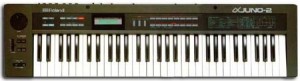
This is an upgraded version of the Alpha Juno 1. It adds an extended 61 note keyboard with velocity and aftertouch and an external memory cartridge slot. Other than that it has the same great sound and features as the Juno 1. Sliders and buttons were replaced by membrane buttons and the Alpha Dial which is used to edit and browse through the extensive selection of parameters: DCO digitally controlled oscillators, LFO, bend, ENV, pulse, waveforms, noise, PW/PWM, high pass filter, VCF filter with freq/env/res/lfo/kybd, VCA envelope, chorus, and more.
Adequate in the studio or on the stage, the Juno 2 has 64 presets and 64 user memory patches, a nice LCD display, an LFO capable of a very slow rate for some cool sweeping effects, and a great bass sound (especially nice for acid basslines) and noise effects! It also has chord memory which is perfect for rave & techno, portamento and keyboard transposing. The PG-300 Synthesizer Programmer gives you traditional slider control of each parameter for much easier and faster editing.
Time machine: ROLAND JUNO-60 Analog Synthesizer 1982
http://youtu.be/Jhn7itB7JQU
Among the first in Roland’s amazing JUNO family! Six analog voices of polyphony and patch memory storage!! The Roland Juno-60 is a classic six voice polyphonic analog synthesizer with 56 patch memory for your sounds. Although the sound architecture is rather basic, it has an excellent analogue sound. The Juno-60 can produce great basses / sequences with its fast envelopes. It can also produce warm smooth pads with its excellent filters.
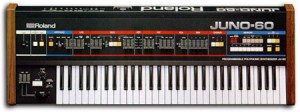
The Juno-60 was used by many professionals like Eurythmics, Howard Jones, the Madonna producers, Paul Van Dyk and many more… it has the DCB interface – the predecessor of MIDI. With a DCB to MIDI interface it is very easy to integrate the instrument in a midi setup.
To my ears the JUNO-60 sounds far better than the very similar JUNO-106 (I had both). The Juno-60 has snappier envelopes and a fater chorus. The difference is clearly notable. IMO the Juno-60 ist the best sounding Juno. But all Junos can sound great… Please note, I am talking about the original Juno series from the eighties.
I played the JUNO-60 without any additional FX or EQ (except the intro music – this is a multi track recording). Excuse the slight distortion in the first minute.
THE SOUND PROGRAMS IN THIS MOVIE:
Do you have a Juno-60 and want to play with the sounds heard in the video? You can buy the “ANALOGAUDIO1 PATCH BANK” (56 sounds) for 12,99 Euros.
After payment through PayPal you will get a MP3 with sound data for the tape interface of your Juno-60 via email.
The details about the functionality of the tape interface are described in the manual of the Juno-60, which you can download for free.The patchbank will NOT work with the Juno-106, because this one has a different data format.
If you want to buy the “ANALOGAUDIO1 PATCHBANK”, please drop me a mail.
Free samples of the classic Roland Alpha Juno 2
Roland Alpha Juno 2 sound bank demo by Hardballs
Hardball Records has released a free sound bank, Hoover Sound Bank, that features sounds of the Roland Alpha Juno 2 synthesizer:
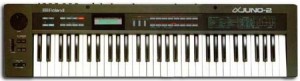
This is exactly the same synthesizer that created the original Hoover sound, patch called “What The”, originally created by Eric Persing for Roland Alpha Juno. Juno 2 is just an upgraded version of Roland Alpha Juno, thus we have the original Hoover sound. Additionally, I have sampled couple of bass sounds, which somebody may find useful.
As usually, each sound is a separate bank for NI Kontakt and EXS-24 samplers.
Each sample was recorded thru the Pro Tools HD from Roland Alpha Juno 2,
without any effects or processing, just clean original synth sound!
All samples are 44.1 kHz, 24 bit, Stereo WAV files.
The audio demo, above, is made using only the synth sounds in this sound bank, plus drums.
You can download the Hoover Sound Bank from the Hardball Records site.
Synth spotting: Above & Beyond – You got to go (Kebu remix)
Here’s what Kebu has to say about the tune:
This is a remix I made for a competition. If you like it, please follow this link and vote for it by pressing “spin” (requires registration):
http://www.beatportal.com/remix/detail/ab-you-got-to-go-k…
I didn’t plan to make any more videos before my upcoming album is ready, but I stumbled upon a competition to remix Above & Beyond’s “You got to go”. Since I’ve recently discovered Anjunabeats and their great trance compilation Worldwide 03, which I’ve been spinning almost every day now for two weeks, I just had to take the time to give it a shot!
I saved only the vocals (sung by Zoë Johnston) from the original track and remade all music using only analog synths. The analog synths and analog drum machines were controlled in realtime by a MIDI sequencer and mixed together with the vocal using an analog mixer and hardware effects.
Equipment used: Korg Mono/Poly, Polysix, Poly-61; Roland Juno-60, Alpha Juno, TR-808 (w. MIDI); Moog Source; Oberheim Matrix 6R; Vermona DRM1 Mk III; Electro Harmonix Small Stone; Boss BD-2 (H2O mod), DD-3; Lexicon MPX500; DBX 290; Emagic AMT8; M-Audio Midisport 8×8/s; Alesis iO26; Cubase SL 1.06; Allen & Heath GS1; Yamaha S30 (as MIDI keyboard); Doepfer MCV1; Kenton Pro 2.
Camera: Canon HF100
Hope you enjoy my t-shirt! 😉
An improvisation in a Valerie Dore / Italo Disco style
An improvisation in a Valerie Dore / Italo Disco style circa 1984. Featuring the Orchestrator, Juno-60, LinnDrum and SH-101
Crumar Orchestrator: string machine
Roland SH-101: bass
Roland Juno-60: synth strings
Linn LinnDrum: drum machine
Reverb: built-in Roland M-10DX digital mixer
Delay on Linn claps: Boss DD-3 digital delay pedal
Hardware feature – Crumar Orchestrator:
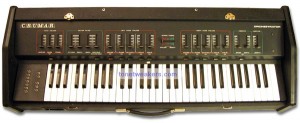
In 1977, Crumar introduced the Orchestrator (called the Multiman-S in Europe), a fully polyphonic orchestral string machine. It has five basic sounds: Brass, Piano, Clavichord, Cello and Violin. The keyboard is split in the middle allowing you to play one combination of instruments with the left hand, and another combination with the right.
All five sounds are available at all times, you simply adjust how much volume you want of each sound. Feature just a single instrument, or create your own orchestral ensemble—you are the Orchestrator! With the keyboard being split, there are five separate instrument volume sliders for the left hand (lower split) and another five for the right hand (upper split).
There is also a sixth sound: Bass. The Bass sound has its own volume slider as well, but it is assigned to only the bottom 27 notes of the keyboard. It is also not the greatest of Bass sounds either, and can sometimes muddy the sound.
There is a filter section but only for the Brass. It uses some pretty old-fashioned terminology: ‘Emphasis’ for resonance and ‘Contour’ for cutoff. There are also Attack and Decay controls for the filter. There is another filter for the Cello and Violin string sounds called ‘Timbre’ which can adjust between a ‘Mellow’ to ‘Bright’ sound—basically it’s a highpass filter. There is a ‘Vibrato’ effect section, basically the LFO, with ‘Speed’ and ‘Depth’ controls. The only global envelope control is a ‘Sustain’ length slider.
The Orchestrator’s best sounds are its Brass (probably because it is the sound with the VCF filter) and the Strings. In fact the Strings sound very similar to the famous ARP Solina. Unfortunately there are no built-in Ensemble effects to really sweeten them up…but that’s what outboard gear is for!
Like most synthesizers of its time, the Orchestrator was built with the performing musician in mind. It is its own flight-case! Its casing is very tough and durable, it has a handle and a cover/lid to keep it protected during transport. And if it looks heavy, it is! Additional options for the Orchestrator included an organ-like 13-note (G-G) Foot Pedal Board, Sustain Pedal, and a Foot Expression Pedal controller for the filter cutoff. There are no CV/Gate options, just connectors for the external pedal controllers.
About section via VSE
JUNO-60 : It don’t get more analog than this… :-)
Background information:
http://www.stephenhobley.com/blog/2011/09/18/fixing-up-a-…
I just refurbished my JUNO-60 – this video is me taking it for a test drive after reassembly. No sequencer, just the built in arpeggiator and the “hold” function. The keys were stripped and washed, the switches and faders were given the full DeOxit treatment, and the dead internal battery was replaced with a lithium button cell. Finally the factory programs were reinstated using a WAV file. The effect is an analog tape delay provided by a Tascam 32 reel to reel. Looping the signal from the playback head to the record head. It don’t get any more analog than this… 
(Actually this is just as much a test of doing a 2×2 synchronous video matrix as it is a test of the synthesizer)
Pulsator – analog synths, sequencers & drum machines
Music composition based around old skool sequencing programming combined with some edgy synth sounds. Featuring Jomox Xbase09 drums, SH101 & Pro-one sequences, Juno & JP8 arpeggiators, JP6 lead, Prodigy bassnotes, plus other bits & pieces.
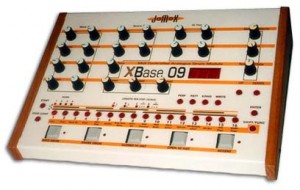
The XBase-09 is serious about emulating the Roland TR-909. Like the 909, it is an analog drum machine, and it sounds just like the 909, and more! It offers the same types of analog controls that the TR-808 and TR-909 did such as tuning, level, decay, snap, etc. However it provides more of these controls for more sounds than the originals ever did and has MIDI implementation and Patch memory making the XBase-09 a much more versatile machine than those originals.
Kick and snare are true analog, not emulation and not sampled. The Hihats, cymbal, ride, rimshot, claps and noise sounds are samples but are still quite tweakable. All your edited sounds can be stored into the 100 patches of memory. Use the built-in LFOs to modulate the Bass drum pitch, Snare Tune, Snare Snap, Snare Noise Tune, HiHat Tune or LFO 2.
The XBase-09’s built-in sequencer is also more advanced yet faithful to the style of its mentors. Step or Real-Time programming just like it’s done on the 909 and 808! However, on the XBase, any edits to the sounds will also be stored with the pattern or song! This really liven’s up your beats and allows you freedom and control to do things not easily possible on the original beat boxes! There’s also an extensive Shuffle mode. Of course the XBase-09 is also happy as a simple drum tone module, with all editable controls accessible using MIDI. The controls also send MIDI data when tweaked so you can record real-time edits into your external sequencer.
Juno 60 and Doepfer in perfect harmony
The Roland Juno-60 is a popular analogue 61-key polyphonic synthesizer produced by Roland Corporation in the early 1980s and a successor to the slightly earlier Juno-6. Like its predecessor, the Juno-60 has some digital enhancements, used only for clocking the oscillators and for saving/loading patches. The Juno-60 synthesizer is a six-voice polyphonic synthesizer. The single digitally-controlled oscillator (or DCO for short) per voice gave the Juno-60 a high degree of stability in maintaining tune; most analogue voltage-controlled oscillators (VCOs) of the time would tend to drift in pitch and require re-tuning of the oscillator. The DCO provides sawtooth and square/pulse waveforms as a sound source, in addition to white noise and a square-wave suboscillator pitched one octave beneath the key played. Both of these additional sources can be mixed in with dedicated sliders.

The filters and envelope on the Juno-60 rely on control voltages sent by depressing the keys on the keyboard and were thus analogue. The Juno-60 features a rather distinctive-sounding 24 dB/octave lowpass filter with resonance. Unlike other VCF’s of the day, the Juno-60’s is capable of self-oscillation and thus could be used to some degree as a tone generator in and of itself. The filter section also features controls for envelope amount and polarity, LFO modulation, and keyboard tracking. In addition, a three-position non-resonant highpass filter is provided to thin out lower frequencies.
The signal is then sent through a voltage-controlled amplifier (or VCA) and a simple four-stage ADSR filter envelope. The Juno-60 provides limited options for modulating the audio signal. A single triangle-wave variable-rate LFO is provided as a modulation source; this can be mixed into the DCO to create vibrato or into the lowpass filter to generate a tremolo effect. The LFO can either be triggered manually by the left hand using a large button above the pitch bend lever or set to engage automatically whenever a key was pressed.
In this video:
Various Roland Juno 60 chords are being sent to the Doepfer A 119 module and then shaped and processed through the A121 Multi Mode Filter, which in turn is being modulated by the A 115 Sequencer.
DATAMASKIN

