
Chaka Kahn goes Moog
This me like  I Feel for You To…
http://www.youtube.com/watch?v=0JlPP8MuL0s
“How the track was put together:
The original Chakakhan version is extremely over produced, so it took me a while to get the same sort of result.
The machine drums at the start, which keeps on running throughout the whole track, was originally done using a DMX, Linn and TR808. All these can now perfectly be recreated inside Reel Machines by XLN-Audio.
I wasn’t really pleased with Reel Machines initially, but having given it a second chance it’s rather convincing and pleasant to work with.
After the rap intro Addictive Drums kick in, to put another layer of drums ontop and to give it a live feel, which I do with all my tracks.
My aim is always to find the middle between the original recording and a live feel.I could have left Melle Mel rap out, unless I had the original isolated track, but no one has that luxury, so I did it myself.
Only then I realized how difficult that rap was. Not having an American accent and of course Melle’s deeper voice makes it somewhat sound silly, but it’s effective enough (I hope?).A lot of Prophet-5 and Jupiter-8 was used, especially all the brass sounds.
The harmonica was another difficult thing to replicate.
I used a sample from my TR-Rack.
The Minimoog is completely unprocessed.”
Shared by Geeljasjes
Fancy a Moog Monochromatic Sweatshirt
Moog Monochromatic sweatshirt for the Moog monophonic aficionado. Black on black Men’s Classic Crewneck Sweatshirt with a glossy black Moog icon on the front and a white Moog logo on the back just under the collar.
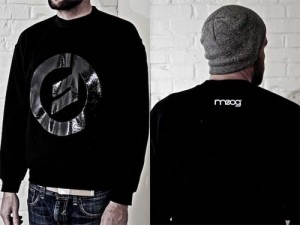
Bonus: you’ll receive a Forty Years of Minimoog Zine if you order this sweatshirt while supplies last. Get it now at http://www.moogmusic.com/moo…
Miles Davis performed with a Fingerboard and a Moog
Mark Smart uses the Haken Continuum Fingerboard and a modular Moog synthesizer to play Miles Davis’ tune.
Continuum Fingerboard: http://www.hakenaudio.com/Continuum/i…
Mark Smart: http://www.marksmart.net
Pogo Studio: http://www.pogostudio.net/
Pogo Studio’s Moog: http://www.marksmart.net/gearhack/pog…
moog Filtatron / moog Little Phatty
A lot of Moogs this morning
The iPhone’s audio output has been connected to the input of the Little Phatty. The Phatty’s filter section is used to manipulate the signal generated by the Filtatron app.
Stereo Ring Modulation tricks with Moog
Chris Stack (formerly of Moog) inaugurates a series of experimental synthesis sounds with a stereo modulation effect, using two of the terrific Moog MF-102 ring modulators as the canvas. Using two Moog MF-102 Ring Modulators, it’s easy to create stereo ring modulation effects. The MF-102’s (and all Moogerfoogers) extensive control voltage capabilities make a number of sophisticated setups possible.
www.experimentalsynth.com
Vintage synth exploration
This guy has released a whole bunch of demos, comparing classic synths:
This is a side by side comparison betweeen my Minimoog D from 1978 (featuring the new oscillator board introduced after SN 10175) and my Synthesizers.com modular, equipped with 3 VCO’s and the Moog 904-A filter clone produced by Mos-Lab in France. Of course this is just a rough demo, because it’s not that easy to set the 904-A and the Mini’s filter exactly the same in real time because of their different architecture. I used the Mos-Lab 904-A instead of Dotcom’s Q150 for no particular reason, they sound almost identical (see my demo about those filters). The VCO’s also are set with the same waveforms (equal wide square wave) and octave intervals. The Dotcom is on the left, the Mini on the right channel, some delay added (be sure your speakers or earphones are correctly connected…).
Another short demo of those great vintage and contemporary analogue synthesizers. The Minimoog is the one performing in the higher register. Direct board take, only delay added.
Roland SH-09 (1980) Demo
Various sounds and settings of my little vintage Roland SH-09 (vco with and without suboscillator, waveform and octave changes, various filter cutoff and resonance settings, s/h filter modulation). Sequenced by a MFB Step 64, delay added. 30 years ago, this was one of the cheapest monosynths on the market, just a low-cost Minimoog alternative. Anyway, even if it lacks a second vco for oscillator beatings, compared to actual digital and virtual analogue synths this little thing rocks! The SH-09 was one if not the last Roland monosynth entirely build with discrete electronic components so it is also easy to repair.
Modular stuff with the Moog Voyager
Modular stuff with the Moog Voyager thrown in. It should be obvious which core sound is the Voyager. The Voyager is run through the Cwejman RES-4, FSH-1 & VC-FC plus the TipTop Z5000 and Analogue Systems RS-290; and that’s only on the right channel. The left channel goes through a Metasonix TM-2. The Metasonix R51 is in the feedback path of the Analogue Systems RS290 delay. You can see when it is brought into the sonic stew by watching the red diode on the right-most tube light up.
If you can stand watching until the last 45 seconds of the video, you’ll see my new favorite trick: Making the Analogue Solutions BD78 self-oscillate and then sticking a very modulated STG Wavefolder on the end of it. Shhhh… don’t tell anyone.
Analog Signature Version 3 – a new member is added to the family

“Analog Signature V3” carries the wits and powers of four vintage beasts into this new era. Moog Source, Korg MS20, the Waldorf Microwave 1 and – from version 3 onwards – the Waldorf Pulse have been accurately sampled in such a way that their charming inaccuracies are still there in this perfect Reason environment in which Soundcells tooks their chance to add polyphony and velocity.
You’ll get 500+ combinator patches containing beautiful analog sounds from the past as well as some mouth watering rex loops covering the old analog drum boxes. The user decides how retro or contemporary the sounds of this ReFill will sound in the music. It all matches almost perfectly with almost everything. Version 2 featured new samples from the Waldorf Microwave 1, 40 new combinator patches and great new backdrops – with version 3 this ReFill is extended even further with 40 combinator patches mainly based on these new Waldorf Pulse samples.
Analog Signature Version 3 Contents:
– 506 combinator patches to keep you busy for quite some time – 40 new ones since version 3.
– Classic synths: Moog Source, Korg MS20, the Waldorf Microwave 1 and the Waldorf Pulse.
-Lots of analog drumbox rexfiles and loads of NNXT patches – the modules folder contains the basic patches which were used for the combinator sounds.
-Extra high realism due to alternate sample switching, mostly three samples per note!
A web address to link to for more info and “Analog Signature V3” only MP3s:
Offering price is 39,90 ,- EUR per Unit (normally 49,90 ,- EUR)
Ambient Analogue 001
This is a very nice video of a new audio experiment we came across
Ambient Analogue 001 is the first release of an audiovisual experiment with footage of Chicago cut to an ambient music track of classic vintage and modern analogue synthesizers.
Audio/Video produced by Logan Mannstrane
Music is available as a free download on SoundCloud:
soundcloud.com/loganmannstrane
Audio information:
Sequential Circuits Prophet VS: From 0:05 – 4:19
Roland Jupiter 8: @ 1:55, 2:21, 2:45, 2:51,
Sequential Circuits Pro One: From 4:20 – 4:48
Oberheim FVS (Four Voice): From 4:49 – 6:26 and 7:57 – 8:32
Roland TR-808: At 4:53-END
Moog Voyager: From 6:28 – 7:56 and 8:32 – 11:09
Sequencing done with Logic Pro and StepPolyArp for iPad. Mixed in Pro Tools 9. Filtering of drums and select synths with the Oberheim Four Voice stereo inputs.
Pictures of Moog’s OMG-1 synth


The OMG-1 Synthesizer
The OMG-1 was designed by Persing as a live performance instrument and is not a commercial product — it’s truly one-of-a-kind
The state of the art dual-manual OMG-1 combines:
- a Moog Little Phatty analog synthesizer
- Spectrasonics’ flagship Omnisphere software synthesizer
- An internal Apple Mac Mini computer
- Dual Apple iPads
- Dual iPods
- Spectrasonics’ new Omni TR iPad app
All this electronic music technology is integrated into a beautiful, hand-crafted curly maple cabinet, created by American artisan Daniel Auon.
During the special presentation, Moog-Koussa, Executive Director of the Bob Moog Foundation, and Persing talked about their collaboration and Eric gave a progtacular demo with the OMG-1. Using the OMG-1, Persing demonstrated that he could play complex OmniSphere virtual instruments and manipulate them using the multi-touch controllers, play iPad synth applications and add true analog leads with the Little Phatty.
“I’ll never forget the first time I played a Minimoog when I was a little kid…it truly changed my life!” said Persing. “So, it’s a privilege after all these years to give back to the foundation honoring my hero Bob Moog and keeping the spirit and history of his inventions alive for the next generation. I had a blast designing the OMG-1 with Dan and I can’t wait to see who wins it!”
Michelle Moog-Koussa added, “Eric’s OMG-1….represents the contemporary convergence of analog and digital, hardware and software. I think Bob would applaud Eric’s efforts to transcend boundaries in order to create an instrument with new and unique capabilities.”
Details on the Moog Foundation will be announced when the contest begins on March 15th, 2011.

DATAMASKIN

