
How To Produce Neurofunk Basslines
Marc Adamo fires up Massive for another S2S video tutorial exclusive. Discover how to make off-the-wall evolving Neurofunk D&B basslines pioneered by TeeBee and Noisia.
Ableton 101 continues – know it all in one video
Forty minutes of pure Ableton tips and tricks in this Ableton 101. This video packs the gross part of what you need to master Ableton, for more information check out the links below:
http://www.musicsoftwaretraining.com/products
http://www.musicsoftwaretraining.com/blog
http://twitter.com/abletonvids
The most Ableton Live Tips, tricks and shortcuts packed into 1 video!
How to Record a Song – Recording Guitar and Bass
Have great ideas on your guitar or bass that you want to record? Line 6′s Propellerhead Product Specialist Matt Piper shows you how to get started recording guitar and bass with your computer at home using Propellerhead Record + Reason Duo software. This video also includes a section on microphone placement for recording a guitar amplifier.
This video is the second part in a series. The first video on how to get set up is here: http://youtu.be/gvzS2jS7bRc
Next time, Matt will show you how to program drum and percussion parts!
Sonnox Fraunhofer Pro-Codec Video
An overview of the new Sonnox Fraunhofer Pro-Codec plug-in, which allows the auditioning of encoded audio in real-time.
For a free demo licence visit: http://www.sonnoxplugins.com/demos
The song used in the demo is “Happiness” supplied courtesy of Jay-J.
In the past it has not been possible to critically audition and then encode multiple formats in real time within a host DAW environment. The revolutionary Sonnox Fraunhofer Pro-Codec now makes this possible, and includes extensive monitoring tools and built-in encoding/decoding features.
Using this plug-in mix engineers may produce mixes optimised towards specific target codecs, thereby ensuring maximum fidelity. Similarly, Mastering engineers may audition in the final format and produce compensated masters for final encoding and distribution.
Advanced Noise Removal
Marie Ebbing & Jonathon Stevens offer advanced noise removal services for music and film post production using a suite of tools by the software developer Algorithmix. These noise removal tools are divided into 2 categories, broadband — including surface noise, hiss & hum; and transient — including camera hydraulics, coughs, page turns and other instantaneous noises.
Their use of these tools extends into the non-standard as well. They can remove unwanted dialog and music from stereo or multi-channel master recordings. Rebalancing or complete removal of instruments in a master recording is also possible and on occasion pitch correction to a specific instrument in a mix. All of this is done with the utmost respect to the sound quality of your original master.
Projects that have benefited from their noise removal services include:
Tron: Legacy, The Curious Case of Benjamin Button, Capitalism, Public Enemies, San Francisco Symphony’s Keeping Score Series, The Lord of the Rings: Complete Music Boxed sets
The making of Depeche Mode’s “Enjoy The Silence”
Here’s a great video from the Mute festival talking about the story behind one of my all time faorite DM tracks. Flood, the legendary producer of many classic albums, describes how the song Enjoy The Silence by Depeche Mode was created in the studio.
In this video:
I’m sorry about the bad sound and video quality – at the close position I was standing, the speakers were actually behind me, there was a lot of rumble from the hall below, and those big windows created a heavy backlight. It doesn’t make the speech less interesting, though…
This was recorded May 14th 2011 in the Roundhouse, London at the Mute Short Circuit Festival.
Worlds first studio production drum machine dedicated to chip music
DCM8 Patterns
“Worlds first studio production drum machine dedicated to chip music sounds.
Two channel roughly equivalent to two emulated SID chips, with multiple oscillators, numerous waveforms and modulation options, several noise types, digital filter, lo-fi bit reduction, DAC masking and clipping.
Easy to use pattern step sequencer editing and live control modes, hundreds of synthesised preset sounds with adjustable pitch and decay parameters, and a highly versatile user instrument editor for creation of custom chip sounds. Wide range of drum sounds with ranging from traditional electro analog emulations, through a diverse range of chip sounds collected from many platforms, to new experimental interpretations.
Steel case with a brushed anodised surface and hardwood end panels.
Launching June 2011, Vic C.
http://www.flickr.com/photos/vxxy/ [slide show below]
http://www.youtube.com/user/vxxynet
http://vxxy.net“
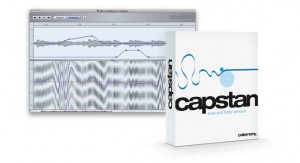
Put an end to wow and flutter in your music with Capstan
Hehe, if you can afford it, yikes it retails at 3600€
Here’s what they have to say about it:
For over 100 years, music has been recorded on mechanical storage mediums, and for over 100 years such recordings have been plagued by the same problems: wow and flutter. Who isn’t familiar with the wobbling and warbling, the droning and dragging? Mechanical degradation caused by defective devices or sticking tapes, by aging or defective storage. Furthermore, wow and flutter were for the most part irremediable.
Countless recordings of renowned orchestras, big bands and rock groups are currently slumbering deep in archives because precisely this problem has rendered them unusable. The tapes worthless, the recordings lost to posterity. Until now.
For with Capstan there is now for the first time a program capable of removing wow and flutter from musical recordings — whether on tape, compact cassette, wax, shellac or vinyl. Capstan detects wow and flutter by analyzing the musical material itself, so the medium is of no relevance. In this, Capstan is clearly superior to solutions such as bias tracking, because Capstan still works even if the tape has already been copied several times or digitized only in low resolution.
Being musically intelligent, the Capstan algorithm is capable of recognizing not only the minutest amounts of wow and flutter but also continuous speed variations within the musical material itself and makes possible detailed editing that extends even to drawing in the curve manually. It is based on the patented DNA Direct Note Access technology made famous by the award-winning program Melodyne, which is used worldwide in all major studios for the editing of pitch and timing.
Whilst the precise detection of the wow and flutter represents the actual technological revolution, repairing the recording is easy: the musical material is simply played back with the velocity curve inverted. Pure varispeed — guaranteed free from artifacts.
More info:
http://www.celemony.com/cms/index.php?id=capstan
SoundWorks Collection: “The Lost Thing”
The story of “The Lost Thing” is about a boy who discovers a bizarre looking creature while out collecting bottle tops at the beach. Having guessed it is lost, he tries to find out who owns it or where it belongs, but is met with mute indifference from everyone else, who barely notice its presence, each unwilling to entertain this uninvited interruption to their day to day lives. For reasons he does not explain, the boy empathises with the creature, and sets out to find a ‘place’ for it.
Supervising Sound Editor and Sound Designer John Kassab discusses his extensive work on this animated masterpiece bringing to life the world of the Lost Thing.
Directors Shaun Tan and Andrew Ruhemann were also winners for Best Animated Short Film for “The Lost Thing” at the 83rd Academy Awards in 2011.
For more exclusive videos check out SoundWorksCollection.com
Join the SoundWorks Collection Vimeo Channel: vimeo.com/channels/soundworkscollection
In Search of the Unsound
playgroundmag.net/playtv
unsound.pl
In Search of the Unsound, Part I
PlayDocs 2011
The Pleasure of Fear: Horror at Unsound
Horror is an essential element in modern music that aspires to break sonic boundaries and generate new spaces for expression and emotions. The Polish Unsound festival, celebrated every autumn in the cold climate of Kraków, knows that all to well, and that’s why the 2010 edition had the concept of horror as its central theme, with artists such as Ben Frost and Demdike Stare. The PlayTV cameras were there and didn’t only record the performances at Unsound. We went with the intention of exploring horror’s place in music, led by journalist Philip Sherburne, our guide from place to place, across artist to artist, and who led our reflections through the labyrinth of emotions that is Unsound. What you will see below is the first episode –with pivotal artists Demdike Stare– of a long documentary in several parts about fear, the pleasure it produces, and the great festival that is Unsound.
DATAMASKIN

