
Video Transmission and Electromagnets
Get ready for some serious noise
Video transmission feedback look that is being modulated by an electromagnet whose own energy is received from the audio produced by the system.
Monotron – more than noise…
Sound of Seventy Three created this track to demonstrate how the Korg Monotron could be used to make “a little music….rather than just noise.”
Here’s what Johnson has to say about it:
This one is called the Monosong featuring the Korg Monotron as a lead synthesizer.
It was improvised in one take. The Monotron was fed into my Mini-KP to add delay & reverb. The backing track was created using my Korg Kaossilator for the first drum loop, the bassline, and the chord progression. The second drum loop was created using the Zoom MRT-3B Micro RhythmTrak filtered through the Monotron’s MS-20 filter.
More info at Johnson’s Youtube site.
Link:
Metering plug-in featuring upsampled peak detection
Audio Pluggers has released a beta of K-Meter, a metering plug-in featuring upsampled peak detection, perceived loudness metering, K-System compatibility, and pink noise monitor calibration.
By using the K-System and K-Meter, audio engineers can ensure that their mixes reproduce accurately on a variety of playback systems, from theaters to MP3 players. K-Meter’s perceived loudness meter models the ear’s sensitivity to different frequencies, giving you a much more accurate indication of loudness than conventional meters. Combine this with the ability to detect inter-sample peaks, and you can be confident that your mixes are of the highest quality.

Audio Pluggers K-Meter
K-Meter features
- Built from the ground up around the K-System.
- Upsampled peak detection that discovers inter-sample peaks missed by other meters (upsamples up to 4x the input rate).
- Perceived loudness meter supporting the LKFS measurement (ITU-R BS.1770-1). This models the ear’s sensitivity to different frequencies.
- Band-limited RMS meter for monitor calibration and compatibility with other meters.
- Pink noise generator for monitor calibration.
- Resettable clip indicators with sensitivity dial.
- Collapsible interface that occupies less screen space.
- All-in-one 32-bit and 64-bit universal binary supporting Intel and PPC Macs.
- SIMD optimization including AltiVec and SSE support.
- User manual including background on the K-System.
The K-Meter beta is available to purchase as an Audio Unit plug-in for Mac, for $25 USD (all future K-Meter updates and patches, free of charge). K-Meter will be $50 USD when it is released.
More information: Audio Pluggers
Pixelpussy releases new stuff

Southern California DJ and producer Daemon Chadeau will release This Is Meower Noise, the debut album from his Pixelpussy power noise project, June 25 on the MoonSlave Radio label. In addition to eight original tracks, the album features five remixes from the likes of ESA, Bioassay and Code 000. Visit the links for more information and sample tracks.
http://www.myspace.com/djdaemonchadeau
Folktek glitch machines
In a world of laptop based software studios and vintage synthesizers it’s good to know that someone is still trying to make real world physical instruments for the future. The guys over at Folktek make beautifully handcrafted mystery- noise- and bleep- instruments.
Wouldn’t you like one of these?
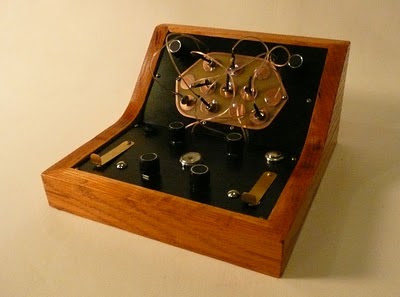
See it in action:
Noise Reduction For Free
Christian Budde Noise Reduction VST plug-in features a spectral noise gate to filter out unwanted noise
 |
Christian Budde says that the new Noise Reduction plug-in is based on a spectral gate to filter out unwanted noise in the frequency domain. The gate is based on the lightweight dynamic series and features a soft knee and customizable attack and release times.
Features:
- Highly customisable spectral noise gate.
- Continuous and consistent characteristic.
- Fully adjustable soft knee in dB (as margin below the threshold).
- Several exotic window functions available.
- Low CPU usage.
- Different FFT sizes.
- Manual included.
- Open Source (as part of the Delphi ASIO & VST Project).
The Art of Noises
Using noise in a musical context is today quite straight forward using samplers and synthesizers. E.g the band Art of Noise made good use of the Fairlight CMI sampler in 1980s and 90s. Their hit single Close (To The Edit) make good use of industrial and mechanical noises.
[youtube=http://www.youtube.com/watch?v=-sFK0-lcjGU]
But before of the birth of the sampler and even the synthesizer you were let to your own imagination. One man that had imagination was italian Luigi Rossolo. In 1913 he wrote a letter to a friend Pratella argueing that the human ear has become accustomed to the speed, energy, and noise of the urban industrial soundscape; furthermore, this new sonic palette requires a new approach to musical instrumentation and composition. He proposes a number of conclusions about how electronics and other technology will allow futurist musicians to “substitute for the limited variety of timbres that the orchestra possesses today the infinite variety of timbres in noises, reproduced with appropriate mechanisms”.
The next step for Luigi Rossolo was to invent a number of instruments he called The Intonarumori (noise intoners). Here’s a list of some of his inventions:
- Gracidatore (the Croaker)
- Crepitatore (the Cracker)
- Stroppicciatore (the Rubber)
- Scoppiatore (the Burster)
- Sibilatore (the Whistler)
- Gorgogliatore (the Gurgler)
- Ululatore (the Howler)
- Ronzatore (the Hummer)
Each instrument was constructed of a parallelepiped wooden sound box with a metal radiating horn on its front side. Inside the box was a wheel that, when turned by means of a crank or electric button, caused a catgut or metal string to vibrate. The wheel could be made of either metal or wood, and the shape and diameter of the wheel varied depending on the model. At one end of the string there was a drumhead that transmits the vibrations to the speaker. The pitch of the vibrating string was controlled by both the speed that the wheel was cranked and by the tension of the string, which was controlled by a lever on top of the box. The lever allowed the performer to play glissandos or specific notes, and also allowed the performer to change the pitch by small intervals. The intonarumori often had a range of more than an octave.
If you want to build your own contemporary instruments today, Reaktor by Native Instruments is a good tool. In the Reaktor User Library you can find a number of instruments that are inspired by Rossolo created by Rick Scott and Dieter Zobel.
http://www.native-instruments.com/index.php?id=userlibrary&type=0&ulbr=1&plview=detail&patchid=4431
DATAMASKIN

