
Boost your Reaktor environment
The Colorspace has released three virtual instruments for Native Instruments Reaktor.
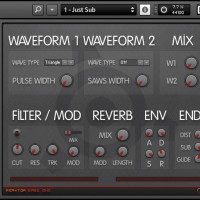
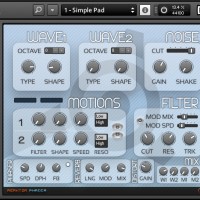
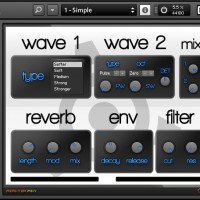
The Colorspace Reaktor ensembles:
- Reaktor Phadia – 4 oscs pads/atmospheres synthesizer.
- Reaktor Bass One – 3 oscs bass synthesizer.
- Reaktor Piky – 2 oscs pikes/plucks synthesizer.
All three Reaktor ensembles are available as a free download. Requires Reaktor full version.
Reaktor Loupe for TouchOSC on iPad
Perhaps even more interesting then the previous Reaktor post. Coming soon – a new version of Loupe with bidirectional OSC mappings for TouchOSC – the slice / note settings update as you play each note so you see the settings at a glance. Grab all three filter parameters with your fingers and drag them around, navigate the waveform with your ears instead of your eyes.
More here:
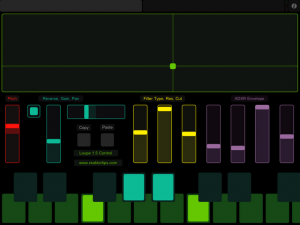
Above is the slice page. Each of the sliders gets updated from Reaktor when you trigger a new slice. This lets you see the loop area, filter settings, envelope settings, etc. of each slice and adjust them. Copy and paste buttons let you copy slice parameters to a different key – handy if you want the same thing on a different key except for panning, or reverse playback.
There’s no way to get the sample waveform to display in TouchOSC, but the large green XY pad works the same way as the Reaktor Loupe GUI – X position sets loop position, Y sets loop length. I actually prefer working with my ears this way instead of looking at the display – it’s a more hardware-y approach.
Changes include:
- Added copy / paste slice (fixed since beta)
- Added duplex OSC mappings for TouchOSC
- Added two page OSC iPad template
- Fixed release envelopes cutting off prematurely
You may download it here. Update is free for owners of Loupe 1.0 – same license info will unlock Loupe 1.5.
Reaktor Fans: Arcturan UltraTheremin for Reaktor and Konkreet Performer
After a few too many pan galactic gargle blasters it’s time to dig out the ol’ Arcturan UltraTheremin and rock out on Squornshellous Zeta until you pass out on a living mattress.
I built this as a learning project to figure out how to map Konkreet Performer’s nodes to voices in Reaktor. If you’re interested, you can download at modulations.noisepages.com – you’ll need an iPad and Konkreet Performer to take full advantage of it. (It also works with TouchOSC if you don’t mind a slightly less freakish playing experience)
New elements for Reaktor
Audio demo for new released NI Reaktor Ensembles:
– Reaktor Phadia
– Reaktor Bass One
– Reaktor Piky
Download for free: http://www.thecolorspace.net/software.html
The Reaktor Library is one of the prominent features of the software, featuring a large variety of sound generators and effects that can be used as stand-alone instruments, or as an educational resource for backwards engineering. Reaktor 4 featured a library of 31 Reaktor ensembles. The fifth generation of software came with 32 new modules (though some were upgrades of Reaktor 4 Library tools). The libraries provide a mixture of conventional implementation of software sythesizers, samplers, and effects, along with a few ensembles of experimental nature, with emphasis on parametric algorithmic composition and extensive sound processing. Due to complete backwards-compatibility between later versions of the software, Reaktor 5 users have access to all 63 proprietary ensembles in Reaktor Library.

Kinect Reaktor Ensemble
A Reaktor Ensemble for visualizing Kinect skeletal data available at geometricmusic.co.uk. OSCKinnection feeds the skeletal data into Reaktor using OSC. The yellow orb is controlled by the two hands and the orb position controls a synthesizer. All joint positions can be used as synth inputs.
Reaktor Tutorial – Additive Synthesis
Native Instruments have just launched their latest Reaktor Synth called Razor and it is causing quite a stir in the sound design and production communities. So what makes this synth so exciting? Well it is down to a process called additive synthesis.
Put in the plainest terms possible, additive synthesis is the summation of simple tones to create more complex ones.
The sound is constructed from partials (or frequency components) firing in parallel, changing amplitude and even frequency over time. Additive synthesis is a very powerful sound design tool because the many micro-variations in the frequency and amplitude of individual partials mirrors those that makes natural sounds so rich and lively, and the resulting sound remains clear and precise at all times, even when heavily modulated.
This video demonstrates how to go about building an additive synth in Reaktor plus an overview of some of the other techniques that you will learn on the Point Blank Online Sound Design course ( http://www.pointblankonline.net/sound-design-course.php ). Even this fairly simple example consisting of just 8 partials, you can begin to hear how an additive synth can create an impressively rich and malleable sound. So when you think that Razor’s additive engine consists of up to 320 partials you can start to see why everyone is so eager to get their hands on it!
Coming soon – RAZOR by Errorsmith & Native Instruments
Native Instruments released this teaser video for a new synth, Razor, developed in collaboration with Berlin-based producer Errorsmith. They’re hyping it as a dubstep synth, but it’s a hybrid additive synthesizer with built-in tempo-synced effects.
“Razor is a synthesizer i developed in collaboration with Native Instruments,” says Errorsmith. “It’s programmed in Reaktor, a modular software synthesizer. You don’t need to own Reaktor in order to use it. Razor can be loaded in the free Reaktor Player software.”
Scapes – effects processor and sound generator for Reaktor

Twisted Tools has released version 1.1 of Scapes , an effects processor and sound generator for Native Instruments Reaktor. With Scapes you can create high quality and unique soundscapes, rhythms and sound effects perfectly suited for use in music, film and game audio. Changes in Scapes v1.1 Touch OSC Template and Mapping
Twisted Tools has released version 1.1 of Scapes, an effects processor and sound generator for Native Instruments Reaktor.
With Scapes you can create high quality and unique soundscapes, rhythms and sound effects perfectly suited for use in music, film and game audio.

Changes in Scapes v1.1
- Touch OSC Template and Mapping.
- Konkreet Labs Performer Mapping.
- New FX Presets.
- New User Templates Download Section.
- Lemur Template by A. Blanca (Coming Soon).
- Various Minor Fixes.
- Tutorial Video.
Scapes is available to purchase for 49 USD. The update is free for registered users.
Twisted Tools has also released Jedsound Twisted SFX, a free sample pack featuring a new collection of sounds by sound designer Jean-Edouard Miclot.
It isn’t everday you can get your hands on unique and properly recorded field recordings, sound effects and foley sounds. Grab ‘em while they’re hot and feed them into your favorite Twisted Tools device!
To get you inspired, we’ve added a bank of FX presets to Scapes that make use of these sounds in Scapes.
More information: Twisted Tools
REAKTOR’s Newscool – Sequencer Controls
Get up the learning curve on one of Native Instrument’s REAKTOR’s most out-there sequencers…
Shared by bkallmer
ParamDrum TR Edition for Reaktor
ParamDrum is a fun and fast way to create unique sounding beats in Reaktor. It’s based on three granular samplers with built in parameter automation and variable length and speed step sequencers. The value of a step gives the probability that the step will trigger as the sequence plays, creating endless variations.
The third edition adds several carefully selected refinements.
- All recordable parameters are now mouse-automatable by clicking and dragging on the indicator, perfect for when you’re stuck with a laptop but no MIDI controller.
- The GUI now matches Frame, Loupe and Mirage with a clearer layout that is easier on the eyes.
- Smooth and swing are now static parameters, making room for envelope decay and sample start as recordable parameters. Try modulating sample start with a melodic sample to build the foundation of a track right in ParamDrum.
- A “Max Vel” switch for each sampler allows full velocity for each step, so step value affects only probability.
- A virtual analogue “sub” kick unit has been added for layering a little extra earthquake with your sampled kicks.
Pricing and Availability:
$15
More information:
DATAMASKIN

