
The Harry Potter Gaia Remix
My favourite Harry Potter themes (John Williams) played on Roland Gaia and Yamaha Motif by Fabien Labonde
A good way to try tweaking clean sounds, pads, leads and dirty sounds from the Gaia
Family Portrait – Hedwig – Buckbeak’s Flight – Window to the Past – Nimbus 2000 – Double Trouble
Howard Jones demos the Jupiter 80
Here’s another demo of the Jupiter 80, this time in english…
 By the way, don´t forget to stop by our new Fanpage >>
Roland Jupiter 80 Sounds & Demo Video from Musikmesse 2011
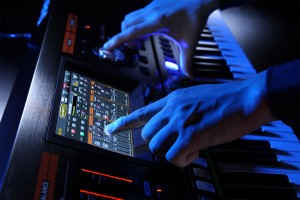
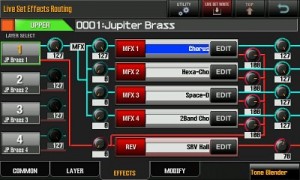
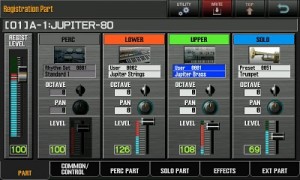
Listen to the new sounds of the Jupiter 80 and below are some additional screen shots, enjoy
Supernatural engine explained:
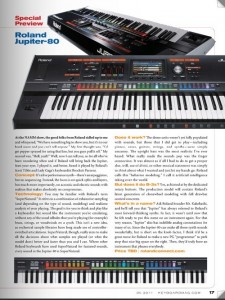
Unlike a conventional PCM synth, you also avoid issues like sample looping and phase issues. Vince DaLuca, Product Manager, Keyboards for Roland US, explains the concept:
What happens when a keyboardist is trying to reproduce sounds other than a traditional keyboard instrument on the synthesizer? This is where synthesizers today really fall short because the typical sound engine inside cannot truly “interpret” an expressive keyboard performance done on keys into an authentic guitar, trumpet, or violin performance – a guitarist plucks or strums strings, a trumpet player uses his breath, lips and trumpet valves, and a violinist plucks or uses a bow on strings. All the keyboardist can do is trigger a static digital sonic picture of sound he is trying to recreate, and each time a key is pressed, the same sonic picture is repeated, but at different pitches as played on the keyboard.
The Jupiter-80 solves this problem by using Roland’s newly developed Behavior Modeling technology. It takes care of the “interpretation” by constantly analyzing the keyboardist normal, natural keyboard performance, and instructs the ultra-realistic SuperNATURAL sound engines inside the Jupiter-80 to “play” and constantly “articulate” the reproduced sound just as the “real” performer would based on the keyboardists timing and interval between notes, the strength at which the various keys are struck, or if the keyboardist is pressing a pedal to sustain notes. These actions, among others available to the keyboardist, are translated by the behavior model for the selected sound being reproduced into an authentic plucked or strummed performance in the case of a guitar, aggressive or smooth bowing in the case of a violin, and the sharp or smooth pitch changes created by the valves on a trumpet and the pressure of the trumpet player’s breath. These are but a few of the articulations possible with Behavior Modeling.
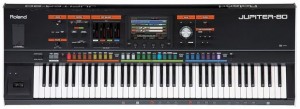
First picture of the new Roland synth – Jupiter 80
In other words stay tuned for next week when Stereoklang reports from MusikMesse
—————
By the way, don´t forget to stop by our new Fanpage >>
What Roland will unveil at MusikMesse is…
….indeed a new keyboard, a stainless steel one with 76 keys, 256 polyphonics. But it is not a new Jupiter 8 even though specualtions at different forums says so. But it is true that it will be branded Jupiter 80, which also is a fact and is true in relation to that Roland recently registered the jupiter80.com domain.
We will show it to you live from MusikMesse next week, so stay tuned

Richard Barbieri of Japan & Porcupine Tree, Talks Roland V Synth (Synthesizer)
Enjoy 
M185 – Clone of the Classic Roland Step Sequencer
A brief demonstration of the M185 Step Sequencer by Defective Records Software. Inspired by the hardware M185 Sequencer developed by RYK. M185 is a MIDI-enabled software recreation of the hardware M185 step sequencer, designed by RYK – developed with their input! The program includes all major functions from the hardware M185. Has a multi-stage step sequencer with stage-selectable gate modes: Mute, Single, Multi and Hold. For fans of the original Roland
The M185 is playing a VST softsynth; drum loop coming from other software. More information at http://defectiverecords.com/m185 .
M185 features
* Virtually all major functions from the hardware M185.
* Multi-stage step sequencer with stage-selectable gate modes.
* Gate modes include Mute, Single, Multi and Hold.
* Trill mode available when in Multi mode within a stage.
* Polyphonic potential when using long Note Length values.
* Each stage can be from 1 to 8 clock pulses in length.
* Internal or MIDI clock control.
* Built-in clock divide capability.
* MIDI output to any hardware or software synth.
* VST instrument hosting.
* 16 preset slots for instant recall of parameters.
* Presets can be saved to and loaded from disk.
Adam Szabo has announced the release of JP6K
Adam Szabo has announced the release of JP6K , a virtual synthesizer instrument for Windows. JP6K is a synth dedicated to emulating the famous Super Saw sound, first found in the Roland JP-8000 synthesizer in 1997.

Adam Szabo has announced the release of JP6K, a virtual synthesizer instrument for Windows.
JP6K is a synth dedicated to emulating the famous Super Saw sound, first found in the Roland JP-8000 synthesizer in 1997. It aims to capture the essence of the sound and the behaviour of the original oscillator. Even after a decade, the Super Saw is still sought after by people all around the world, and is a crucial part of such music genres like Trance.
JP6K features
- 32 voice polyphony.
- Two Super Saw oscillators, an upper and lower.
- 1 noise oscillator.
- Three filter modes: low pass, band pass and high pass with -12 & -24 dB/Oct.
- Three independent LFOs controlling the filter, amp and pitch.
- Built in delay and EQ.
JP6K for Windows (VST) is available to purchase for $25 EUR.
More information: Adam Szabo / JP6K
micronaut – experiment five
After experiment 4 – time for number 5
Audio is available at http://micronaut.bandcamp.com
Another “live in the studio” jam. Sequenced from Live, and I’m using a Korg nanoControl to turn tracks on and off and such. I play the DSI TETR4 from my iPad running Audanika’s SoundPrism app, which is a very cool MIDI controller app done in a cycle-of-fifths layout. The little bass sound that comes in here and there is The World’s Most Expensive CS-5, while a René sequencer drives a SynthTech Cloud Generator for the arpeggiated sine part from the modular.
MeeBlip is running in to a Roland RE-201 for the sound you hear very early on, the snare-ish hit that has a spring ‘verb and echo. The other sound right in the beginning is an MS-20 running in to my circuit-bent BOSS RRV-10. The other prevalent effects are Eos for the ‘verb, and the Eventide TimeFactor on its ModDelay algorithm, in line from the TETR4. This is what creates the big hollow drone sound. I just jack the feedback up full and when it is humming along I hit the repeat button.
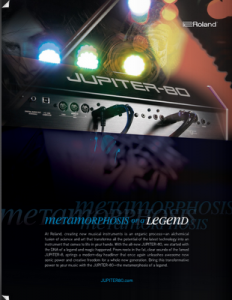
Teaser from Roland: Metamorphosis of a Legend
A dramatic transformation has begun. The spirit of a legend re-emerges. An amazing new instrument takes form. Prepare for a new musical beginning. http://www.rolandconnect.com
Something featured on the upcoming MusikMesse 2011 perhaps
DATAMASKIN

