
Acid on the Buchla
Just a bit of fun, here’s the details. Impressive set up from DinSync. DinSync is a blogger focusing on vintage analog Roland “x0x” musical instruments. Primarily focusing on the SH-101, MC-202, TB-303, TR-606, TR-808, TR-909. Also featuring eurorack modular synthesis and DIy projects.
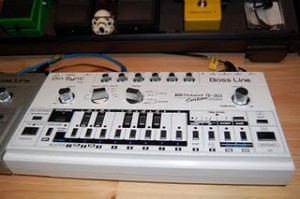
DinSync.info TB-303 Special Edition
MPC1000 TR-707 kick
Bongo #1 Doepfer A-111-5 fm’d internally -> Makenoise QMMG Ch4,
Bongo #2 DinSync.info OSC303 fm’d by Makenoise Maths -> Makenoise QMMG Ch3
Hats Doepfer A-117 -> Doepfer A-106-5
Cowbells Doepfer A-117 -> Doepfer A-106-1
Additional drums Boss DR-110
FX Boss RE-20 Space Echo, Boss PH-3, Behringer VD400
Synthporn Saturday – inside Jorge’s studio
http://youtu.be/-pc4F-RQ9Xs
Well you can definately everything you need in this guys studio 
One things that caught my eye was the Teisco 110F. In the beginning of the 80’s Kawai began manufacturing synthesizers under the company name of Teisco. Their early designs resulted in synths like the S110-F above. The Synthesizer 110-F is an upgraded S60-F, with dual analog VCO’s and an updated look. It has a small but usable 37 note keyboard. Classic analog sawtooth, square, and triangle waveforms plus noise are on-board and can be mixed with external sounds run through the 110-F’s filters and envelopes. The oscillators can be de-tuned for duophonic textures or phatter leads and bass sounds.
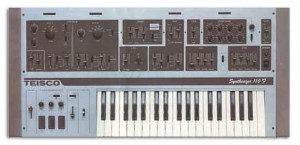
There’s plenty of modulation ability and classic analog effects in the 110-F to really liven up the sound. There’s an LFO which can modulate the VCO and VCF and can trigger the EGs. The VCF resonant low pass filter is great too. There’s also a VCA section with Attack, Decay, Sustain and Release controls and finally there’s a Hi-Pass filter. There is also a portamento effect, a ring modulator, vibrato and sample-and-hold for those classic analog synth effects and tricks! Lots of pretty blinking lights, a sleek and straight-forward layout and very nice analog bass, lead and synth sounds are all a part of the Synthesizer 110-F experience.
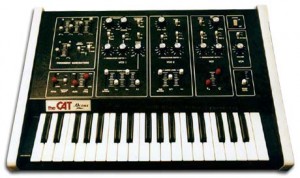
But also the Octave Cat. Octave released this analog classic – the Cat – during the era of the Minimoog and ARP Odyssey synthesizers. The Cat is actually very much like the ARP Odyssey, so much so that ARP had sued them in the late 1970’s for cloning their designs. The Cat is a monophonic/duophonic analog synthesizer with 2 oscillators capable of square and sawtooth waveforms. VCO 1 also has a triangle waveform. Each of the waveforms can be played simultaneously and mixed together and there are additional sub-octave oscillators on each oscillator to blend new and interesting sounds.
In this video:
Bob Weigel of http://www.sounddoctorin.com begins his month or so long journey to see former Bozeman residence the Wiest family in Sheriden, WY and former roommate Alfredo Pinto in Denver area. Also quick interview with Jorge about his awesome synth studio featuring a Jupiter 8, Teisco 110F, Prophet 5, Juno 60, Minimoog, Korg MS-20, (I said 10…) Roland SH-5, Octave Cat, etc.
Full mix down made with the legendary Roland System 100M
As reported in the interview we did with Nitzer Ebb the Roland System 100M was their absolute favorite. Now this video was released that gives a neat overview of its capabilities.

The System 100m is Roland’s contribution to professional analog modular synthesis. It was based on the more limited, semi-modular System 100, but is several steps of ahead of its predecessor. The System 100m offers over 20 modular components to pick and choose to design a custom modular set-up. The Main unit is the M-110 which has a single VCO oscillator, VCF, and VCA section. You can then build upon this system adding any number and configurations of the various other modules which include dual VCOs, ring modulators, dual VCFs, eq, dual VCAs, dual envelopes, LFOs, various effects, mixers, sequencers, and control interfaces including 3 different keyboard controllers.
Modules are assembled into racks. The System 100m has 3 rack sizes, the M-190 holds 3 modules, the M-191 and M-191J hold 5 modules. Each rack provides the necessary 8-pin DIN power connectors and internal CV/gate connections between the modules. You still need to do some external patching, however, to send your signal through the modules of your choice to create any sounds. As for sounds, the System is basically monophonic, unless you get several racks of them for lots and lots of money! Its sound is not as warm as the System 100 before it, but it offers much more capability, as seen in Hans Zimmer’s system below!
Hans Zimmer’s massive System 100m, image and info courtesy of Kevin Lightner. “It features 58 VCOs, 37 VCFs, 32 ENVs, 12 VC Phase shifters, 9 Sequencers, 1 Remote controlled 4-space rack-mount power supply (25′ away.), and 24 Trunk lines go to his large Moog synth across the room. The unit can link the “Keyboard” inputs for all the modules, and with this feature, all VCO’s can track one input with only one patch cord. The unit was built into 6 flight cases on casters with removable front and rear covers, then later encased in wood and built into his studio. “—-Kevin Lightner
System 100’s have been used by Orbital, Hans Zimmer, Vince Clarke, Depeche Mode, Heaven 17, Freddy Fresh, Luke Vibert, Meat Beat Manifesto, Electronic Dream Planet, Jamiroquai, Human League, and Peter Howell of the BBC Radiophonic Workshop.
Back in time – Analog electro 80s
All things analog and here among other things you will witness the Jupiter 8.
The Jupiter 8 was Roland’s first truly professional analog synthesizer. The Jupiter 8 features 16 rich analog oscillators at 2 per voice, eight voice polyphony and easy programming! At eight voices you can get some pretty thick analog sounds. Easy and intuitive programming via front panel sliders, knobs and buttons for all your tweaking needs. The legacy of the Jupiter synthesizers is due to their unique voice architecture and design, creating sounds that were so unreal and amazing that they have to be heard! No other synths in the world can create analog sounds as cool and authentic as these.
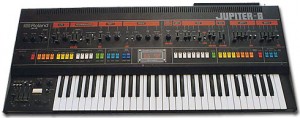
The Jupiter 8 was the biggest and fattest of them all (Jupiters and Junos)! It was one of the first synths to allow its keyboard to be split and layered – it’s eight voices of trance heaven! Cross-mod, oscillator sync, a great LFO and a classic arpeggiator are also on-board. There’s also two killer resonant analog 24dB/oct filters with 2-pole and 4-pole settings as well as low- and high-pass filtering methods. Unfortunately for the earlier models, tuning was very unstable but that seemed to be resolved in later models. Unlike its smaller counterpart, the Jupiter 6, the Jup 8 does not feature MIDI, only Roland’s DCB sync can be found on some models. However, MIDI retro-kit’s are available from various companies. Patch presets can store keyboard splits, arpeggiator settings, voice assign mode, hold, portamento and modulation settings.
But you will also notice the fat sound of the TR808:
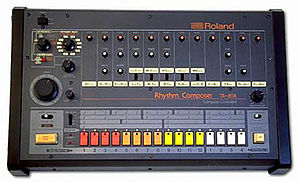
The Roland TR-808 Rhythm Composer was one of the first programmable drum machines (“TR” serving as an initialism for Transistor Rhythm). Introduced by the Roland Corporation in early 1980, it was originally manufactured for use as a tool for studio musicians to create demos. Like earlier Roland drum machines, it does not sound very much like a real drum kit. Indeed, because the TR-808 came out a few months after the Linn LM-1 (the first drum machine to use digital samples), professionals generally considered its sound inferior to sampling drum machines; a 1982 Keyboard Magazine review of the Linn Drum indirectly referred to the TR-808 as sounding like marching anteaters. However, the TR-808 cost US$1,000 upon its release, which was considerably more affordable than the US$5,000 LM-1.
Drum machines in general became an integral part of hip hop music as a cheap and simple way of producing a drum sound. The Roland TR-808 held specific appeal because of the ability of its bass drum sound to produce extremely low-frequency sounds.
In this video:
This video features a Jupiter-8 bass patch U: (21), slightly edited with Fc set to 6 with no resonance. this patch is in poly-1 mode, (half of JPs oscillators used). Also featured is the TR-808 with an original pattern programmed just before the recording. Both the Jupiter-8 and TR-808 are magic machines!
New patches for Arturia’s jupiter-8V
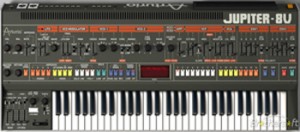
Kid Nepro has released the Jupiter-8V Collection, a collection of 100 new virtual analog patches for the Jupiter-8V by Arturia.
A hot mix of 100 new virtual analog patches that will kick start your Arturia Jupiter 8V.
The Arturia software has received great reviews for its sound quality compared to the original Jupiter-8 and adding our new sounds to the software package brings out it’s best.
The Kid Nepro Jupiter 8V Collection is available as a download for $25 USD. All five Arturia V collections (500 sounds) are available in a bundle for $100 USD.
More information: Kid Nepro / Arturia Jupiter 8V Collection
Jupiter-8 background:
Roland released one of it’s coolest (and heaviest) synths back in 1981 and produced about 2000 Jupiter-8’s before discontinuing them in 1985. The Jupiter was released a couple of years before the invention of the MIDI spec and did not have MIDI included, although later models had a DCB port which let you interface the Jupiter with computers, drum machines (like Roland classic TR808) and other midi synths. Roland produced the MD8 “DCB to Midi converter” which connected everything together. There were also a few third party midi retrofits that were produced from companies like Kenton which brought the Jupiter into the modern studio.
Compared to other analog synths manufactured during that time period, the Jupiter-8 is produced with a higher quality and built to last. Compared to the Curtis chips, used by Oberheim and Sequential, the failure rate of the Roland IR series IC’s used in the JP-8, is very low and as a result many of the 2000 original units are still being used today by a wide range of keyboard players and producers. When an original Jupiter is offered for sale it still commands a hefty price and one in good condition can sell up to about $2000. US dollars.
Molten Drum Machine for iPad triggering Roland TR-707
the amazing Molten drum machine controlling the TR-707. iPad connected to ableton via wifi. Ableton connecting to 707 with a DIGI002. Timing seems to be good, but it is dropping a lot of notes.
Circuit Bent Roland TR 505 Drum Machine
I just bent this Roland TR-505 with a 55 point patchbay for some really weird sound modulations and sequencer glitches, a pitch knob, distortion and feedback distortion.
Right know I am building a new case for this to make it look a little betterIf you’re interested in this, feel free to contact me. I’m planning to use this as a prototype and build a few more of it.
Roland Octapad SPD-30 demo
Like the kings and queens of pre-annexation Hawai’i (‘sup, Sarah Vowell), the Roland Octapad SPD-30 has a long and storied lineage. Building on the successful design of the SPD-20, the newest Octapad adds better triggers, more sounds, a nicer user interface, and a fairly flexibly built-in phrase looper.
The majority of this demo is devoted to an examination of the Looper functions on the Roland SPD-30, during which non-drummer Owen O’Malley bravely attempts to lay down a 3/4 groove inspired by the world music he never listens to. If you like this video demo, you’ll love Owen’s solo album Ragas in the Key of White Guy.
JUPITER-80 Synthesizer Workshop in Musikmesse 2011
http://www.rolandconnect.com/product.php?p=jupiter-80
Scott Tibbs introduced the JUPITER-80 Synthesizer at the Roland demo cabin in Musikmesse Frankfurt 2011.
The JUPITER-80’s expressive, organic approach to synthesis makes a new world of sound design possible with multilayered SuperNATURAL textures under the control of a full-color touchscreen and creative hands-on controllers. Experience the metamorphosis of a legend with the all-new JUPITER-80!
- Powerful integrated SuperNATURAL synthesis engines designed for legendary vintage synth sounds to realistic organic acoustic sounds and more
- Single Tone is equivalent to the performance of powerful single synthesizer—stack four of these to create a mind-blowing “Live Set”
- Tone Blender tweaks multiple parameters of tones in realtime for complex, emotive sonic movement during performance
- Fast, friendly operation with intuitive front panel and color touchscreen optimized for live performance
- 76-note semi-weighted synth keyboard, and 256 polyphonic voices (varies according to sound-generator load)
- USB-memory Song Player/Recorder for backing tracks or quick idea capture
- Easy integration with computers via built-in USB-MIDI/Audio interface
MARK JENKINS “Space Dreams & Sequencers”
MARK JENKINS “Space Dreams & Sequencers” live at the Shaw Theatre, London. Background video effects by Mark Jenkins using the Fairlight CVI Computer Visual Instrument. Includes part of “Millennium” from the CD “Space Dreams” available worldwide through Amazon (dealer; mark jenkins music) and www.markjenkins.co
Instrumentation includes;
Roland JD800 (recorded), Korg M1, multitrack sequencer, Kawai PH50, Roland Octapad
DATAMASKIN

