
New frequency cutter

Kutter is a frequencies cutter effect. Cuts frequencies on the 12 bands easily and synchronizes the effect on the beat with the 16 steps modulation sequencer.
Kutter features
- 12 bands frequencies cutter.
- 16 steps modulation sequencer.
- Sequencer play forward or reverse.
- Full MIDI automation.
- Easy MIDI learn on all parameters.
- Use 7-bit MIDI Continuous Controller or High resolution 14-bit MIDI NRPN and RPN.
- Phase inverter, Effect bypass, Gain boost.
- Works in mono or strereo.
- Patch manager, rename, copy, save, load…
- Undo your changes to initial patch value.
- Randomize parameters position.
- 32 Factory presets.
- Up to 128 user presets per bank.
- Easy installer.
Price: EUR 18.00
Visit: Tek’it Audio
New Moon Modular Sequencer 568
568 is the new sequencer – as you can see it is 32 steps per row. looks like they really care about putting more features on top of the existing sequencers to date. in fact not even close to “cheap” but if it feels the same as the prvious models it must be a pleasue playing it. Mond News

Via Moogulator
Sequencing…
The new CRO-2 8 step sequencer doing the dirty on my three CRO-1.
All three outputs into the CRO-2 filter which is also fed some CV from the sequencer bolts. Sorry for the lo-fi filming…
http://www.youtube.com/watch?v=eJog68XpaW4&feature=player_embedded
Sequencing with the Novation Drumstation
dyLAB0303 has treated us with a couple of nice demos using Novation Drumstation
Using the live clips follow actions each clip goes to the next clip at each 16th.
This is based on the Tom Cosm video where he demonstrated something similiar,
The midi out from each clip is routed to the novation drum station drum rack I have set up and then audio comes in from the drum rack.
I have only set up a few step length permutations , with a launch pad or similar you could set up 7 launch permutations and stop for each channel and have a wicked little beatbox app
I extended my follow action sequencer into a series of different length slots, starting off with the 4 then 2 then 1 for the 4/4 style clips, then added 3, 5 and 6 as well as 8 steps.
These sequences can be triggered to experiment with interesting poly rythms using ableton and any drum rack. In this instance I’m sending the midi to my novation drum station.
Add something like a novation launchpad to start the different length clips and you have yourself a world of fun.
Novation Drumstation sequenced with Sonar
The Novation drum station in full action, check it out
bassdrum is on output 1 and in a different input on my emu1616 so i have some distortion on it. further no effects where used. sounds are from 909 and 808. thanks for listening
Telemark and the Oberkorn sequencer
Analogue Solutions continues to treat us with nice demos, here’s one on how to connect a Tele-Mark Semi-modular synth to the sequencer:
HOW TO: Connect an Analogue Solutions Telemark Semi-Modular synthesizer (www.analoguesolutions.com) to an AS Oberkorn Analogue Sequencer.
This video covers basic connections from the Oberkorn sequencer to the Telemark synth (connecting: pitch x 2, filter, and EG/Trigger).
Another great feature of the Telemark is the integrated MIDI control, which can be used to transpose live sequences as they play back from the Oberkorn (shown in the video). This means that you can sequence the transposition via MIDI in your DAW of choice – control those analogue basslines!
Synths in video: Telemark, Station X/Y, TBX-303 [Analogue Solutions]
Sequencing the TBX-303: AS Europa
*Simple drum pattern provided by a Machinedrum.
Game Boy style music sequencer
Oliver Wittchow has released Nanoloop Lite (App Store link) – a free version of his Game Boy style music sequencer.
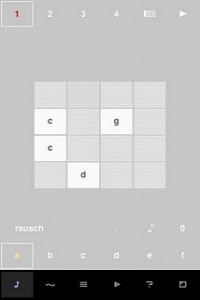
Nanoloop was originally developed for Game Boy (first release in 1999) and is a popular platform for mobile music creation. The new iPhone version presented here follows the same basic structure and design concept but otherwise it is an entirely new program. It does not simulate the Game Boy’s sound or other functions but has been fully optimised for the iPhone’s capabilities.
Lite Version Limitations:
- Projects can not be saved or sent, only the current status is kept in memory. The current project can be exported to the full version (if installed on the same device).
- Sample memory is limited to five files.
Otherwise, the lite version is fully functional and shares all features of the full version:
- Straight, minimalistic graphical interface
- Pattern-based stepsequencer
- 6 channels, each can be synth or sampler
- Song editor with loop function
- Synth with envelope, filter, lfo etc
- Sample on the fly
- Re-sampling
Synth
The simple but powerful synthesizer allows to create a great bandwidth of sounds, including beats, noises, basses and pads. Available synthesis types are:
- rectangular wave with filter
- FM
- LFSR noise generator
Each synth channel is two-voice polyphonic and an additional stereo effect can be applied.
Sampler
- Samples of 1 sec length (44 kHz, mono) can not just be used in a drum-machine style, but also be pitched and played as notes.
- Samples can be recorded via microphone (iPhone only), headset microphone (iPhone, iPod touch 2nd gen only) and from nanoloop’s own sound output.
A sequencer designed for playing live
IMEA has released IMEA Sequencer, a sequencer designed for playing live and creating your own music.
Easy to use, this new sequencer allows you to create your own music (House, Electro, Techno, Progressive …).
It comes with the plugins IMEA (Drums, Sampler, Synth, Chorus, Flanger, Reverb, Delay and Compressor), and is compatible with all VST plugins.

IMEA Sequencer
IMEA Sequencer features
- Sequencer
- 16 Patterns per instrument.
- Tool to help you create patterns and to improvise drum solos live.
- Controls and external MIDI keyboard.
- Compatible with VST instruments.
- Morphing
- The Morphing allows you to interpolate one or more settings of an instrument simultaneously.
- It affects the plugin, effects and mixing parameters.
- Ability to control up to 4 morphings per instrument.
- Mixing
- 4 effect sends and 2 inserts per instrument.
- Sampling rate of 44.1Khz to 192Khz.
- Saving the output mix in WAVE or MP3.
- Compatible with ASIO audio output drivers.
- Instruments & Effects included
- SynthI, Drums, Sampler, Reverb, Delay, Compressor, Chorus, Flanger.
IMEA Sequencer for Windows PC is available to purchase for 24 EUR. A demo version is available to download from the IMEA website.
More information: IMEA
Nice demo from Analogue Solutions
Here’s a video demonstrating the Analogue Solutions Europa hardware MIDI sequencer [www.analoguesolutions.com] in action, re-creating a classic beat (Depeche Mode’s People are People).
The beat was created using Europa’s Internal mode (not synced to MIDI clock or using outside sequencers). An Ensoniq ASR-10 was providing the drum samples in this case.
The Europa was also used to sequence the AS Telemark synthesizer at the end of the video and uses the Europa’s velocity controls (per step key) to control the Telemark’s filter (velocity to filter).
At the end of the vid, Europa is put into External clock mode and synced to MIDI clock (DAW sequencer). At this point, Europa will start/stop when the computer sequencer starts/stops. Europa also is sending sync to the AS Oberkorn MK3 sequencer, which is controlling the SE ObieRack.
Feast your eyes on the new Doepfer

Deopfer has released updated pictures and information on its Dark Time sequencer – a companion to the Dark Energy analog synthesizer.
Dark Time is an 2 x 18 / 1 x 16 step analog sequencer that is planned as an add-on for the Dark Energy. But it may be also used in combination with other MIDI, USB or CV/Gate equipment.
The Dark Time sequencer will be available as a stand alone model – or combined with the Dark Energy to make a killer Dark combo.
Pricing on the Dark Time is expected to be Euro 450.00 – 500.00 (about $700), and availability to be end of 2010.
Note: As the unit is still in the development state (as of October 2010) all specifications, prices and release dates are still are subject to change.
Features:
- two rows with 8 controls each
- for each step:
- – rotary control (same knob type as Dark Energy)
- – red LED
- – three-position switch On/Off/Skip
- On = trigger signal is active for this step
- Off = no trigger for this step
- Skip = step is skipped
- – three-position switch Stop/Continue/Jump
- Stop = sequence stops here
- Continue = sequence continues
- Jump (as yet Reset):
- If only one of the 16 toggle switches is in the Jump position a Reset is carried out (i.e. sequence jumps to stage 1)
- If two or more of the switches are in the Jump position the sequence jumps to the next step with the switch in the Jump position and then continues from this position (until another step with the switch in the Jump position is reached and then the same procedure is carried out again)
- several operating modes:
- 1×16 (i.e. the two rows are daisy-chained)
- 2×8 (i.e. both rows run in parallel)
- custom mode (e.g. three times row 1 and the once row 2, probably not yet available in the first firmware version)
- several running directions:
- forward
- backward
- random
- several voltage / tuning ranges: 1V, 2V, 5V (corresponding to 1/2/5 octaves)
- quantization on/off/custom scale (custom scale probably not yet available in the first firmware version)
- transpose via switch (-1/0/+1 octave), Midi/USB or external CV input
- timing control, selected by a three position switch:
- internal via built-in clock oscillator with frequency and pulsewidth controls
- external via Midi/USB
- external via analog clock/start/stop
- analog interface for CV/gate/clock/Start-Stop (inputs and outputs, 3.5 mm miniature jack sockets)
- Midi interface
- USB interface (power supply via USB is not possible)
- basic parameters are set in the configuration mode (e.g. Midi channel for row 1, Midi channel for row 2, Midi clock dividing factor, custom scale, custom running mode)
- optically adapted to Dark Energy (same knobs, same depth and height, same wooden side plates and so on)
- Powered via external power supply (12 AC/min. 400mA) for 230V
- powering the device via USB is not possible, because the analog circuits require a dual voltage (+/-12V).
DATAMASKIN

