
Update: SoundPrism 2.5 – new features
An overview over all the new features in SoundPrism and SoundPrism Pro 2.5
- connects to your favorite DAW or hardware synth
- … via WiFi (iPhone, iPod touch or iPad) or USB (iPad only)
- allows individual control of multiple instruments at the same time
- support for non-diatonic scales (iPad only)
- turns your iOS device into a wireless 3D MIDI controller
SoundPrism is available as a free download for iPhone and iPad. http://soundprism.com
Time machine: CRUMAR TRILOGY Analog Synthesizer 1981
This is a short HQ sound demo of the Crumar Trilogy. I played it dry without any additional effects.
The Crumar Trilogy is a multi keyboard instrument / string machine from 1981. It has 3 polyphonic sections: ORGAN, SYNTHESIZER and STRING ENSEMBLE. The best about the Trilogy is the polyphonic synth section, which has 2 VCOs per voice, 24 dB filters which employ the famous SSM chips… The STRING ENSEMBLE and ORGAN sections sound somewhat cheesy, but hey, sometimes you need some vintage cheesy sounds 😉
Very impressive looking. It has no patch memory like you might think. The Oberheim-type led buttons just recall presets.
On a Vangelis record (I don’t remember the title) you see a picture of the Trilogy.
HackMe Rockit Synthesizer Demo
A close up look at the HackMe Rockit synth:
This is a demonstration of some of the sounds and features of this HackMe Rockit synthesizer, designed by Matthew Heinz, which I built from kit a little while back. This demo is less about music and more about the technology and functions of the machine so if you are not into synths you will probably find it boring. You can find out all about the synth or order your own kit from this site http://hackmeopen.com/?page_id=474&fb_source=message.
The Rockit is a dual oscillator monophonic synthesizer. The oscillators are 8 bit and each have 16 different waveforms. It has a VCA with full ADSR as well as a multi-mode 2 pole VCF again with full ADSR. Add to this a pair of LFOs with complex routeing options, Full MIDI support and 16 patch memories and you have a nice little package.
Because of the 8 bit wave table oscillators this thing can do a plethora of Atari sound with the VCA and VCF wide open but once you start get them involved then it moves over to more traditional analogue mono sounds.
Just so you are aware I built the little box case for my Rockit from scratch, the designer does have a case for sale from his site but I am planning to rack mount this thing at some point so I built my own cheap case as a temporary method of keeping it dust free.
AlephOne-Looper2 – Cellular
Here’s a new sneak preview of a micro-tonal synth:
“Looping behavior is close to what I want. Aliasing and impulsing seem to be well under control, and balance is now reasonable.”
DSI Poly Evolver Keyboard Demo
Background information:
Only using a single PEK voice. Oscillators turned on/off for variation parts, using Output Pan for stereo affects. Sequenced/recorded live, from the PEK. Tiny amount of compressions and EQ (bass rolloff). No external effects – delay is from the PEK. All drums from Jomox 888 / 999.

The Poly Evolver Keyboard is DSI’s flagship synthesizer, a nearly-knob-per-function knockout that sounds unlike any other synth out there—except another Evolver, of course! Don’t like a high-end hardware synth that requires wading through endless menus to program? Not an issue with the Poly Evolver’s 78 knobs—60 of them potentiometers—and 58 buttons, incuding a keypad for direct access of programs.
An analog/digital hybrid, the four-voice Poly Evolver features four oscillators per voice—two analog and two digital—in a unique stereo voice architecture with a real Curtis analog low-pass filter per channel. The digital processing does not simply add effects at the end of the signal chain, but is tightly integrated with the analog electronics for tuned feedback, distortion, bit crushing, and synced delays. It can also process external audio and has separate stereo outputs for each voice.
The Poly Evolver is capable of producing sounds ranging from classic analog to more brash and edgy digital sounds. It is also multitimbral, with the ability to play up to four parts simultaneously through separate stereo outputs. And it can process external audio.
The Poly Evolver is not a generic “slab” workstation. If you’re looking for realistic pianos and strings, keep looking. But if you want a truly unique, inspirational, real instrument, look no further.
- Each voice is a complete Evolver with four oscillators per voice, two analog and two digital.
- True stereo signal path with separate Curtis analog low-pass filters in each channel for each voice. Each voice has its own independent effects (feedback, delay, distortion, high-pass filter, etc.).
- Highly accessible sound control for easy, intuitive operation: 78 knobs and 58 switches.
- Clocked, pulsing blue LEDs and hardwood end-panels.
- Each voice has an independent 16 x 4 step sequencer. Everything (sequencer, LFOs, and delay) syncs perfectly to MIDI.
- In Program mode, all four voices play the same sound. In Combo mode, voices can be allocated however desired: stack all 4 for a huge unison sound, split or layer the keyboard in any configuration, and/or play one or all sequences at the same time. Each voice can respond to a different MIDI channel.
- Each voice has its own stereo output in addition to the mix and headphones outputs.
- Stereo audio input that can be routed to any or all of the voices, enabling parallel audio processing of external stereo or mono signals. The output of one voice can be routed to the input of another for interesting double-processing effects.
More on the new MacBeth Micromac – three shadows
Here’s what they have to say about it:
As we hit production of the micromac- her’s one of the last videos from the prototype units- this video features the desktop version doing baqss lines and the 3U format version doing some strange glide stuff! It’s been an interesting experiment- the keyboard controllers are 2 x Korg Prophecies doing the arpegiation thing at different timings! Apart from my own designs featured here- I’d highly recommend 2 x Prophecies as keyboard controllers! I guess all this sound coming from such small units….starts to erase the need for the massive modular…especially if you after this kind of sound! All played live….and yes, the video needs a touch of brightening slash contrast!
Oscillographic Synthesizer and Computer Interface
The de/Rastra oscillographic synthesizer is a real-time audio/video instrument and computer-interfacing device that allows a performer to generate visualizations intrinsic to cathode ray tube technology while simultaneously creating the acoustic analog of the displayed imagery. The de/Rastra oscillographic synthesizer is an open source project and will eventually be accompanied by tutorials on methods of CRT hacking. Related tutorials can be found at http://www.crackedraytube.com/textstutorials.html but specific information regarding de/Rastra are in progress.
EMW WCS-1 Synthesizer “On the Mix”
Little track showing the WCS-1 bass sound.
WAVE COMPOSITION ANALOG SYNTHESIZER WCS-1

Description
The WCS-1 is a MIDI synthesizer module that utilizes a digital oscillator followed by all discrete analog circuits to produce unusual and heavy sounds. The exclusive wave addition resource together with a dual input powerfull VCF and a lightning fast VCA ensures its powerfull sound generation capabilities, being an ideal tool for electronic music production.
Utilization
To make use of the WCS-1 you need a MIDI controller keyboard or any other type of equipment that has a MIDI OUT port, like drum machines, MIDI Pad controllers, bass pedals or a computer with MIDI connection. The WCS-1 has a 1/4″ (P-10) mono jack on the back panel in order to be connected on a sound mixer, computer audio interface or directly to an amplifier.
IVOR – new free two-oscillator subtractive synthesizer for Windows
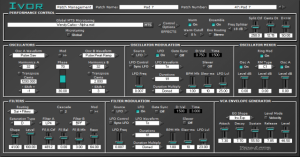
Xen-Arts has introduced IVOR – a two-oscillator subtractive synthesizer that features full-controller MIDI Pitch Microtuning using MTS (MIDI Tuning Standard). Any MIDI Note Number can be freely microtuned to any desired pitch across the MIDI range, enabling musicians and composers to explore the expressive possibilities of composing music with alternative intonation systems.
Features:
- Oscillator Section
- Two Oscillators with 22 Waveforms
- Microtonal, Harmonic Series and Subharmonic Series Oscillator Transposition
- LFO (with Rate Sequencer) and Envelope Generator for Phase, Pulse-Width and Pitch Modulation
- LFO and Envelope Generator features both Unidirectional and Bidirectional Modulation
- Analog Pitch Drift Emulator with both Unidirectional and Bidirectional Modulation
- Velocity-to-Harmonics Modulation enables oscillators to dynamically sound harmonics of the fundamental pitch
- Ring Modulation with 23 RM Types
- Oscillator and Ring Modulator Mixer
- Filter Section
- Pre-Filter Saturation Stage with 20 Saturation Types
- Two Independent Filters with Six Filter Types: LP4, LP2, HPF, BPF, BRF, APF
- One and Two Stage Filter Cascade
- LFO (with Rate Sequencer) and Envelope Generator for Filter Cutoff Frequency Modulation
- LFO and Envelope Generator enables both Unidirectional and Bidirectional Filter Modulation
- VCA Section
- Dedicated Envelope Generator
- Switchable Velocity Sensitivity and Fixed Volume Control
- Performance Control
- MIDI Pitch Microtuning with MTS (MIDI Tuning Standard)
- MTS Support for both Single Note and Bulk Dump
- Loads MTS Microtuning Format Files Internally and Receives MTS Externally
- Local (Per-Patch) and Global Microtuning (Static Microtuning for All Patches)
- Microtunings can be loaded from any directory on hard drives or storage devices connected to the computer
- Ten Note Polyphonic
- Monophonic Legato Mode
- Polyphonic Portamento with Three Glide Modes
- Microtonal Pitch Bend
- Vibrato
- Effects include Warm Filter and Stereo Ensemble
IVOR is available for download as a 32-bit VSTi for Windows XP or higher.
Hohner Multimonica I – Vacuum tube synthesizer of the 1950s
The “Hohner Multimonica” is a combined double-manual keyboard instrument consisting of a monophonic synthesizer (sawtooth oscillator, vacuum tube technology) and a polyphonic harmonium with fan-driven reeds. This electro-acoustic musical instrument comes from the German postwar era. It was produced in two main variants (“Multimonica I” later “Multimonica II”). The “Multimonica I” even had a built-in AM radio for local station reception. But there was also a version available without radio.
The first appearance of the Multimonica is falsely dated to 1940. Some may even date it back to the prewar era. But its tube technology suggests that this musical instrument came into trade in the early 1950s. The short newsreel report from 1952 in this video supports this fact.
Hohner modeled its musical instrument after an electro-acoustic instrument by the German company “Siegfried Mager & Co.” and the harmonium manufacturer Johannes Straube (“Mager-Straube-Kleinorgel”). German engineer Harald Bode (*1909 †1987) was incorrectly assigned to the construction of this musical instrument.
DATAMASKIN

