
Closer look at the Roland Juno 6 synth
Background info:
The Juno 6/60 is a popular synth that is the subject of a lot of discussion, and much of it is negative. I am a huge fan of the Juno 6/60 and think it gets and unfair amount of criticism, primarily behind the veil of the internet. This demo showcases its amazing sound and some of it’s capabilities.
Below is the link to the original uncompressed demo:
http://soundcloud.com/briancastro/roland-juno-6
Pekka Kauppila updates MauSynth beta
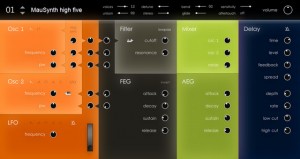
Pekka Kauppila has released a new beta version of MauSynth, a free polyphonic synthesizer plug-in for Windows.
MauSynth is a basic subtractive synthesizer with emphasis on high sound quality and friendly interface.
The plugin is written in c++. It is currently in beta stage, feedback is welcome. MauSynth will stay free even after beta.
Changes in the new beta version
- Improved oscillators.
- Improved filter.
- Improved GUI.
- Aftertouch support.
- Adjustable velocity sensitivity.
- Improved legato mode.
The MauSynth beta is available to download as a VST instrument plug-in for Windows.
Roland Jupiter 80 “Tomi-Tanks”
Info about the synth from Roland below:
Roland’s all-new JUPITER-80 is a groundbreaking live performance synthesizer that simply could not have been built until now. It’s the first synthesizer designed completely around SuperNATURAL® sound modeling technology, delivering expressive instrumental realism far beyond anything previously possible.
Since the launch of the JUPITER-80, many professional keyboard players and producers have praised its expressive SuperNATURAL sounds and live-performance capability. With the Version 2 software update, the JUPITER-80 offers new features that enhance its synthesis power, and provides more flexibility and creativity for musicians designing their own sounds.
Roland Jupiter 80 artists
MicroTones – microtonal synthesizer for iOS
MicroTones is a microtonal synthesizer, allowing simultaneous playback of up to thirty sinewaves set with accuracy to one hundredth of a hertz.
Available on the App Store: itunes.apple.com/us/app/microtones/id522720716?ls=1&mt=8
Place new sinewaves just by touching the screen, adjust volume, and frequency, add more and listen to subtle changes in soundscape. Easily create ambient atmospheres and drones.

Manipulate multiple sinewaves at once with full multitouch support.
Adjust frequency range using scale displayed at the bottom of the screen – move to lower/higher frequencies, zoom in to adjust sinewaves with more accuracy, or zoom out and see the whole picture.
Remove one or more sinewaves just by dragging them to the bottom of the screen, or all at once by shaking your device.
New Groove Drums Synth from IMEA
Steelberry Clones reader Dan A from IMEA tipped us on their new Groove Drums Synth that now has been released, here’s what he tells about it:
VSTi plugin and Application, its architecture combines a sequencer, a sampler, a synthesizer and the randomization tool of Groove Drums that allows you to create easily and intuitively grooves and drums loops.
The standalone version allows you to use the plugin without the need for a host sequencer and so be able to export drum loops independently.
The difference with GROOVE DRUMS is to affect the channels to a sampler and a synthesizer that allows you to create synthetic percussions.
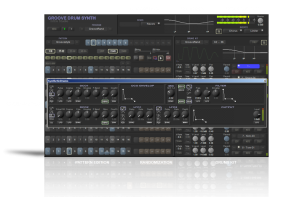
Features:
• Pattern based drum machine engine + Sampler + Synthesizer.
• Innovative tool for randomization.
• Ability to export audio loops.
• 12 channels.
• 3 parametric filters per channel.
• 2 effect sends per channel.
• Independent outputs.
• 16 patterns of 64 steps per channel.
• Drag & Drop patterns.
• SCALE mode for velocity on the tune that selects the closest note in an editable range.
• Master equalizer and insert effects.
• Comes with Chorus, Compressor, Delay, Filter, Flanger, Limiter, Reverb and Overdrive.
• Comes with standalone version allows the use of the VSTi without the need for a host sequencer.
Roland Jupiter-50 review
Check our exclusive video to see the first, full, in-depth review of the new Roland Jupiter-50. Dan ‘JD73’ Goldman shows off the Jupiter-50’s sounds and digs deep into the synth engine, before revealing his final verdict on the performance keyboard.
Rolands pitch:
With its unprecedented fusion of synthesis and acoustic instruments, the new-generation Roland JUPITER has changed the way we play, react to, and feel a keyboard. By combining the supreme expression of the JUPITER-80 with the travel friendliness of the JUNO series, the new JUPITER-50 brings SuperNATURAL sound and pro performance to every stage and studio.
- – Stunning SuperNATURAL sounds powered by our most advanced sound engine
- – Travel-friendly design; 76-note weighted keyboard
- – Fast, friendly user interface with intuitive color-coded buttons and sliders
- – Registration function for saving and selecting sounds instantly
- – Pro-quality multi-effects and reverb
- – Expressive performance controllers, including D-BEAM, pitch/mod lever, and control input jacks
- – USB Song Player/Recorder
- – USB audio/MIDI functionality; bundled with SONAR LE and JUPITER-50 Control Surface plug-in for SONAR
Oscillator – new and free audio-controlled synthesizer
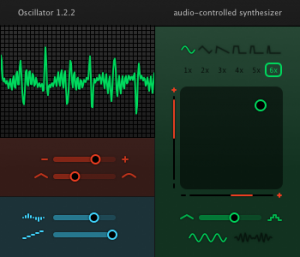
SineVibes has released Oscillator– an audio-controlled synthesizer for the Mac – as a free download.
Oscillator is an AudioUnit effect plugin that lets you turn any audio into sci-fi effects, glitches and noises. It is based on a multi-waveform oscillator with up to six voices and variable frequency stepping, whose parameters are modulated using the input signal’s dynamics.
The oscillator output can then be processed via effects which include ring modulator, sample rate degrader and bit crusher. This lets Oscillator turn any audio signal into a wide variety of sounds and effects.
Oscillator is a free download at the SineVibes site.
Time machine: KORG DW-8000 Digital Waveform Synthesizer
KORG DW-8000 Hybrid Synthesizer from the year 1985.
single sound demo
– 8 Voices
– 2 Oscillators per voice
– 16 digital waveforms
– analog lowpass VCF
– analog VCA
– Arpeggiator
– Digital-Delay

Take Korg’s first digitally controlled analog synth hybrid (DW-6000) two steps higher and you get the more popular DW-8000. Sound is digitally generated from the DWGS (Digital Waveform Generator System) and has been doubled from 8 sampled digital waveforms to 16 simple analog to complex digital waveforms. The DW-8000 has 8 voice polyphony in two modes, or one monophonic mode with all eight voices stacked. The analog VCF resonant filter and VCA both have independent ADBSSR envelopes. Parameters can be altered in real time via a single programmable slider. There are 64 presets that can be reprogrammed by the user.
When the DW-8000 succeeded the DW-6000, it expanded it to 8 notes polyphony, 16 sampled waveforms, a velocity sensitive keyboard with programmable aftertouch, auto-bend, a simple arpeggiator and a digital delay unit. The Digital Delay was an astonishing goody for the time, offering up to 512ms delay, phasing, flanging, chorusing and other time effects. Both the Arpeggiator, Auto-Bend and Digital Delay make this synth an inspiring and great sounding machine to use for great 303 basslines, techno and house bass and synth sounds and more! The EX-8000 (pictured above) is a rackmount version of the DW-8000. Several 3rd-party developers offered expansion boards for the DW-8000 providing up to 1024 presets, layered sounds, keyboard splits and Sample+Hold for the LFO.
Oberheim OBX-a: Unison lead demo
OBX-a Unison lead. 8-voice Unison. WFs- VCO-1 & 2: SW. LFO: Sine.

The OB-Xa is a massive analog synthesizer with a very familiar and classic Oberheim sound. Its sound, size and power are very similar to the Prophet 5 from Sequential. However this one has up to 8 voices which can be split, layered and stored!
The OB-Xa was available in four, six or eight voice polyphonic models. They all featured patch memories, also in varying degrees. A minimum of 32 patches were available on early models (4 banks of 8). The maximum amount of patch memory storage found on many OB-Xa’s is 120 patch memories. All models of OB-Xa, however, featured the new Curtis chips which offered great stability for an analog synth and they are attributed to its great filters and sounds.
The OB-X was very similar to the OB-Xa except that its voices could not be split or layered and, more significantly, the OB-X had a lowpass-only discrete SEM 12dB/oct state variable filter, which had a great and classic Oberheim sound. The OB-Xa changed that in an attempt to economize manufacturing and increase stability by switching to CEM3320 Curtis chips for its filters. The Xa offered two switchable filter modes: 12 dB/oct (2-pole) or 24 dB/oct (4-pole). This hardware change resulted in a more agressive sound, not quite as creamy as the OBX original, but what still became a “bread and butter” sound of the Oberheim line.
Splitting the keyboard mode separates the OB-Xa into two 4-voice synths with two available patches. The Layer mode plays the two patches simultaneously. There are also some added effect sources, perfect for any analog polysynth, including portamento, unison, sample & hold, chord memory and three LFO’s!
However none of the original OB-Xa’s have MIDI, unless otherwise having been modified. The OB-Xa is a classic and fat analog machine. It will give you thick analog pads and drones, punchy bass and cyclic analog effects.
Korg Radias – Step Sequencer Tutorial
“This is for the people that had asked me to do a tutorial on the Korg Radias Step Sequencer. This is the Low quality Version, I will upload the 720 Version soon. Please note – This is a Very Basic – I say again. Very Basic Tutorial on Step Sequencing and Creating a sound that has Velocity Sensitivity effected by the Step Sequencer causing the Filter (EG1) on the Radias to change the way the notes are played.”
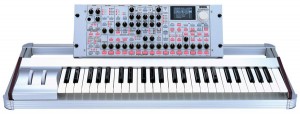
The Korg Radias is a Virtual Analog synthesizer that was released by Korg in 2006. It takes advantage of the MMT (Multiple Modeling Technology) that their flagship OASYS synthesizer module employs. The synthesizer itself is similar in design to the MS2000, but offers many more capabilities. It is capable of emulating older digital synthesizers and classic analog synthesizers like the MS-series without any noise or aliasing. The Radias also allows for various external sounds to be fed through its filters and envelopes. It also has the Korg DWGS (Digital Waveform Generator System) that the Korg DW-8000 employs.
The Radias also takes advantage of the KKS (Korg Komponent System) which allows it to be used with the 49-key keyboard or used as a standalone rack module, and the Radias-R unit can be connected to the M3 Music Workstation/Sampler along with its various keyboard models.
The Radias has two oscillators per timbre and a noise generator. Oscillator #1 has nine basic waveforms, with four types of modulation and PCM (64 synth sounds, 128 drum sounds) and Oscillator #2 has four basic waveforms with two types of modulation. The Radias has the ability to stack up to five types of waveforms in Oscillator #1, while using only one voice of polyphony. In Unison mode, you can stack five additional waveforms, while using more polyphony. With this function, you can create some awesome super waveforms-the overall result can contain up to 25 detuned waveforms. The Radias also has two Low-frequency Oscillators (LFO) that add more modulation to the two audio oscillators. These LFO’s provide six waveforms and their speeds can be set manually or by tempo.
The Radias itself has four timbres per program. With a timbre, you can assign one drum program, another can have a lead, a bass, and a vocoder as well; all in one program! Each timbre can contain one synthesizer/drum kit, equalizer, and two multi-effects.
The Radias has two filters that can be used side-by-side, individually, or in a series. They offer Low Pass, High Pass, Band Pass, and Combination modes. Each filter offers 24 or 12 dB modes for the low pass filter. The effects on this unit are remarkable as well. The Radias comes loaded with 33 different effects: Delays, Chorus, Flangers, Compressors, talking modulator, and even the good old Polysix Ensemble effect. You can assign one master effect to the program, while each timbre gets its own two effects, creating a whole world of possibilities. The Radias also offers a 16-band vocoder with a nice Formant Motion recording function that allows you to record up to 7.5 seconds of external audio which can then be triggered via the keyboard.
The Radias has a built in arpeggiator as well, providing six different patterns to choose from. Patterns can be up to 32 steps long and the gate/velocity can be set for each step to get that sound you want! It also has two 32-step sequencers (they can be combined for a 64-step on a single timbre). They can easily be assigned to a drum kit, for example, to use the Radias as a programmable drum machine. The step sequencer supports 8-voice polyphony per step.
DATAMASKIN

