
Sneak preview of the new Sugar Bytes CYCLOP synth
Cyclop is the new bass synthesizer from Sugar Bytes.
Check it out!
It’s a monophonic monster, armed to the teeth with jaw dropping effects and wobblier than a jelly on a space hopper. CYCLOP is the scratch-looping, sample-mashing, sub-generating, harmonic-splicing mothership of the twisted bass alliance and it’s landing on your desktop soon. With masses of new sounds for you audio-junkies, from screaming analog syncs through brutal FM sounds to scintillating spectral shimmers. The integrated sampler also works as wavetable synth and pitch transformer for creating unbelievable and disturbing monster voices. CYCLOP is more than massively loaded with features: 10 incredible filters, unique wobble generator, feedback processor, 3 overdrives and an effects sequencer. CYCLOP is expected to be released in spring 2012.
Punk synth – feature of the legendary ARP Odyssey synthesizer
A GForceSoftwareTV feature on the legendary ARP Odyssey synthesizer.
While the Minimoog proved to be a runaway success as the first compact studio synthesizer, ARP responded with a compact and user-friendly studio synthesizer of their own with the Odyssey in 1972. An almost equally legendary machine itself, the Odyssey was ARP’s highest selling synth back then, and still is to this day in the second-hand market.
The Odyssey essentially gives you a simplified hard-wired ARP 2600 in a much smaller and affordable package. The Odyssey is a 2-oscillator analog synth (with duo-phonic capability) and it sounds really nice; the Minimoog has three oscillators and is capable of thicker sounds. The Odyssey comes well equipped with all the tweakable features and analog goodness you’d expect: a resonant low pass filter, ADSR envelopes, sine or square wave LFO, and a sample-and-hold function.
The Odyssey also added a few new features such as a high pass filter that could be used in series with the low pass, oscillator-sync capability, and pulse-width modulation. It is a very professional and expressive machine that can create nice analog basses, interesting leads, great effects and sweeping sounds straight out of a Tangerine Dream album!
There were many versions of the Odyssey over the years, each a little different. They can be broken down into 8 models spanning 3 Mark “Mk” version.
Sneak preview: HandySynth from Icebreaker Audio
HandySynth
HandySynth is a sample based re-creation of a custom circuit-bent Yamaha HandySound HS-200 for Native Instruments Kontakt 4 or 5.
- All instrument sounds chromatically sampled at 24-bit 48kHz
- 8 circuit-bent sound variations
- Convolution based emulation of the original speaker at various microphone positions
- Authentic emulation of the HandySound volume envelopes and tuning via custom scripts
- Additional Effects: Distortion, Filter and Spring Reverb
- Download also includes a copy of C-Bent Kit for Battery
Coming February 3rd from Icebreaker Audio
Moog Micromoog demo
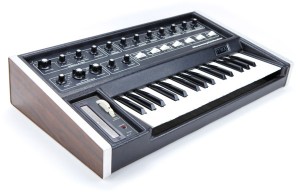
A demo of the Moog Micromoog, the “baby” Minimoog with one oscillator and sub oscillator. Plenty of routing capabilities can create standard Moog bass/lead, but also incredibly crazy FX. Micromoog is a single-oscillator mono-synth, designed as a budget performance Moog. But it’s an inexpensive alternative to the Minimoog. In fact, it is often used as just a stand-alone filter processor since it has a filter that is virtually identical to the one found in the Minimoog, and it accepts external sounds for processing through itself (all at a fraction of the price for a Mini)! It also employs a ribbon controller (which was a cool new feature) for pitch bending. Notice that there are still plenty of knobs to give you access to the shape of your sounds! Unfortunately the construction feels kind of cheap.
Moog Source goes to Berlin School
A demo of my Moog Source (old Berlin school)
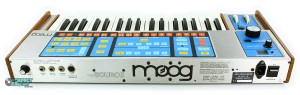
Moog’s Source was their first to offer patch memory storage as well as some other new features. It boasted 16 memory locations so you could finally save and recall your synth patches. A casette-tape jack was also implemented to transfer your patches to and from an external tape and free up the on-board memory for additional new patches. But in an effort to modernize with the eighties, the Moog had replaced all buttons, knobs and sliders with flat-panel membrane buttons and a single data-wheel assignment format. At the time, this may have seemed far-out, but in all actuality it is the Source’s downfall.
Parameters are edited not with hands-on sliders and knobs but by assigning a selected parameter to the dedicated data wheel. This is very tedious and does not allow for true hands-on tweaking during performances nor can you adjust different parameters simultaneously or while playing. These days, the membrane buttons don’t always seem to work quite right either. However, those famous monophonic Moog sounds are still inside this synth which has two fat analog oscillators and the legendary 24 dB Moog filter.
Roland RS-202 demo
“The wonderful string chorus ensemble sound of the Roland RS-202, a classic string synth of the 1970s.”
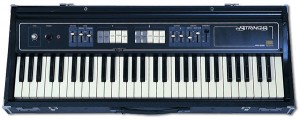
The RS-202 is a string and brass synthesizer released in 1976 that followed the lackluster RS-101. Oddly the RS-202 wasn’t much different than its 101 predecessor. The RS-202 had two new features: a user-controlled delay for the vibrato, and an Ensemble/Chorus effect (that would be seen on dozens of future Roland analog synths for years, including the Junos and Jupiters). It makes the ultimate “disco” string sound.
The RS-202 is fully polyphonic (all 61 keys can play simultaneously). Basically three sound presets are in the RS-202: Strings I, Strings II and Brass. Forget the brass, however, because this machine is all about the strings, and for a time it was considered Roland’s finest string machine. Strings I covers low cello & bass type sounds and Strings II is thinner and in the higher registers for Viola and Violin type sounds.
The keyboard is permanently split into two separate sections, the lower 2 octaves and the upper 3 octaves. Each section has it’s own set of identical controls. These include three white On/Off buttons for each of the three sound presets. This means you can assign any sound to each section, and any combination; For example, set the lower section to Strings II and set the upper section to Strings I+II+Brass if you like. There are also two grey buttons in each section for “Slow Attack” and “Volume Soft”. Each section also has its own sustain slider and there are global brilliance sliders for the brass and string sections independently.
Basic effects included the Ensemble (chorus) effect and Vibrato. A switching-slider is used to select Ensemble I, Ensemble II or Off. The Vibrato effect section had just two sliders: Delay and Speed (depth could not be changed). The Ensemble section did wonders for the sound of this machine; the ‘Ensemble II’ setting introduced a rich chorus, whereas the ‘Ensemble I’ produced the faster, deeper ensemble effect that became an instant classic. Sadly, like most vintage synthesizers the RS-202 is mono (high/low output jacks on back) and provides only a trigger output for an external synthesizer. It’s built-in to a suit-case style housing which made it easily portable.
The RS-202 is a truly vintage and classic machine. Historically, it launched Roland’s signature Ensemble effect. It also sounded fantastic – with or without the ensemble effect engaged. It easily stood up against many competing synths of its time such as the Arp Solina.
iPad Experiment Controlling Sunrizer Synthesizer from TNRi
Here’s a new feature from Mark Mosher 
Background details:
In this video I’m experimenting with using an TNRi to drive the Sunrizer synth which is running in the background.
I’ve used the physical Tenori-On W for over two years. I prefer to run use it as a controller and run racks for virtual instruments running in Ableton Live or to turn external hardware rather than using it’s internal synth engine. So naturally, after getting TNRi for my iPad I wanted to replicate the same idea.
Luckily, certain synths such as the wonderful Sunrizer (http://beepstreet.com/) can remain running in the background allowing you to switch over to a controller app such as TNRi.
This video shows all this in action. Here is the setup:
1) Start Sunrizer and find or create a patch to your liking
2) In the top-right of Sunrizer is a button labelled ‘BCK”. Click it and it will start blinking yellow.
3) Click the Home button on your iPad
4) Start TNRi
5) Launch the menu by clicking the status window above the play button
6) Select “Preferences Menu” and turn “Local Control” to “Off”.
That’s it, now all the MIDI gets pumped through to the background app.
Review: Chromaphone physical modeling synthesizer
Ronnie Rekkerd review of the Applied Acoustics Systems’ Chromaphone physical modeling synthesizer:

“With its physical modeling, Chromaphone produces wonderfully dynamic, expressive sounds. Experimenting pays off, as just the turn of a knob or two can yield completely different, unique sounds.
Needless to say, Chromaphone is a fantastic synthesizer for cinematic, soundtrack type works. It will likely suit many electronic music producers as well, especially in the area of ambient, minimal, and idm genres.”
Hπ Instruments Microsynth: New Synthesizer App For Mac
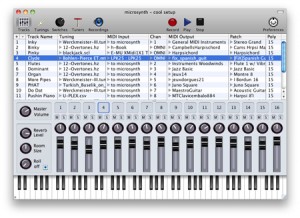
Make some microtonal music on your Mac with Hπ Instruments Microsynth, a polyphonic multi-timbral microtonal synthesizer application (standalone). It’s now available in two versions: the multi-timbral version and the mono-timbral (single-track) version dubbed Microsynth-mini.
Both are Mac OS X SoundFont synthesizers for microtonal music, supporting seven types of tuning files, instant retuning, audio file recording, routing to and from standard MIDI hardware controllers, and sequencing and notation software such as Sibelius and Finale. Overall, Microsynth is designed to give you total control of tuning in your music.
The tuning features are the same in both Microsynth and Microsynth-mini. There are 16 independent tracks, each with tuning, MIDI I/O, SoundFont, and patch selection. Check out all the synth features, below.
Microsynth features:
- Unlimited tunings, any key to any pitch
- Individual tuning per track
- Supports MTS real-time Sysex messages
- Supports .scl .tun .hz .csv .mtx .gly and .tonex tuning files
- Supports single channel tuning tables of 128 tones
- Supports OMNI-channel tuning tables of 2048 tones
- Allows real-time transposition and remapping of scales
- Unlimited user-defined MIDI CC tuning switches and tuners
- Supports pitch bending of microtonal pitches
- Comes with GM / GS sound set
- Built in reverb
- Loads .sf2 SoundFonts
- Unlimited MIDI connections
- One virtual MIDI input and output
- Records WAV audio files
- Loads and saves scenes
- Multiple Undo
The Hπ Instruments Microsynth synth for Mac (standalone) is available for $19.99. Microsynth-mini (single-track) is half as much, at $9.99. For more information, go to the company’s Web site at h-pi.com.
Nordic Red – the new Modular G2x ReFill from SoundCells

DATAMASKIN

