
New synthesizer specifically designed for creating electronic kickdrum sounds
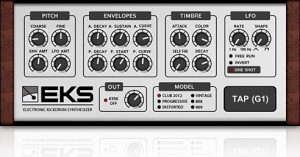
Synapse Audio has introduced EKS Pro, a VST/Audio Unit plugin for Mac & Windows, designed for creating electronic kickdrum sounds.
The plugin offers six high-quality sound models, a mix of vintage hardware emulations, and new, modern kick drum sound models. Despite their fundamentally different nature, all models respond to the sound parameters in largely the same way.
The user interface is organized into four sections controlling the pitch, the amplitude and pitch envelopes and its curvature, the attack stage and finally pitch modulation. This layout makes it simple and straightforward to program your own patches or modify existing ones.
EKS Pro for Windows and Mac (VST/AU) is available now for US $39. A free demo is available.
An Epic synth for iPad
Developer Jean-Pierre Martineau has released EpicSynth – a new $5 software synthesizer for the iPad. EpicSynth is a polyphonic synthesizer supporting CoreMIDI and Line 6′s Midi Mobilizer MIDI interface.
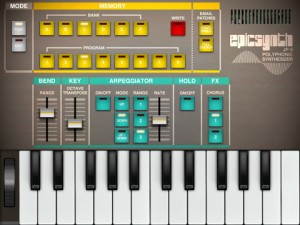
EpicSynth was inspired by legendary analog synthesizers of the 1980s. It’s designed from the ground up to be EASY TO USE, POWERFUL, and FUN!
EpicSynth distills the essence of subtractive synthesis into a simple yet powerful app. Epic Synth’s sound architecture is simple enough for beginners to learn about synthesis yet powerful enough to satisfy experienced sound modelers. Its straightforward interface is never an obstacle and lets you focus on the essential: the pleasure of creating new sounds!
Details below:
FEATURE LIST:
Transposable two-octave keyboard (C to C) with pitch bend control.
Multi-mode arpeggiator
– Key hold function
– Stores 48 sound patches in 6 banks of 8 programs
Single patch sharing via email
Full memory backup via email
– Compatible with Midi Mobilizer MIDI interface by Line6
– Compatible with CoreMIDI compliant USB keyboards via Apple’s Camera Connection Kit
– Four voices of polyphony
EPIC SYNTH IS EASY TO USE
EpicSynth’s layout is very intuitive and efficient: you’ll spend your time tweaking sounds instead of searching through endless pages of complicated parameters you never use. After all, synthesizers are tools for exploring sound, not exploring user interface pages!
EPIC SYNTH IS POWERFUL
EpicSynth’s features have been hand-picked to preserve the essence of classic synthesizers. Without being overwhelming, EpicSynth’s sound architecture provides tons of room to create great sounds, from classic leads to juicy acid basses, from 8-bit-like effects to complex evolving sonic textures.
EPIC SYNTH IS FUN
EpicSynth’s straightforward layout, inspired by the classic analog synths of the 1980s, yields instant tweaking gratification, while the arpeggiator assists you in creating awesome rhythmic soundscapes. Lose yourself in a sea of virtually infinite possibilities! Be warned that fooling around with EpicSynth can make you lose track of time!
SOUND ARCHITECTURE:
– Each of the four voices has:
– A simultaneous-multi-mode oscillator comprised of a pulse wave with pulse-width-modulation, a sawtooth wave, a sub-octave square wave and white noise generator.
– A standard envelope generator with attack, decay, sustain and release
– A lowpass (ladder) filter with resonance control and modulation routings
– Dual-mode Amplifier using Envelope Generator or Key Gate
– Shared components include
– LFO with adjustable delay
– High-pass Filter
– Chorus effect
MeeBlip – the hackable digital synthesizer
The MeeBlip sequenced by a Yamaha QY 10 and later added the Eventide
Timefactor. MeeBlip is a hackable, affordable digital synthesizer, made for accessible sound and hands-on control. It can be someone’s first synth. It can be a unique-sounding addition to your music setup, playable with MIDI hardware and software. It can be a synth you open up and modify, learning about sound creation, code, and electronics. Or it can be the basis of new projects and ideas.
- Out of the box, a monophonic virtual analog synth.
- Eight user-definable knobs and sixteen slide switches, for hands-on control with the immediacy of a classic monosynth.
- Tasty digital synth sounds.
- Use it as-is, or use the source code to remap controls or completely redefine the instrument’s architecture.
- Available ready for simple, solder-free assembly with a case, or as a kit, all on a single board. Build your own, or make a different project with the MeeBlip sound engine.
- 8-bit digital brain.
- MIDI input.
- 4-pole active low-pass antialising filter.
- Open source hardware. Modify anything, buy some kits and sell your own builds, or make new projects. We want to see what you create, and share progress. (Find out more about open source hardware and the MeeBlip.)
- Complete kits ship with a custom front panel illustrated by Nathanael Jeanneret
iSynthesizer Pro becomes freeware
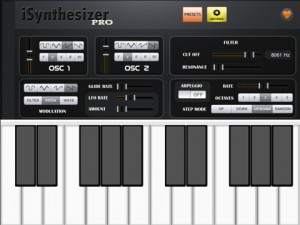
Amitech has cut the price on iSynthesizer Pro (App Store link) down to a free download.
iSynthesizer Pro is a monophonic virtual analog synth that, according to the developer, is designed for live performance.
Features:
- Monophonic, playing one note at a time like a class synthesizer
- Designed for live performance
- Configurable Presets, save your favorite settings
- Oscillator Module
- Dual oscillators
- Square, Triangle, Sawtooth, Reverse Sawtooth waves
- Octave selector, supporting 5 octaves
- Glide between notes (Lag Processor)
- Oscillator fine tune (more than one full octave)
- Oscillator sync
- Low Pass Filter Module
- Modulation module
- Tremelo/Wave
- Vibrato/Pitch
- Filter
- Envelope Generator module
- Supports ADSR (Attack, Decay, Sustain, Release)
- Volume
- Filter (amount of low pass filter)
- Arpeggio
Featuring the Roland MKS 30 + PG 200
Short track with the Roland MKS 30 Planet S. All sounds made with the MKS 30. Multitrack recording + external FX.
The MKS-30 Planet S is commonly referred to as a rackmount JX-3P, although it really shares its heritage with the GR-700 guitar synth. The MKS-30 has several advantages over the JX-3P, including simultaneous use of the PG-200 programmer and MIDI, a cartridge slot for storing an additional 64 patches, and velocity response.
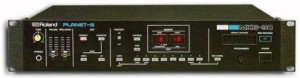
The voice architecure is identical to the JX-3P. The two digitally clocked oscillators use a master clock which is divided by an even integer to achieve the desired pitch. This method never allows the oscillators to produce a pure pitch across the entire range, and is probably accountable for the MKS-30’s somewhat cold sound. The two oscs can be synced together or cross modulated using the METAL setting. I’m not sure what actual process is used, but it definitely sounds metallic. The filter module is the same one featured in the Juno 106, and has both a resonant low pass filter and a variable nonresonant high pass filter. Only one shared envelope is available for VCA and VCF. The LFO provides sine, square, and sample and hold waveforms, and has variable rate and delay.
The PG-200 is the dedicated programmer interface for the MKS-30, JX-3P, and GR-700. The programmer communicates with and is powered by the synth via a 6 pin DIN cable. The PG-200 provides knobs and switches for all parameters such as DCO, VCA, VCF, envelope, and LFO. Unlike the JX-3P, the programmer and MIDI can be used simultaneously with the MKS-30.
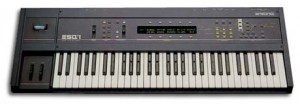
ENSONIQ ESQ-1 VINTAGE SYNTHESIZER 1986 DEMO
The Ensoniq ESQ-1 is a hybrid synthesizer from 1986. It has 32 digital waveforms and analog lowpass filter. It is flexible, since it employs 3 oscillators, 4 envelopes and 3 LFO’s per voice. Also it has a built in pattern sequencer.
“The ESQ-1 is a mostly digital (It has analog filters) 8 voice polyphonic, synthesizer with multitimbral (8-part) capabilities and MIDI. Sounds can be split or layered. One nice feature is that changing the sound while the previous sound is still playing doesn’t cut the first sound off. It can store 40 sounds internally, and another 80 to cartridge. Sounds and sequencer data can also be stored via cassette tape.
Each sound, or timbre is constructed with up to three Oscillators. Using all three oscillators can give very thick, rich string pads and brasses, especially as the sounds can be de-tuned and panned in a variety of different ways.
Each oscillator draws upon a bank of 32 hybrid digital/sampled waveforms including sawtooth, sine, square and a variety of conventional waveforms such as piano, human voice and organ. This may not sound very many in comparison to today’s synths, but there are enough editing features to independently change these basic waveforms in an almost limitless fashion.
One of the strongest parts of the ESQ architecture is the filter section, which features analog four-pole (24dB/octave) resonant filters. The filter covers a broad sonic range, and can be modulated via a number of inputs including key velocity, modulation wheel, any of the three LFO’s and any of the four Envelopes.
The ESQ-1 comes standard with an 8 track 2400 note sequencer which can be expanded to 10,000 notes. The sequencer features a flexible ‘pattern play’ facility for chaining patterns one after the other in any order. The ESQ-1 sequencer does all the usual stuff, but has one extremely useful feature: You can record a sequence (or Pattern), comprising of up to 8 independent tracks (Bass drum, Snare, hats, synth, strings, bassline etc) and copy this to another location. You could then for example, remove the bass drum track from one of the sequences, but leave it in the other. While the sequence with the bass drum track is playing, you can select the one without the bass drum track, which will start to play with seamless integration once the first sequence has played to the end. This method of letting you chain any of the sequences in any order you like, continuously and seamlessly, means that you have total freedom with song arrangement. After trying out arrangement ideas this way, the 8 track sequences (of which 30 can be stored) can finally have their ‘play order’ fixed into a Song. I haven’t come across another sequencer that gives you the ability to play a looped sequence as many times as you want before selecting another sequence, without first having to save the order in which you want them to play. This is a very useful feature in Dance music and Techno music where the song is generally built up over time in the same key, but with additional instruments coming and going. You are not limited to using only the ESQ-1 sounds on the sequencer, as each track can be made to play the ESQ-1’s internal sounds, external sounds over MIDI, or both.”
Core Synth HD – free synth for iPad
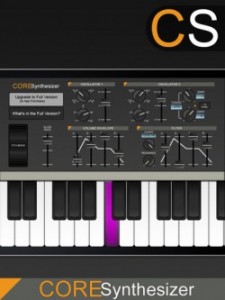
Jasmine Lee has released a free monosynth for the iPad – Core Synth HD.
Get your groove on with Core Synth HD, the definitive monophonic synthesizer for the iPad. With tons of features packed into a small package, Core Synth is great for live performing. A Pitch Wheel replicates perfectly the real thing!
While it’s free and has a lot of features – no mention is made of MIDI support, at this time.
Features:
- Pitch Wheel
- 2 Octave keyboard
- Keys light up in different colors when pressed
- Oscillator Module
- Dual overlapping oscillators
- Four wave patterns: Square, Triangle, Sawtooth and Reverse Sawtooth
- Select from 5 octaves
- Adjust glide between notes
- Fine tune Oscillator 2 with option to sync with Oscillator 1
- Volume Envelope Shaper
- Edit ADSR (Attack, Decay, Sustain, Release)
- Low Pass Filter Module
- Adjust Cutoff and Resonance
- Edit ADSR (Attack, Decay, Sustain, Release)
- Upgrade to the full version within the app for the following additional features:
- 7 Octave Keyboard
- Octave control to move along entire range
- Modulation Wheel
- Patches Module
- Save an unlimited number of individually named patches
- Browse through your collection before applying patch
- Delete unwanted patches
- Modulation Module
- Four wave patterns: Square, Triangle, Sawtooth and Reverse Sawtooth
- Modulate Filter, Pitch or Wave
- Adjust LFO Rate and amount
- Arpeggiator Module
- Arpeggio moves up to 5 octaves
- Four step modes: Up, Down, Up/Down, Random
- Adjust rate
Core Synth HD includes open source code from MobileSynth, developed by Allen Porter.
The Essential Guide to Native Instruments
Native Instruments has not one, but two products called MASSIVE. You know the synth; now it’s time to get cozy with the other—one of the most righteous drum computers in the universe. Get ready to go deep with the secret-weapon drum machine of the world’s savviest producers. This is gonna be big.
MASSIVE is a sonic monster – the ultimate synth for basses and leads. The analog concept belies the contemporary, cutting-edge sound it generates. The high-end engine delivers pure quality, lending an undeniable virtue and character to even the most saturated of sounds. The interface is clearly laid out and easy to use, ensuring you will have MASSIVE generating earth-shuddering sounds from the very first note.This unique synthesizer has its own uncompromising character that produces the most distinctive of sounds. From the deepest low end, MASSIVE is capable of the creamiest, punchiest basses to give your tracks a solid foundation. Razor-sharp leads that cut through the mix, even with grit and dirt piled high, set MASSIVE apart among analog style soft synths. And just beneath the surface, MASSIVE’s overwhelming array of wavetable oscillators, versatile modulation options and bountiful filter and effects sections offer a sonic spectrum as broad as it is inspiring.
New powerful virtual synth’s been announced

Xils-Lab has announced a new software synthesizer – The Synthix.
Here’s what they have to say about The Synthix:
It is inspired by a famous and legendary Synthesizer from the 80′s, which a lot of talented guys used as their central Keyboard, including some synths Gurus.
Its a piece of history, maybe the last Vintage Analog Polyphonic synthesizer.
It has a special multitimbral mode, 5 different hi quality and hi character filters, as you could expect from a Xils-Lab synth.
It is MORE than a strict emulation.
It has many additional features compared to its glorious ancestor, as you could expect from a modern era synthesizer .
But this is NOT ENOUGH. It has also never seen features !
Details below.
Features:
- 4 ‘LFO like’ modulation sources.
- 4 envelopes ‘with a special feature, increasing far away the sound design possibilities’
- 2 oscillators : simple, but with cross modulation features.
- 1 filter – ‘not so simple!’
- 1 polyphonic sequencer (up to 4 tracks, with legato mode), part of the modulation sources.
- More than 25 modulation nodes, with 29 sources and 38 destinations.
Pricing and availability are to be announced.
Major update of Tone2’s ElectraX has been released
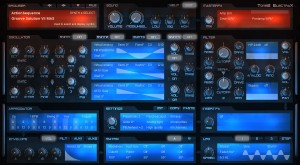
Tone2 has released version 1.2 public beta of ElectraX, a virtual synthesizer instrument for Windows and Mac.
ElectraX v1.2 will be available soon. We added a huge number of new features and improvements. This update will be for free for all ElectraX customers.
Changes in ElectraX v1.2 (public beta)
- New features:
- ‘Load patch to synth’ allows to stack up to 4 patches for fat multitimbral sounds.
- ‘Copy’ button now includes the option to create 4x stereo unison patch.
- The filter section has been extended with multiple unique Fractal Filters. These innovative, new filter types are exclusive and not available from any other company..
- Analog modeled ‘Moog’ filter (Analog controls self oscillation and non-linearity).
- Analog modeled State Variable Low-pass with ‘Filter-FM’ (analog controls FM amount).
- Nonlinear 12dB Low-pass ‘LP Shaped’ filter.
- Native PC 64 Bit standalone version.
- 20 additional patches.
- The oscillators now support drag&drop for wav and resynthesis import.
- Samples longer than 10 seconds can be loaded now.
- Loop/Single is automatically set on sample import.
- Octave/Semi is automatically detected from sample name (e.g. Piano_A-3.wav).
- Last directory is remembered on wav load and fxp load/save.
- Mod Matrix destination ‘Start’ sets OSC start phase or sample start point.
- Mod Matrix destination ‘Mix’ crossblends between filter1 and filter2.
- Mod Matrix sources ‘Midi CC’, ‘Breath’, ‘Foot’, ‘Expression’, ‘Hold’….
- Mod Matrix source ‘VoiceNr’ returns a value which depends on the current voice number.
- Mod Matrix source ‘NumKeys’ counts the number of pressed keys for more dynamic expression.
- Mod Matrix source ‘KeySat.’ returns a saturated version of key follow.
- Mod Matrix source ‘Impulse’ returns a 1ms long impulse suitable for attack sounds.
- Mod Matrix: 12 additional analog ‘Decay’ envelopes as source.
- Improvements:
- Improved graphics with 4 new skins.
- FM on/off, OSC on/off, Distortion type and Sync can also be changed during playback.
- Oscillators that are FM modulated by a deactivated source do no longer output noise.
- Many improvements in sample handling.
- Up/down controls now display an arrow and are more smooth to handle.
- Improved sound when using glide mode.
- ElectraX is more robust against broken Midi data which is sent by hosts.
- Improved CPU compatibility.
- Waiting icon is now displayed during patch load.
- ‘Analog’ psychoacoustic mode has been improved.
- Smarter installer.
- Changes:
- Trancegate is now only available as Insert Effect.
- Fixed:
- Fixed a crash which could happen if patches were loaded during playback.
- Fixed a possible problem with could result in hanging notes.
- Fixed a rarely appearing problem where the plugin did not output sound.
- Fixed a rarely appearing GUI freeze.
- Fixed a click in sample playback.
- Fixed a possible glitch in the filters.
DATAMASKIN

